
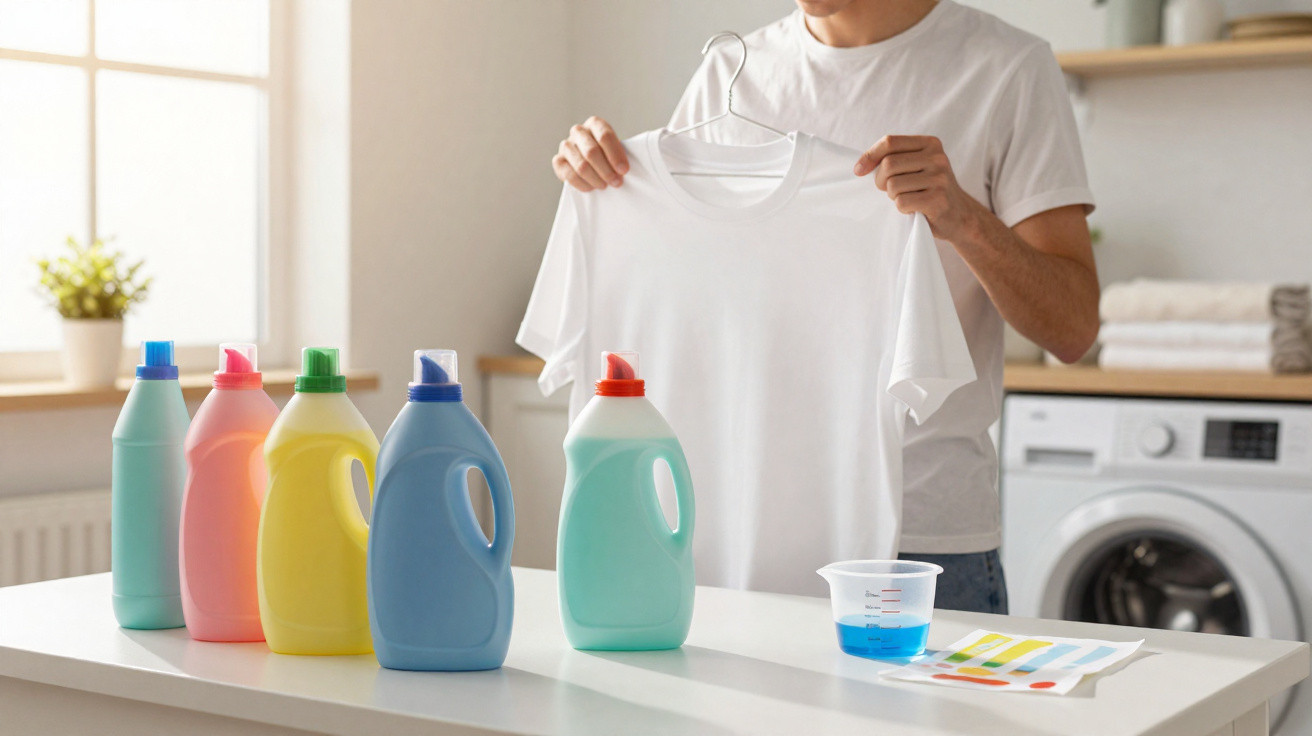
Every laundry day tends to begin with the same question: will this detergent really remove the stains, or will the whole load need washing again tomorrow? A recent comparison of eight widely used liquid detergents, conducted in France, offers unusually clear answers. Rather than judging advertising claims, it ranks the products according to their ability to tackle 11 particularly difficult everyday stains.
A laboratory-style test for everyday laundry
The study, conducted by the French magazine Femme Actuelle, aimed to settle one straightforward issue: which liquid detergent is most effective on genuine, stubborn marks when there is no scrubbing beforehand?
Eight commonly sold liquid detergents were put through washing-machine cycles using the conditions recommended by their manufacturers. Every product was challenged with the same demanding set of 11 stains on identical pieces of fabric:
- foundation
- lipstick
- ballpoint pen ink
- red berries
- chocolate dessert cream
- coffee
- red wine
- cooking oil
- meat sauce
- tomato concentrate
- soil
The test mimicked a real household wash: no pre-scrubbing at the sink, just detergent straight into the machine.
This method is important because few people have the time to treat every mark before washing. The ranking therefore measures each detergent’s cleaning strength in the way it is most often used: pour it in, start the machine and hope for the best.
Ariel Original tops the test for stubborn stains
Once the wash cycles had finished, one product was noticeably ahead of the rest. Ariel Original took first place, removing nearly every stain included in the trial, among them especially challenging marks from tomato, meat sauce and red fruits.
The testers highlighted more than the disappearance of coloured stains. They also noted the brightness of the white fabric after washing. Shirts and cloths emerged looking sharply white and luminous, despite receiving no hand scrubbing before the cycle.
Ariel Original excelled on very stubborn stains and delivered a strikingly bright white, even without pre-treatment.
However, this level of performance involves compromises in both cost and the longer-term care of coloured fabrics. According to the test’s estimated usage figures, regular use of Ariel Original would amount to about €63.27 per year, making it the priciest detergent in the comparison.
There is also a consideration for people whose wardrobes are largely made up of coloured clothing. Repeated use was said to make colours slightly duller over time. Ariel Original is therefore a particularly strong option for heavily soiled white textiles, but the findings suggest it may not be the best all-round choice for those who mainly wash dark and brightly coloured garments.
Carrefour Expert and Epsil offer strong value
Close behind Ariel were two cheaper products that also performed impressively: Carrefour Expert Optimal Clean and Epsil Perfect Fraîcheur.
Carrefour Expert Optimal Clean: a dependable low-cost option
Carrefour’s own-label detergent secured second place overall, combining a high standard of general cleaning with a considerably lower price. Certain stains, notably lipstick and ballpoint pen ink, were harder to shift, although it dealt effectively with most common household marks.
Its principal strength is its cost. The estimated yearly spend is around €22.37, which is approximately one third of Ariel’s annual budget. For bigger households and parents who run several loads each week, that difference can be significant over a year.
Carrefour Expert Optimal Clean delivers solid cleaning power for families who prioritise frequent washes without stretching their budget.
Epsil Perfect Fraîcheur: best when stains are pre-treated
Third place was awarded to Epsil Perfect Fraîcheur. It performed especially well when stains were treated quickly beforehand - in other words, when a little of the liquid was rubbed into or poured directly over the mark before the wash began.
With a projected annual cost of €21.38, it offers a sensible balance between price and stain-removal performance, as long as users are happy to spend a few extra seconds before filling the machine. The testers also mentioned its pleasant fresh fragrance, which may suit people who like their washing to have a noticeable scent.
Epsil Perfect Fraîcheur rewards a tiny pre-treatment step with strong results and a noticeable fresh smell.
Which liquid detergent is right for you?
The test findings indicate that no single product is “perfect” for every household. The most suitable choice will depend on your washing habits, the garments you deal with most frequently and the amount of time you are prepared to devote to stains.
| Profile | Recommended detergent | Main advantage |
|---|---|---|
| Households with very stained whites (shirts, tablecloths) | Ariel Original | Excellent stain removal, bright white result |
| Large families on a tight budget | Carrefour Expert Optimal Clean | Good cleaning at a significantly lower price |
| Users who pre-treat stains willingly | Epsil Perfect Fraîcheur | Strong performance with pre-treatment, plus fresh fragrance |
Put simply, the results point towards three distinct approaches:
- Spend more on Ariel if removing stains from whites is your overriding priority.
- Choose Carrefour Expert if you wash many loads and want reasonable results at a low cost.
- Opt for Epsil if pre-treating stains is already part of your routine and you want to control spending.
What the comparison says about liquid detergents overall
Looking beyond the top three, the investigation reflects a pattern seen in many laboratory comparisons in recent years: powder detergents frequently perform better than liquids on extremely difficult stains. Nevertheless, liquid detergents remain popular in France and in many other countries, mainly because they are simpler to measure out, dissolve rapidly at low temperatures and are less likely to leave white residue on fabrics.
The report also draws attention to an issue that is not always obvious on supermarket shelves: the chemical preservatives used in some liquid formulas. These may include ingredients such as isothiazolinones or phenoxyethanol, which are recognised for their potential to cause allergic reactions in sensitive people.
Liquid detergents can contain preservatives linked with skin reactions, while many powders and capsules avoid these ingredients.
Anyone with eczema, contact dermatitis or highly reactive skin may wish to inspect ingredient lists more closely, or look for fragrance-free and hypoallergenic alternatives. Reading labels carefully or selecting powder products can limit exposure to some of the more controversial preservatives.
Better laundry decisions at home
To apply these findings in daily life, it is useful to consider real situations rather than abstract ratings. Picture a household with two sport-playing teenagers and one parent who works in an office. Mud-covered trainers, white shirts marked with tomato sauce and make-up traces around collars may regularly end up in the laundry basket.
In that kind of household, reserving Ariel Original for heavily stained whites and using a less expensive detergent such as Carrefour Expert for ordinary loads could provide a practical compromise between cleaning results and household spending. In another home, where someone has sensitive skin, gentler formulations may take priority, even if this requires more frequent pre-treatment of stains.
Pre-treatment itself need not be difficult. Applying a pea-sized amount of detergent directly to a tomato mark or foundation streak, then leaving it for only a few minutes before washing, can make a major difference. Epsil Perfect Fraîcheur demonstrates this in the test: its position improves considerably once that straightforward step is included.
Key terms and simple habits that make a difference
Two concepts regularly found on detergent labels and in laboratory testing are worth explaining:
- Optical brighteners: chemicals that take in UV light and release it as blue light, causing whites to look brighter even where some residue from a stain is still present. They improve the appearance of whiteness, but do not actually “bleach” the fabric.
- Enzymes: biological molecules that break down particular categories of stains, including proteins (blood, milk), fats (oil, sauce) and starches (pasta, rice). Detergents that perform well generally contain a combination of several enzymes.
A few everyday habits, alongside selecting the right detergent, can also improve results: wash heavily stained clothes sooner rather than leaving them for several days, keep very soiled items separate from lightly worn garments, and follow dose recommendations instead of automatically using extra detergent “just in case”. These small steps can help clothes retain a better appearance for longer, whichever product you pick from the shelf.

Comments
No comments yet. Be the first to comment!
Leave a Comment