
You know the scene: after a demanding day, you collapse onto the bed, sink into the mattress and feel that instant sense of relief.
The bedroom is dimly lit, the fan hums steadily, and everything seems set up for rest. Then your nose starts itching. One sneeze arrives, followed by another. Your eyes sting slightly. You assume it is simply dust from the day, close your eyes and try to ignore it. What you cannot see is the tiny invisible army living beneath the freshly washed sheet, among the fabric fibres: dust mites, fungi and skin flakes. The bed that ought to be a refuge becomes a kind of micro-forest. No clean fragrance can disguise that for long. The good news is that there is an easy way to tackle it without spending a fortune, and it begins at the laundry-room door.
Why a “clean” mattress is rarely truly clean
The mattress is usually overlooked during cleaning. We change the sheets, fluff the pillows, wipe the headboard and assume everything is sorted. Inside the mattress, however, years of sweat, dust, dead skin and moisture can build up. It is rather like an archive of your sleeping routine. No one sees it, and no one thinks about it-until the body starts sending signals. Interestingly, many people spend money on air fresheners, expensive sprays and sophisticated covers while neglecting the basics: cleaning the surface they sleep on every night.
Most of us have heard it before: someone says, “I’ve been waking up with a blocked nose lately,” and the response is that it must be dry weather. A study by the University of São Paulo has indicated that indoor spaces can contain far greater quantities of dust mites than outdoors, particularly in mattresses and upholstered furniture. One domestic cleaner recalled, with an embarrassed laugh, that a client’s mattress turned grey when she vacuumed it for the first time in ten years. The dirt was not new; it had simply been invisible. The body had been reacting for a long time, but people become used to overlooking the connection.
Dust mites do not bite, make noise or leave visible traces. That is exactly why they thrive. They feed on skin flakes and flourish in humid conditions. The more enclosed the bedroom and the heavier the mattress, the better this microscopic ecosystem fares. People with rhinitis, asthma or allergies tend to notice the effects more readily, with morning sneezing fits, a dry cough and a feeling of tiredness on waking. It is not fussiness. A mattress acts like a sponge: it absorbs what your body releases during sleep, then returns it as particles suspended in the air. Deep cleaning is not a luxury for overly anxious people; it is a basic form of looking after your body.
The simple mattress-cleaning method: layers without costly products
The starting point is almost underwhelming: a decent vacuum cleaner, ideally with an upholstery attachment. Do not wipe the mattress directly with a wet cloth or pour on litres of scented products. First, it needs to “breathe”. Remove every sheet, pillow and protector. Open the window and allow air to circulate. If possible, stand the mattress upright against the wall so that it can receive natural light. Even in a flat, a little side-on sunlight can make a difference to moisture levels. Then vacuum slowly, using unhurried movements and covering the entire surface, including the sides. Think of it as a careful, methodical sweep.
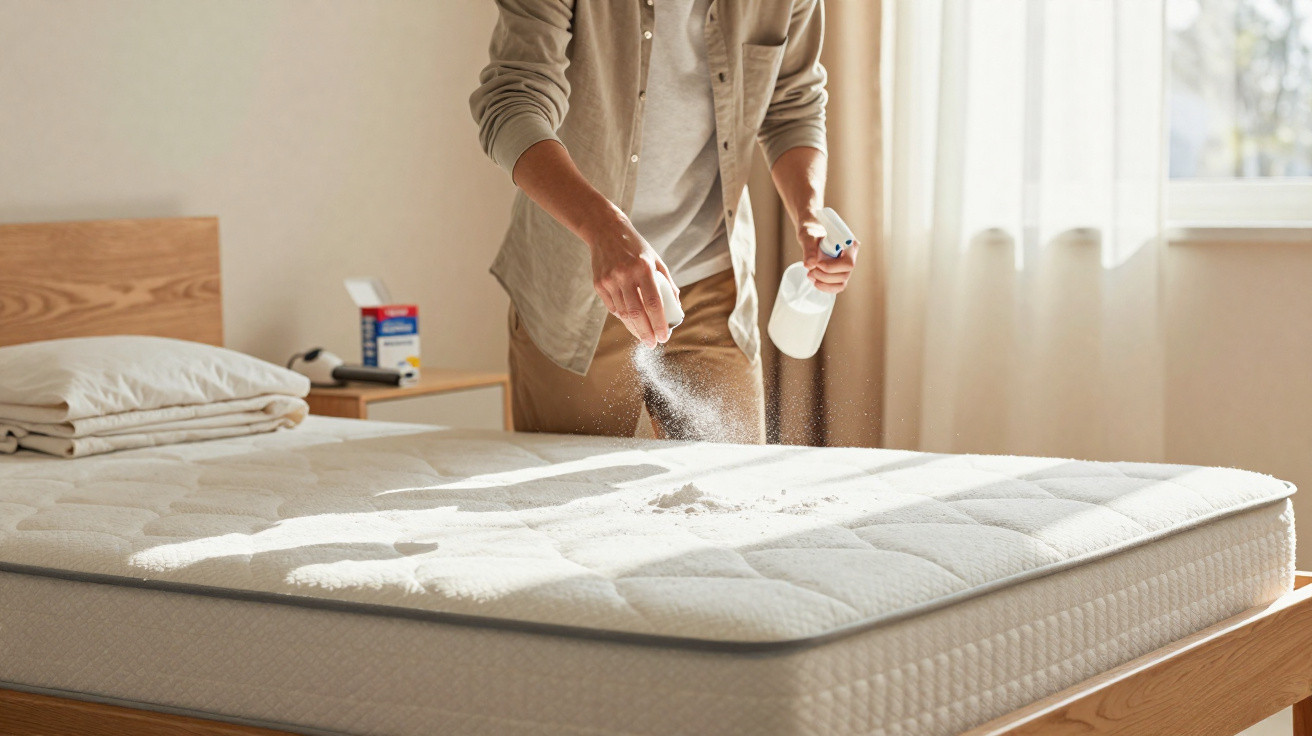
The second layer uses two familiar household staples: bicarbonate of soda and white vinegar. Bicarbonate of soda works as a deodoriser and helps draw out surface moisture. Sprinkle a thin, even layer across the mattress, as though seasoning something delicate. Do not leave heaps of it. Let it sit for at least 30 minutes, or for an hour if you can. Meanwhile, mix equal parts white vinegar and water in a spray bottle. The vinegar will not leave your bedroom smelling of salad forever; it evaporates. Once you have vacuumed up the bicarbonate of soda, lightly mist the solution over areas that are usually damper, such as the middle of the mattress or the foot end.
Let us be realistic: no one does this every day. The aim is not to create another impossible routine, but to establish a focused, thorough task that you can repeat every two or three months. A classic mistake is trying to make up for missed cleaning with very expensive “anti-mite” sprays, or using too much water on the mattress, which only makes the moisture problem worse. Another common error is putting the sheets back on before it has dried, turning the mattress into a small, stuffy terrarium. Layered cleaning works best when you allow each stage the time it needs: time for the bicarbonate of soda to work, time for the vinegar to evaporate and time for the mattress to dry.
“The biggest secret to cleaning a mattress is not the product, but the habit. It is more about repeating a simple method than discovering a magic formula,” says a domestic-cleaning specialist who works with families in small flats.
- Vacuum slowly – Move the vacuum cleaner in overlapping lines, taking your time and reaching the edges and seams.
- Use very little liquid – Spray the vinegar-and-water solution only until the surface is lightly damp, never soaked.
- Dry with the window open – Let the mattress air for several hours before putting sheets back on.
- Quarterly routine – Repeat the process every 2–3 months, doing it more often during wetter periods.
- Washable mattress protector – Use a simple, easy-to-wash cover as support between deep cleans.
A less hostile mattress and more honest sleep
Using this method to clean your mattress will not magically turn the bedroom into a sterilised laboratory, nor does it need to. Its appeal lies in bringing care down to a realistic, human and achievable level. When you vacuum properly, let sunlight reach the mattress and use bicarbonate of soda, vinegar and time, getting into bed feels different. It smells different, feels different, and your mind relaxes in another way. There is something almost therapeutic about looking at something as ordinary as a mattress and deciding that, from today onwards, it will no longer be merely a forgotten block beneath an attractive sheet.
Between expensive products and home remedies, what matters most at the end of the day is a sense of control. Knowing that you do not need an arsenal of imported brands to reduce dust mites, lessen rhinitis flare-ups and wake with a less congested nose can quietly change your routine. This is cleaning that will not show up in before-and-after photographs, but it can reveal itself in the first sneeze that does not happen on waking. When someone says they are always tired and sleeping badly, the conversation almost never turns to their mattress. Perhaps it is time that it did.
This straightforward method requires neither professional equipment nor a cinema-sized budget. All it takes is a little attention, a working vacuum cleaner, two inexpensive cupboard ingredients and the willingness to create a short ritual every few months. At a time of quick fixes and promises in a spray bottle, returning to the basics may seem unglamorous, but it often delivers what it claims to. If you know someone who wakes up sneezing and insists that “it’s just the weather”, this may be the kind of advice worth sharing. Bed by bed and mattress by mattress, these small actions can create homes that are a little less hostile and nights that are a little more honest with our bodies.
| Key point | Detail | Benefit for the reader |
|---|---|---|
| Layered cleaning | Vacuum, use bicarbonate of soda, then apply a light vinegar-and-water solution | Reduces dust mites and odours without relying on expensive products |
| Moisture control | Open windows, do not soak the mattress, and allow drying time | Prevents mould and allergy flare-ups, while extending the mattress’s lifespan |
| A simple, realistic routine | Repeat every 2–3 months and use a washable protector day to day | Makes mattress care an achievable habit rather than a burden |
FAQ
- Question 1: How often should I carry out this full mattress clean? For most homes, every 2 or 3 months is a good schedule. For stronger allergies or very humid places, it is worth shortening the interval to 40–45 days.
- Question 2: Can I use bicarbonate of soda without vinegar? Yes. Bicarbonate of soda alone already helps considerably with odours and surface moisture. Vinegar is an occasional extra step, especially for heavily used areas or older mattresses.
- Question 3: Will the vinegar smell remain strong in the bedroom? If you use the diluted solution and air the mattress with the window open, the smell disappears within a few hours. It is strong initially, but it evaporates quickly.
- Question 4: Can a spring mattress be cleaned this way too? Yes, as long as you do not soak the fabric. The principle is the same: vacuum thoroughly, use little liquid and ensure good airflow while it dries.
- Question 5: Are “anti-mite” sprays worthwhile, or can I do without them? They can be an added extra, but they do not replace physical vacuuming and moisture control. If money is tight, the bicarbonate-of-soda and vinegar method already provides a large part of the benefit.





Comments
No comments yet. Be the first to comment!
Leave a Comment