
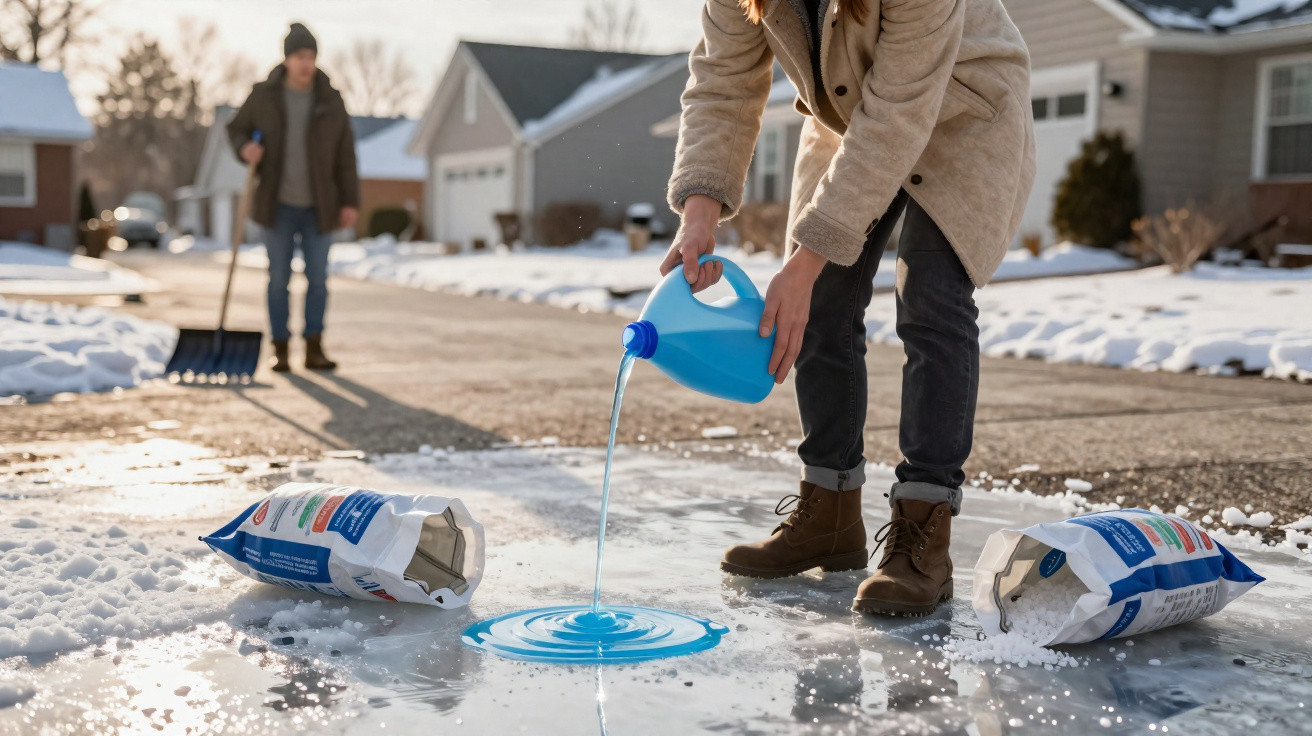
The first crackle of black ice beneath your boots is always unexpected. One moment, you are making your way to the car with coffee in one hand and keys in the other. The next, you are performing an unwanted cartoon-style split on an unseen sheet of glass across the drive, hoping the mug makes it through intact. You blame the weather app, the council, then recall the half-used bag of rock salt you shoved into a corner last March. Where did it end up? Ripped open? Hardened into a pointless block of concrete? Most likely both.
That is when growing numbers of people reach for an alternative. Not something from the DIY shop, but an item beneath the kitchen sink or in the utility room. A product made for an entirely separate task, suddenly recruited for winter service.
And it melts ice alarmingly quickly.
Forget the salt bag: the surprising product people are pouring on their driveways
Imagine a suburban road at 6.45 a.m., with headlights slicing through freezing drizzle. One neighbour is already outside, scattering rock salt as though it were confetti and stamping their feet as they work. Opposite, a woman in a hoodie steps out carrying something that seems completely out of place in the cold: a cloudy plastic bottle with a vivid blue cap. She is not sprinkling it. She is pouring it.
Within minutes, the frozen crust on her front steps begins to give way, with slush spreading where solid glass-like ice had been moments earlier. There is no scraping and no desperate hacking with the edge of a shovel. Instead, there is a quiet wet crackling as a safe route gradually appears. The neighbour pauses halfway through a throw and simply watches.
The bottle does not contain some miraculous “polar tech” liquid from the DIY aisle. It is standard liquid laundry detergent, occasionally combined with a little warm water in a watering can or spray bottle. Social media is packed with clips of people applying detergent solution to icy steps, car windscreens and frozen pavements, then happily watching the ice release and slide off.
A TikTok video showing a woman covering her entire drive with a blue detergent mixture attracted millions of views over a weekend. The comments flooded in: “Where has this been all my life?”, “This works better than salt!”, and, rather less casually, “Wait, is this safe for the environment?” The argument has continued ever since.
At a simple level, the method is understandable. Many liquid detergents include surfactants and different salts that reduce water’s freezing point, much as rock salt does, while the soapy ingredients offer further assistance by working their way between ice crystals. This creates a fine liquid layer that disrupts the ice’s attachment to the surface below. The ice is not being magically “heated”; its hold is being reduced so that gravity and friction can take over.
That explains why the outcome can appear so rapid in viral videos. The upper surface turns soft, tiny fractures form and pieces of ice begin to shift. It can seem almost theatrical. However, that same apparent simplicity is precisely what makes the shortcut so contentious.
How this detergent trick works - and where it can backfire badly
The most common approach is almost comically straightforward. Put warm, rather than boiling, water in a bucket or watering can. Mix in a substantial squeeze of liquid laundry detergent or washing-up liquid - many DIY users suggest roughly one generous tablespoon per litre - then stir it lightly. Pour the mixture slowly across the iced patch in narrow lines or zigzags instead of tipping it out in one large rush.
After a few minutes, the ice surface should begin to look different. Rather than hard and matt white, it develops a darker, wetter appearance. That is the point to use a shovel or a stiff brush. The important benefit is that the solution can help release the ice in sections, rather than leaving you to chip at a firmly frozen layer for 30 minutes.
Here is where the practical problems begin: many people estimate the amount by eye and spread detergent as if it were both free and risk-free. Most of us know that feeling, when a fast solution is so gratifying that potential unseen damage is easy to overlook. Use too much and the result can be a foamy, slippery surface that is more dangerous than the original ice. Once the meltwater freezes again overnight, detergent residue may also leave steps unexpectedly slick.
Realistically, hardly anyone studies the small-print warnings about aquatic life before pouring half a bottle outdoors. Certain detergents are far more aggressive than others, containing phosphates, colourants and fragrances that do not simply vanish once they reach the closest drain or flowerbed.
For that reason, even those who acknowledge using this method advise some restraint.
“Does it work? Absolutely,” admits Martin, a maintenance supervisor for a small housing complex. “But I only allow it on critical spots like the emergency exit stairs, and only with eco-labeled detergent in small amounts. You’re just trading problems otherwise.”
Several important questions sit at the centre of the debate:
- Are you choosing biodegradable, fragrance-free detergent, or one that is heavily perfumed and full of dyes?
- Will the runoff flow into soil, plants, a surface-water drain or directly into the road?
- Might somebody slip on the soapy layer left behind after the initial thaw?
- Are pets likely to walk through the treated area before licking their paws indoors?
- Could you achieve 80% of the effect by using only a small quantity of detergent alongside sand or fine gravel for traction?
The hack isn’t magic - it’s chemistry, with all the compromises that come with it.
Rethinking winter habits: safer tweaks, smarter trade-offs
Once you start noticing how much rock salt is scattered every winter, it is difficult to ignore it. There is the white residue lining pavements, the bare circle around trees in spring and the quicker spread of rust beneath the car. Salt is effective, yet harsh on metal, concrete, paws and soil. This is why the detergent idea appeals to so many people: it seems contemporary, ingenious and almost rebellious. It offers a way to “beat” winter using something already in the cupboard.
A middle-ground option being tested by some households is the micro-dose method. A very small splash of eco-labeled liquid detergent is mixed with warm water and sand, then used only on the riskiest places: the first step outside, the sloping section of the drive or the route to the wheelie bins. The aim is not to melt every bit of ice, but to weaken its grip enough to remove it or provide traction.
The major error is using detergent as a like-for-like substitute for rock salt over extensive areas. That is when the environmental and safety drawbacks begin to accumulate. Broad, smooth drives may become slippery, soapy slides if the top layer melts while temperatures remain below freezing. Drains can fill with foam during the next thaw. By spring, grass at the edges may show yellow patches, caused not only by salt damage but also by surfactants altering the way water travels through soil.
There is also a question few people enjoy considering: does every square metre really have to be completely clear? Or would a wide, safe route be enough, leaving the rest to weather, sand and time? This modest change in perspective lessens the urge to soak every surface in any product, whether salt or soap. Sometimes the most effective “hack” is simply applying treatment more selectively.
Professionals and council workers, who spend winter quite literally dealing with ice, generally sound remarkably measured about the dispute.
- “Detergent works, yes, but we treat it like a last-mile tool, not the main strategy,” says Claire, who manages road maintenance in a mid-sized town. “Our priority is traction: sand, gravel, mechanical clearing. Chemicals are only one part of the puzzle.”
- “People underestimate plain shoveling,” adds Alex, a building caretaker. “If you go out just a bit earlier, you often only need a light de-icer touch at the end, not a full chemical bath.”
- “On small private steps, a drop of eco detergent in warm water can make sense,” notes a municipal environmental advisor. “But doing your whole sidewalk that way every storm? That’s where we start worrying about runoff.”
- “One thing we see a lot,” says a vet tech, “is dogs coming in with irritated paws from walking through mystery slush. Sometimes it’s not just salt - it’s detergent mix too.”
- “Everyone wants the fastest fix,” concludes Claire. “But winter is a season, not a problem to delete. Choosing the slower, less ‘magical’ method is often kinder to everything around you.”
So, will you try it - or stick to the old ways?
Once you discover that something as everyday as laundry detergent can melt ice within minutes, it is difficult to forget. The next time you slip on the porch, the blue bottle under the sink may suddenly seem like a secret weapon. But the viral trick represents more than a single quick solution. It concerns the way we treat pavements as battlefields, roads as testing grounds and household chemicals as harmless props.
Some people will use the trick cautiously and on a limited basis: eco detergent only, small areas and essential locations. Others will reject it entirely, relying instead on shovels, sand and restrained quantities of traditional de-icers. A small number will quietly choose whichever method clears the drive most quickly, leaving the consequences for later.
The lingering question is straightforward, if a little uncomfortable. Are we looking for another magical way to outwit winter, or are we prepared to reconsider our wider relationship with ice, safety and the unseen flows of water that carry away our choices when the thaw arrives?
| Key point | Detail | Value for the reader |
|---|---|---|
| Detergent can melt ice quickly | Liquid laundry detergent or washing-up liquid in warm water lowers the freezing point and breaks ice adhesion | Provides a rapid emergency option for hazardous steps or paths |
| Use is controversial | Runoff, residue, slips, pet exposure and environmental effects prompt criticism | Helps readers balance convenience with longer-term consequences |
| Targeted, moderate use is key | Small doses on critical spots, paired with shovelling and sand, lower the risks | Offers a practical, balanced way to remain safe without excessive chemical use |
FAQ:
- Question 1 What household product are people using instead of rock salt to melt ice?
- Answer 1 Mainly liquid laundry detergent, sometimes washing-up liquid, usually diluted in warm water and poured over icy areas.
- Question 2 Does detergent really melt ice faster than rock salt?
- Answer 2 It can appear faster on small areas because surfactants help release the ice layer quickly, but rock salt or purpose-made de-icers are more practical for large surfaces.
- Question 3 Is using detergent on ice bad for the environment?
- Answer 3 Yes, if it is used often or in large amounts, particularly non-eco detergents; runoff can affect soil, plants, waterways and aquatic life.
- Question 4 Is there a safer way to try this hack if I really want to?
- Answer 4 Choose a small amount of eco-labeled, fragrance-free detergent, dilute it thoroughly, use it solely on critical spots and combine it with shovelling and sand for grip.
- Question 5 What are good alternatives if I don’t want to use detergent or too much rock salt?
- Answer 5 Mechanical clearing with a shovel, sand or fine gravel for traction, calcium magnesium acetate where available, and concentrating on clearing a safe route rather than the whole surface.





Comments
No comments yet. Be the first to comment!
Leave a Comment