
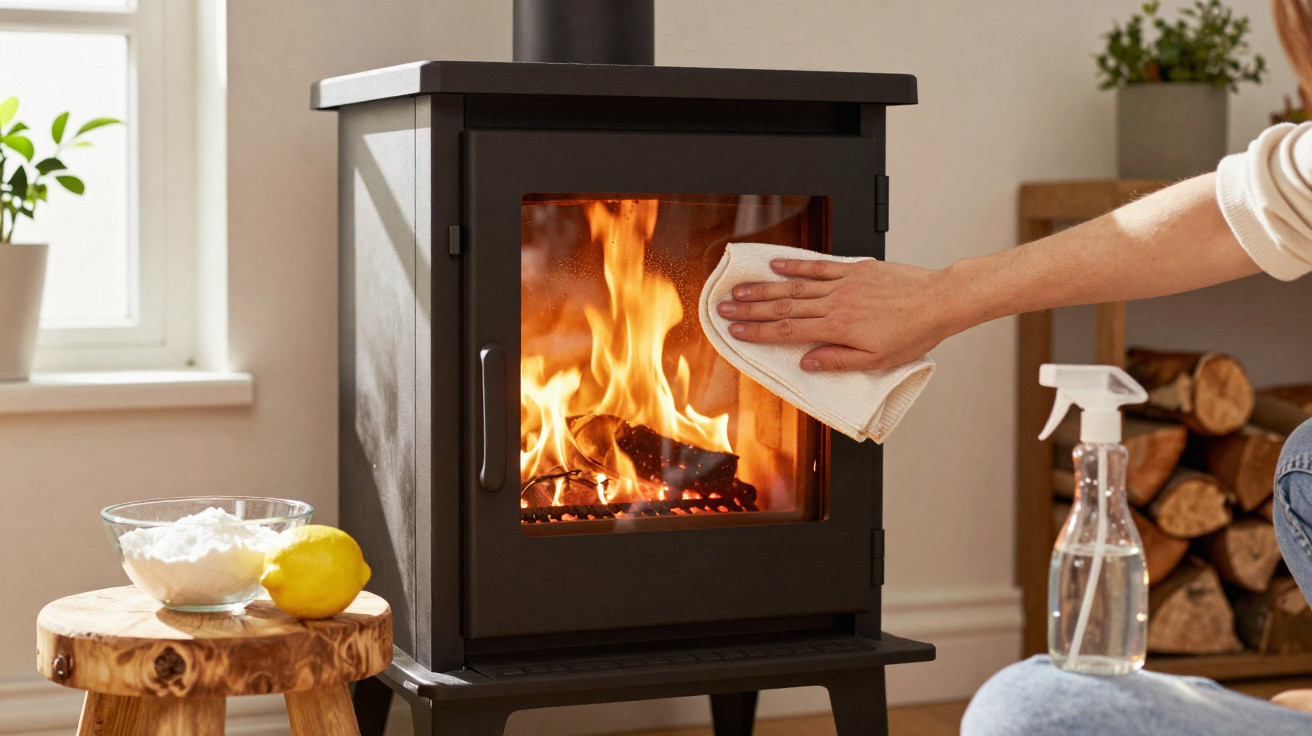
When the fire in the stove is crackling but the glass looks grey and greasy, it can quickly spoil the whole winter atmosphere.
Many homeowners still clean their stove window in the traditional way with ash. While it works, it is messy and time-consuming. A straightforward natural alternative gives you a clear view of the flames much faster, using ingredients that nearly everyone already has at home. It may sound unremarkable, yet it is surprisingly effective against soot, streaks and brown deposits.
Why stove glass turns black so quickly
Before trying the cleaning method, it is useful to understand the causes. Knowing why stove glass becomes sooty can greatly reduce how often it needs cleaning in future.
- Poor-quality or damp firewood
Wet wood smokes instead of burning cleanly. Particles from that smoke settle particularly readily on the glass. Well-seasoned wood with a residual moisture content below 20 per cent is ideal. - Incomplete combustion
If the stove is not hot enough or receives too little oxygen, more unburnt particles remain. These then form a black coating on the glass. - Incorrectly adjusted air supply
Restricting the airflow too much effectively “suffocates” the fire. The flames may look cosy, but soot build-up rises dramatically. - Constant use in economy mode
Many people turn their stove right down to save fuel. This encourages slow smouldering rather than hot flames, creating ideal conditions for soot on the glass.
Clean fuel, sufficient airflow and a proper operating temperature are half the battle when it comes to keeping stove glass clear for longer.
The simple trick: clean stove glass with household remedies instead of ash
The familiar method of using damp ash and newspaper is well known, but it can often leave a fine haze behind. A much cleaner option combines two inexpensive household remedies: clear table vinegar (or household vinegar) and bicarbonate of soda.
It works on a simple principle: the acid breaks down grease and combustion residues, while the mild powder provides gentle abrasion without scratching the glass.
Why this method works so well
- Vinegar degreases and loosens soot
Its acidity softens the characteristic greasy layer that sticks to the glass after several evenings of using the stove. - Bicarbonate of soda provides mild abrasion
It helps lift stubborn deposits without the risk of scratching caused by harsh scouring products. - Together, they fizz slightly
When combined, they create fine bubbles which lift the dirt layer and make it easier to wipe away.
Step-by-step guide: making stove glass crystal clear again
Step 1: Mix the solution
Prepare the mixture only once the stove has cooled down completely:
- Put two parts clear vinegar into a small bowl.
- Stir in one part bicarbonate of soda.
- Wait for the slight fizzing to settle, stir briefly, and it is ready to use.
The mixture can remain fairly runny. It is enough for the powder to be evenly distributed.
Step 2: Apply the solution
- Dip a soft cloth or sponge into the mixture.
- Work over the glass using circular movements, without pressing too hard.
- Generously wet heavily soiled areas and leave the solution to work for one to two minutes.
If preferred, make the paste a little thicker and apply it like a mask. This is especially worthwhile for older, heavily baked-on deposits.
Step 3: Wipe off and polish dry
- Thoroughly remove any remaining mixture with a damp cloth.
- Buff the glass with a clean, dry microfibre cloth until no streaks remain visible.
Once it becomes routine, the entire cleaning process rarely takes more than five minutes – and the glass can often look as though it has just been fitted.
Other natural alternatives for clean stove glass
If you do not have vinegar or bicarbonate of soda to hand, several other products commonly found around the house can also help.
- Liquid soft soap
Dissolved in warm water, it reliably removes greasy films and light soot marks. - Alcohol-based cleaner
It evaporates quickly and is effective at lifting grease. This is useful when there is no time for extensive wiping afterwards. - Hot water and newspaper
An old household remedy: dampen the paper, rub the glass, then finish by drying it with a clean cloth. It is sufficient for fresh dirt.
How to prevent heavy soot build-up from the outset
The cleaner a stove burns, the less often its window will need a thorough clean. A few simple habits can significantly reduce the cleaning required.
Improve fuel choice and stove operation
- Use only genuinely dry wood
Hardwoods such as beech or oak are ideal. Freshly cut or damp logs do not belong in the stove. - Bring the stove up to operating temperature regularly
Set the air supply a little higher during the first few minutes after lighting, so the flames can establish themselves properly. - Avoid continuous operation in “slow-burn mode”
A permanently low fire may look inviting, but it dirties both the glass and firebox much more quickly. - Wipe away light dirt immediately
A quick wipe over still-lukewarm glass, using a suitable cloth, saves a great deal of scrubbing later.
Why household remedies are often better than specialist cleaners
Shops are full of sprays and gels made specifically for fireplace and stove glass. Many contain strongly alkaline or corrosive ingredients that may irritate the skin and mucous membranes. They can also have intense fragrances that are unpleasant in an enclosed living space.
| Option | Advantages | Disadvantages |
|---|---|---|
| Vinegar & bicarbonate of soda | Inexpensive, readily available, tolerable smell, gentle on glass | Slight vinegar smell; two applications may be needed for extremely old deposits |
| Specialist cleaner | Often works very quickly; convenient spray-bottle application | Aggressive ingredients, higher cost, more packaging waste |
| Ash & water | No additional product required; traditionally proven | Messy to use; incorrect use can cause scratches |
For households with children, pets or sensitive airways, simple kitchen ingredients are generally the more relaxed choice. Their cleaning power is entirely adequate for typical household stoves, provided soot has not been allowed to build up undisturbed for months.
Practical advice and safety considerations when cleaning a stove
Even as part of an everyday routine, a stove remains an appliance that operates at high temperatures. A few points should be kept in mind every time it is cleaned.
- Clean only when the stove is cold
Glass can crack because of temperature shock. Any remaining embers or warm ash can also cause flare-ups while wiping. - Wear gloves
Soot stains very easily. Thin household gloves keep hands and nails clean. - Do not use sharp tools
Metal scrapers or pan scourers can create microcracks in the glass, which can become a genuine safety risk over time. - Follow the instruction manual
Some manufacturers recommend particular products or warn against aggressive cleaners to avoid invalidating warranty claims.
Combining stove-window cleaning with regular ash removal soon creates a simple routine. A quick look at the glass after every second or third firing is enough to decide whether it needs a brief wipe or can wait a little longer.
Incidentally, many modern wood-burning stoves have an air-wash system, in which a directed airflow helps keep the glass clear during use. Even then, a grey film will eventually form. The vinegar and bicarbonate of soda method is equally suitable in these cases, as it does not damage the glass coating.






Comments
No comments yet. Be the first to comment!
Leave a Comment