
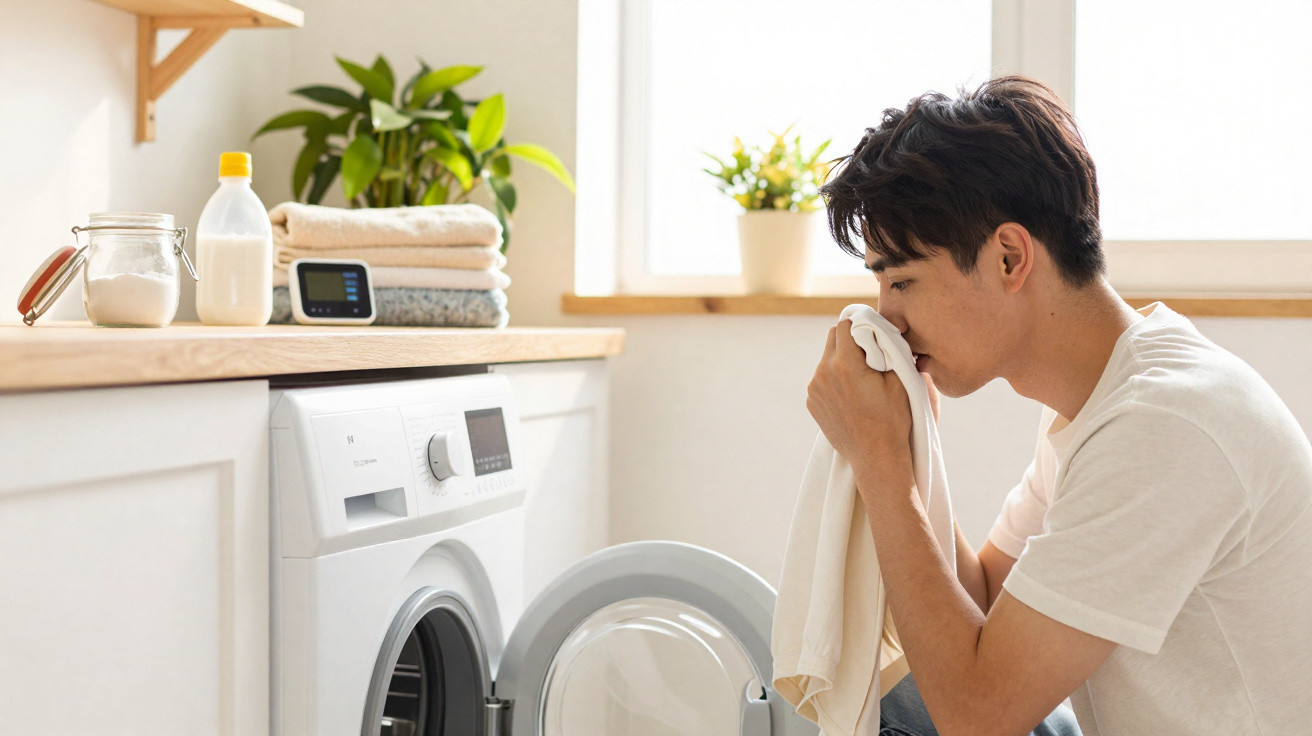
Laundry is still sitting inside the drum, cooling into a damp bundle while you scroll through Instagram or move on to another Zoom call. When you eventually open the door, a warm puff of air that smells “not quite clean” meets you. It is not revolting, but it is not fresh either. It is simply… wrong.
You give the T-shirts a shake, convince yourself they are probably fine, then put everything on the drying rack. Several hours later, the odour has intensified: a clammy, changing-room-like spectre that sticks to your favourite hoodie. You wash the full load again, feeling mildly irritated with yourself and slightly concerned that the washing machine may be at fault.
The following week, it happens again: the same beep, the same delay and the same smell. Yet beneath this seemingly harmless routine, something persistent is beginning to establish itself in the drum.
Why laundry forgotten in the washing machine smells – and does not simply “get over it”
The first occasion you leave wet washing in the machine, there is usually nothing alarming to see. There is no patch of mould or horror-film scene. Instead, clean garments remain shut inside a warm metal box containing microscopic organisms and traces of detergent.
That enclosed environment becomes an ideal humid greenhouse. Each fibre remains damp for hours, sometimes until morning. As the drum slowly cools and air remains still, the bacteria that survived the wash quietly feed on residual sweat, dead skin and the film left by soap.
For your nose, this gradual feeding session becomes the familiar smell of “wet dog meets old towel”. It also lingers more stubbornly than you might expect.
Research from the University of Arizona found that an ordinary load of underwear and towels can introduce millions of bacteria into the wash. Detergent does not eliminate every one of them. In a load left behind, they merely take on a new role: no longer visitors, but colonisers.
Imagine damp T-shirts compressed into a heap in the drum. The middle of that bundle may remain wet for 8, 10 or even 12 hours. This gives odour-producing bacteria enough time to multiply again and again. When you finally remove the washing, the smell is no longer confined to its surface.
It has worked its way into the fibres, particularly those of cotton and synthetic sportswear. This is why a quick rewash with only a small splash of detergent frequently fails. You are tackling an odour that has had time to bond with the fabric, rather than one resting on its outer layer.
There is a quieter consequence too. Whenever damp laundry is left in place, a thin, unseen coating accumulates on the drum, door seal and drawer: detergent remains, fabric softener, body oils and tiny particles of dirt. This biofilm leaves a light musty scent inside the machine. At the next wash, even a brand-new T-shirt passes through that atmosphere. Without realising it, you begin at an odour disadvantage.
How to stop the cycle and remove “washing machine smell” for good
The most straightforward way to prevent persistent odours is obvious but uncompromising: take the washing out promptly. In practice, set a phone timer for the precise end of the programme, or use the machine app if it has one. On a busy day, the beep alone seldom does the job.
If you know you tend to think “I’ll forget”, start shorter programmes while you are at home instead of just before you go out. A 40-minute wash at 40°C, emptied straight away, is better than a 2-hour eco cycle left full for 5 hours afterwards. Cleaning is a chain; the last step counts as much as the first.
As soon as you open the door, remove the clothes without keeping them bunched together, allow them a minute of air, then space them properly on the rack or place them in the tumble dryer. The priority is to undo that dense, wet ball as quickly as possible.
On a particularly bad day, the odour is immediate when you open the washing machine. The load has stayed there overnight and the clothes feel warm and weighty. You know that drying them as they are will lock in the smell, making them unpleasant to wear.
At this point, many people sigh, shut the door and select “Quick 30” with additional detergent. Usually, the outcome disappoints. The smell may ease slightly, only to return when the garment warms against your body. A second wash at a higher temperature, without extra fabric softener, is often more effective instead.
For loads that are especially stubborn, some people put white vinegar in the softener drawer, using about half a cup, and run a full programme. Vinegar helps to loosen the residues on which bacteria feed. Your clothes will not smell like a salad, and its scent generally vanishes when they are dry.
A less obvious struggle is also happening within the machine. The rubber door seal can feel slightly slimy, the detergent drawer never quite becomes dry and the drum has a faint marshy smell whenever you open it. You are not imagining it.
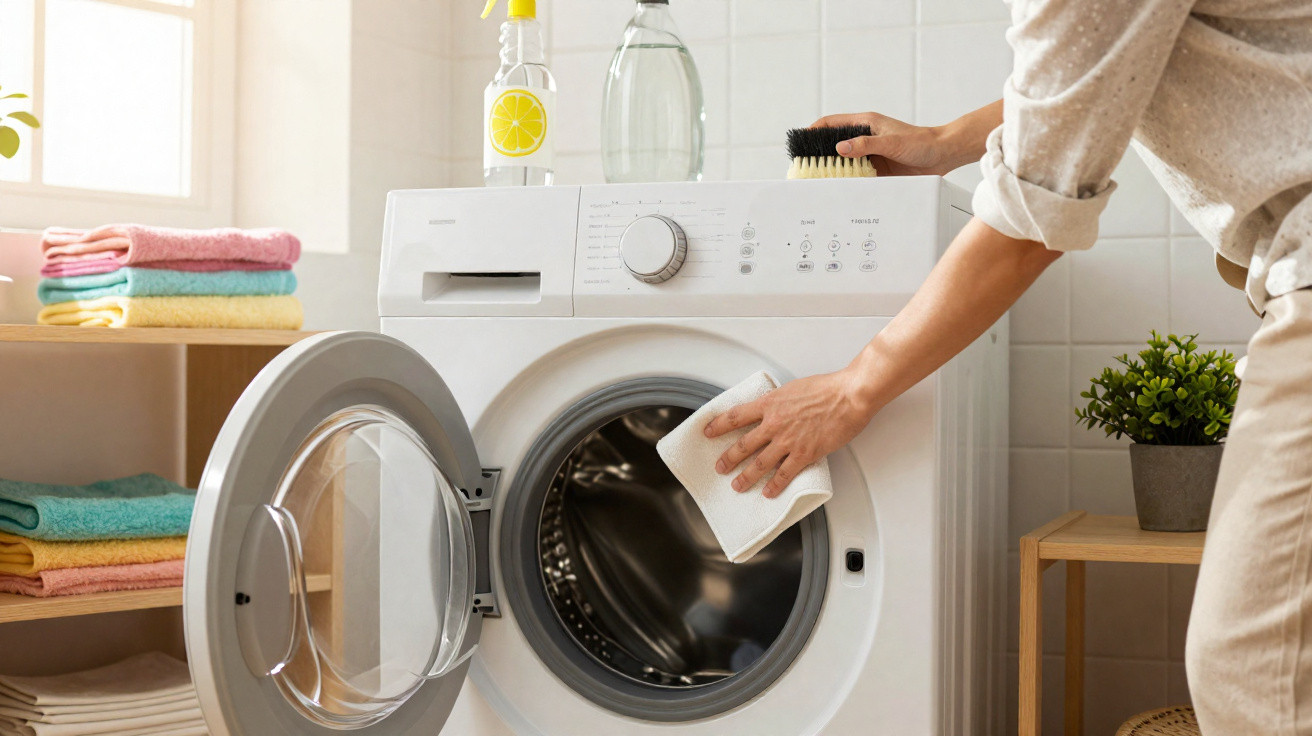
In this case, regular maintenance washes with an empty drum at 60–90°C, plus a little specialist cleaner or ordinary washing soda, can alter the underlying smell of your laundry. Wiping the seal with a cloth after a wash and leaving the door slightly open allows air to disrupt the damp cocoon where mould enjoys growing. Let us be honest: hardly anyone truly does that every day.
“The odor you notice on your clothes is often just the tip of the iceberg. Most of the problem lives inside the machine, in places you never see but your laundry passes through every single time.”
- Golden rule for your nose: when the empty machine smells musty, your laundry will never smell genuinely clean.
- Leave both the door and detergent drawer open after every wash so the inside dries faster.
- Once a month, run a hot “machine cleaning” programme, particularly if you regularly wash at 30°C.
- Use slightly less detergent than you assume you need; surplus product nourishes the biofilm that traps odours.
- Trust your senses: a faint smell often signals that bacteria are already ahead of you.
The small habits that shape how your laundry will smell next year
Smelly washing is often treated as a minor nuisance, but it reveals much about how we manage time, household jobs and our own bodies. A forgotten load is commonly one squeezed into a day that is already overloaded. The washing machine waits quietly in its corner, turning moisture into chemistry while we hurry towards something else.
In practical terms, escaping this pattern rarely requires a miracle product. It is mainly about small actions that become nearly instinctive: beginning a wash when you know you will be there to empty it, airing the machine between loads and choosing one evening each month to reset the drum and seals. None takes much time, but together they subtly change how clothes feel against your skin.
More personally, faint musty odours attach themselves to more than textiles. They affect how we enter a meeting, pull on a clean T-shirt or hug a child goodnight. We have all had that moment when, after raising an arm, we wonder whether our jumper really smells fresh. Speaking openly about it, exchanging tips and admitting that we also forget the washing from time to time can make space for a different relationship with these everyday routines.
Odours are powerful memory triggers. A towel with a permanently slightly stale smell makes the bathroom somewhere you put up with rather than somewhere restorative. A hoodie carrying a trace of mould ends up neglected over the back of a chair. Altering how long laundry stays shut in that enclosed drum, and how your machine airs out between cycles, is a quiet way to change the feel of your home. Next time a programme ends and you think “I’ll get it later”, you will know what may begin growing behind that thought.
| Key point | Details | Why it matters to readers |
|---|---|---|
| Maximum “safe” time in the drum | Ideally, take laundry out within 30–60 minutes of the programme ending. After 4 hours, warmth and moisture give bacteria and mould a substantial advantage. | Helps you judge when a quick rewash is needed and when you can dry the load without risking persistent odours. |
| Best cycles to avoid musty smells | Mix low-temperature eco programmes with occasional 60°C washes for towels, sportswear and bed linen to remove more odour-causing microbes. | Stops the machine becoming a lukewarm, bacteria-friendly environment while keeping energy consumption manageable. |
| Simple “rescue” method for forgotten loads | When clothes have spent several hours in the drum and smell wrong, run another, hotter programme with a half-cup of white vinegar in the softener drawer. | Offers a specific, inexpensive way to save a smelly load without throwing products at it or accepting that “semi-clean” scent. |
FAQ
- How long can I realistically leave laundry in the washing machine? In most households, up to an hour is normally fine, particularly in a cool room. After 3–4 hours, the chance of a musty smell rises quickly, and if it has been there overnight, you will almost certainly need to wash it again.
- Do smells mean my clothes are actually dirty again? The fibres may not be covered with visible dirt, but an odour means bacteria are active among the moisture and residues. Your nose is correct: if it smells “off” while wet, it will return once you wear the item.
- Is adding more detergent the solution for smelly laundry? It is often the reverse. Excess detergent leaves a sticky coating that holds bacteria and keeps the inside of your machine damp. The recommended amount-or a little less-will generally keep things fresher.
- Can a smelly washing machine make clean clothes stink? Yes. A musty drum, grimy door seal or mouldy detergent drawer can pass its odour to every load, even with excellent detergent and prompt emptying.
- Are front-loaders worse for odors than top-loaders? Front-loaders usually retain more moisture around the seal and door, so they require an open door and frequent hot “maintenance” washes. Top-loaders can develop smells as well, but usually a little more slowly.
- Does fabric softener play a role in bad smells? Thick softeners can accumulate inside the drum and on fibres, producing a sticky feast for bacteria. Using less, or using white vinegar for some loads, often cuts long-term odours.




Comments
No comments yet. Be the first to comment!
Leave a Comment