
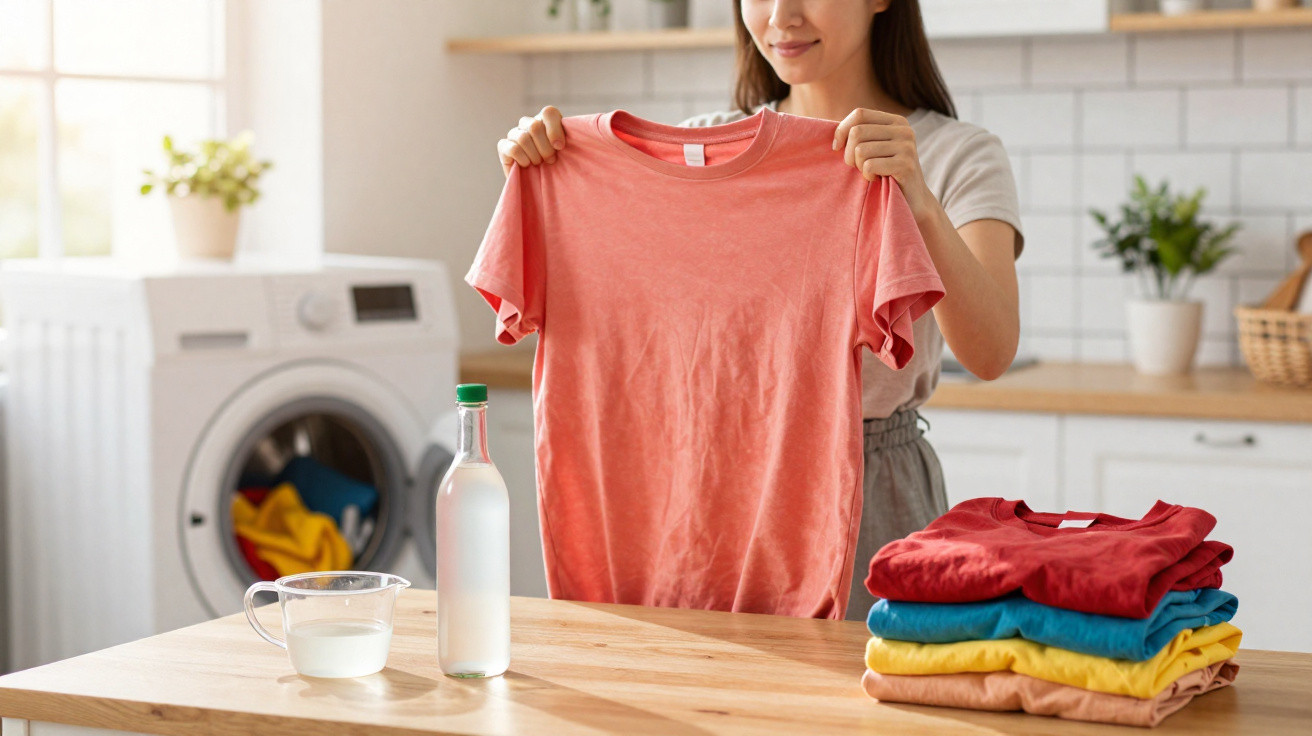
Your black clothes have become charcoal, while that cherry-red hoodie now resembles dried rose petals. Yet a cupboard essential can quietly change the result in one wash, with no specialist boosters needed.
There was no label and no fanfare. Her laundry basket was a patchwork of weary shades: school T-shirts, a washed-out floral dress and a pair of jeans looking distinctly gloomy.
Forty minutes later, she held up the dress and its pattern genuinely seemed revived. The black lines looked crisper, while the pink tones were no longer muted. She smiled as though she had performed a tiny magic trick without needing anyone to applaud.
When I asked what she had used, she simply raised the bottle and shrugged, as if the solution could not possibly be so straightforward. But it was.
The hidden reason colours look dull in your washing machine
We tend to assume clothing fades simply because time takes its toll. That is partly right, but there is another, subtler culprit inside the washing machine: residue. It may be detergent that has not rinsed away properly, minerals from hard water, or fluff and microscopic fibres that stick to fabric like dust on a matt photograph.
Most of us know the feeling of lifting a once-black T-shirt and finding that it looks vaguely dusty. It has not necessarily faded; instead, it has been dulled by an unnamed film. Repeat that across weeks of regular washing, and colour starts to lose its strength. The pigment remains, but it is hidden beneath a hazy coating.
Here is the surprising part: hard water affects around 85% of homes in the US, and mineral deposits can attach themselves to fabric much as limescale grips a kettle. Reducing the pH of the rinse water helps loosen that grip. This is where the easily overlooked ingredient, distilled white vinegar, quietly proves its worth.
Why distilled white vinegar restores colour in one wash
Distilled white vinegar contains roughly 5% acetic acid. Added during the rinse, this modest amount lowers the pH, frees lingering detergent and breaks down the mineral haze. The fibres loosen, residue releases, and colours do not receive extra dye; they simply reveal the depth they already possessed.
Imagine black jeans that have started to appear grey around the knees. Run a wash, pour half a cup of white vinegar into the fabric-softener drawer, then look at them in the light. The dull, matt surface is reduced and the edges appear more distinct. They will not become the deep black of a brand-new pair, but they will look noticeably richer, as though someone has cleaned your glasses.
Textile chemists explain that alkaline residue scatters light, making colours seem flat. An acidic rinse reverses that optical effect. It is straightforward physics rather than magic, and the change can happen quickly. A single wash may be enough to expose it. That is why this method can feel like a cheat when it is really just more intelligent cleaning.
How to use distilled white vinegar today
For a front-loading washing machine, add 1/2 cup of distilled white vinegar to the fabric-softener compartment. With a top-loader, pour in 1 cup during the final rinse. To refresh an item by hand, combine 1 tablespoon per litre of cool water, swish the fabric gently and rinse until clear. Nothing more is required.
For particularly stubborn build-up, use a pre-soak: add 1 cup of white vinegar to a basin of cool water, leave the items for 20–30 minutes, then wash normally. Realistically, no one is doing this every day. Save it for a “Sunday reset” load, such as gym kit, dark garments or school uniforms that get plenty of wear.
“People think color loss is permanent. Nine times out of ten, they’re looking at residue, not ruin,” says a longtime laundromat owner I met while fact-checking this piece.
- Choose distilled white vinegar only, rather than apple cider vinegar or cleaning vinegar.
- Never combine vinegar with chlorine bleach, as dangerous gases may form.
- Begin with cool or warm water for dark items; high heat accelerates wear.
- If your machine offers a “rinse+” setting, use it alongside vinegar for a cleaner result.
Mistakes to avoid when using vinegar in laundry
Using the incorrect vinegar is the first common mistake. Distilled white vinegar is the useful option here. Apple cider vinegar may mark pale fabrics, while stronger cleaning vinegar is too acidic for clothing. Stick to the plain, reliable version.
Another error is pouring vinegar into the drum alongside detergent. They are not meant to be mixed. Detergent works best in an alkaline environment, whereas vinegar disrupts that process. Allow the detergent to clean first, then use vinegar in the rinse, where it can work most effectively.
Do not expect a dramatic rescue from genuinely damaged dye, either. Vinegar cannot recolour a T-shirt that has been bleached or undo fabric damage caused by sunlight. It can, however, remove the build-up that prevents the true colour from showing. That is a difference you can both see and feel.
A small laundry ritual that changes how clothes age
This is not about buying another product. It is a small adjustment that can extend the life of clothes you already have. Vinegar deals with hard water without making a fuss. It softens fabrics without artificial “fragrance”. It can make your wardrobe look closer to how it did when you first loved those pieces, and that effect carries over.
Test it on one load this week: your darkest items or a print that has started to look sleepy. Notice the fabric surface change from chalky to clean. Then decide whether this unassuming kitchen bottle deserves a lasting place in your laundry routine. The best upgrades don’t shout; they just keep paying rent quietly.
What the science says in plain English
Fading has more than one cause. Some dyes wash out, while some fibres become worn through abrasion. But much everyday “fading” comes from residue that refracts light. As a mild acid, vinegar neutralises alkaline remnants from detergent and hard water. This lowers the pH of the rinse, allowing the final traces of suds and minerals to release. Colours look deeper because light reaches cleaner fabric surfaces.
It is similar to wiping fingerprints from a camera lens. Your jumper has not acquired more colour; the surface layer that made it appear flat has been removed. Since vinegar softens without leaving a coating, fabrics remain breathable too. Towels do not become slippery, and leggings do not start to squeak.
One wash can often produce a visible difference, particularly with black, navy, crimson, emerald and densely printed fabrics. Where water is especially hard, make it a weekly routine for dark loads. Pair vinegar with sensible basics: turn clothes inside out, choose a gentle spin and avoid a scorching tumble-dry cycle. No fancy products. Only better chemistry.
There is a subtle change in mindset as well. When clothes look vibrant, we tend to wear them for longer and replace them less quickly. A bottle of vinegar will not save the planet, but it can genuinely slow the rate at which laundry wears out. In practical terms, that means fewer replacement purchases, less dye bleeding and fewer repeated rinses. Distilled white vinegar costs very little and delivers a visible return.
| Key point | Detail | Benefit for the reader |
|---|---|---|
| Use distilled white vinegar in the rinse | 1/2 cup for a front-loader, 1 cup for a top-loader | Immediate colour clarity with minimal effort |
| It removes residue, not dyes | The acidic rinse lifts detergent and mineral film | Colours appear richer after one cycle |
| Safety matters | Never mix it with bleach; avoid apple cider vinegar and cleaning vinegar | Helps protect fabrics, skin and your machine |
FAQ:
- Which vinegar should I use? Use distilled white vinegar with approximately 5% acidity. Avoid apple cider vinegar and cleaning vinegar.
- Will my clothes smell like vinegar? No. Its smell dissipates during the rinse and evaporates as the clothes dry.
- Is it safe for my washing machine? Yes, when used in rinse-sized quantities. Put it in the softener drawer, avoid over-pouring and never combine it with bleach.
- Can I use vinegar with all fabrics? It is suitable for most cottons, linens and synthetics. If you are concerned, spot-test silk or acetate blends, and avoid leather trims.
- How often should I do it? Use it weekly for dark loads in hard-water areas, or as a reset whenever colours begin to look dull. Rotate according to need.




Comments
No comments yet. Be the first to comment!
Leave a Comment