
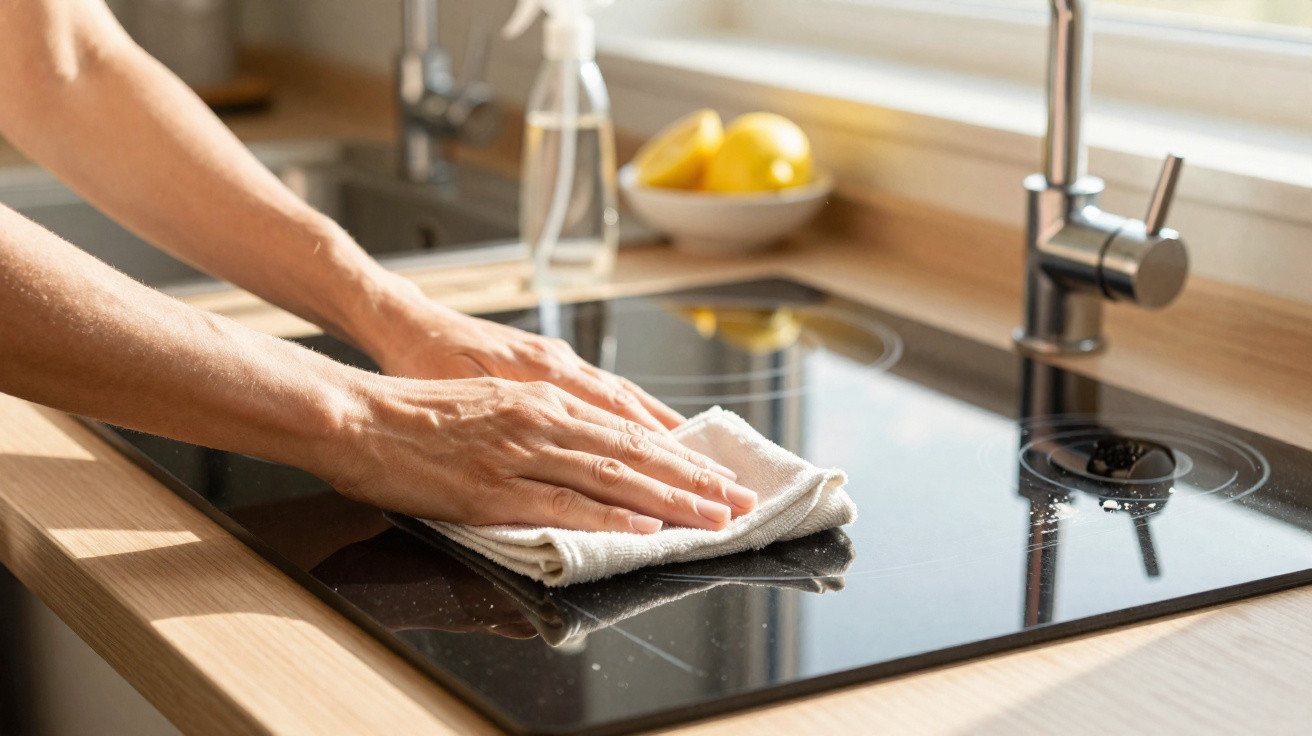
The first scream makes no sound.
You pull a green scourer over a “stubborn” mark on your glass cooktop, only half focused as a podcast plays and you think about last night’s pasta mishap. After several firm passes and a little extra force, the stain finally lifts. You rinse the surface, dry it, stand back and enjoy that small sense of achievement. Gleaming. Clean. Sorted.
Then the morning light changes, and you notice them.
Faint, misty curves across the glass, resembling spectral fingerprints. They are not grime. They are not grease. They are scratches. And they are permanent.
We do not often link that brief, angry burst of scrubbing to lasting harm. Yet cleaning professionals repeat the same understated caution: every “just this once” scour can leave a mark that is initially invisible.
Until it is too late.
Why your scrubbing habit is quietly wrecking delicate surfaces
Watch anybody clean when they are rushed, and the same action usually appears. Elbow raised, jaw tight, hand rubbing fiercely back and forth as though cleanliness relies entirely on force. We do it to glass doors, shower screens, induction hobs, laptop displays and even the costly non-stick pan we promised we would “treat carefully this time.”
It seems effective, even a little athletic. There is foam, there is motion, and it feels as if you are defeating the mess.
But delicate surfaces do not register “effort”.
They register friction.
A cleaning technician based in London told me about a customer whose induction hob was almost new. “Every time I visited,” she said, “the glass looked more hazy, like someone had wiped it with very fine sand.” The customer proudly said that after every meal she scrubbed it “properly” with a standard powder cleaner and a green pad.
After two years, the surface was covered in spider-like micro-scratches that held on to grease and stains. Technically, the hob still functioned, but it could never look properly clean again. The same issue appears in bathrooms with frosted glass, marble kitchens, matte-black fittings and shiny phone screens cleaned with paper towels containing wood fibres. The damage builds in slow motion, just under our radar.
Cleaning experts often put it in very straightforward language: materials have personalities. Glass, stone, coated metals, plastics and varnished wood all have a hardness level and respond differently to friction, heat and chemicals. Whenever the cleaning tool or product is tougher or more aggressive than the surface itself, the surface loses.
At first, that loss is barely detectable. It may be microscopic channels, slight haziness or an area that catches the light differently. As the months pass, these minute scars collect dirt, limescale, soap scum and minerals. You then scrub with more force, making the grooves deeper. The harder you work to correct it, the worse it becomes.
This is why many surfaces that appear “worn out” are not actually old.
They have simply been scrubbed too much.
From brute force to smart touch: how the pros actually clean
Professional cleaners seldom appear to be battling dirt. Look carefully and you will see that they prioritise contact time rather than pressure. For glass cooktops, for example, a seasoned cleaner I spoke with uses a soft microfibre cloth, a little gentle washing-up liquid and warm water. She leaves the soapy mixture on burnt-on food for a few minutes, before releasing it with a plastic scraper held nearly flat against the glass.
No frantic rubbing back and forth.
No scouring pad.
The method is to soak, soften, then glide, rather than attack.
The same approach works on other delicate surfaces. For shower glass, professionals begin with white vinegar mixed with water, spray it generously and leave it for ten minutes. They return only then with a non-scratch sponge or microfibre cloth, using long, gentle strokes rather than small, aggressive circles. With marble or natural stone, they avoid vinegar and acidic cleaning products completely, choosing pH-neutral cleaners and soft cloths before drying the surface thoroughly.
The aim is not an immediate transformation produced by one furious movement. It is to loosen dirt gradually with as little abrasion as possible. In truth, nobody follows this routine every day. But when you see a five-year-old worktop that still appears new, the slower technique starts to seem quicker over the long term.
Professionals also make a mental adjustment that most of us miss. Their first question is, “What’s the surface?” rather than “What’s the stain?” That one question changes the entire process. The same dried tomato sauce on stainless steel, on a Teflon pan and on a marble worktop requires three separate methods, because the material beneath matters more than the mess on top.
One cleaning consultant put it this way:
“People think of cleaning as removing dirt at any cost. I think of it as preserving surfaces for as long as possible. Dirt is temporary. Damage isn’t.”
To prevent this kind of harm, careful cleaners run through a quiet checklist:
- Start with soft tools, such as microfibre, soft sponges and cotton cloths, and only use something harsher when there is no alternative.
- Allow products time to work, so chemistry does the hard work.
- Pair the cleaner with the surface: use pH-neutral products for stone, non-abrasive options for glass and screens, and no bleach on coated metals.
- Try unfamiliar products on an inconspicuous corner before using them everywhere.
- Wipe and dry with a light touch, following the grain on wood or metal rather than wiping across it.
The quiet art of cleaning without causing future problems
Once you begin noticing, you see the small decisions that either protect your home or punish it. Taking the rough side of a sponge for a “quick pass” over a non-stick pan. Rubbing a fingerprint from your laptop using the edge of a jumper. Applying a magic eraser to glossy paint whenever your children leave a mark. Each choice seems insignificant, an almost invisible and harmless shortcut at the time.
Then, one day, you look around and find that your “new” possessions already look worn.
Faded areas on the dining table. Hazy glass. A phone screen without its shine.
We have all experienced that realisation: you have aged your belongings with your own hands.
The alternative that cleaning experts discreetly recommend is almost deliberately gentle. For screens and phones, they rely on a barely damp microfibre cloth, passed lightly in straight lines rather than pushed firmly in circles. For induction and ceramic hobs, they keep a designated soft cloth and non-abrasive cream cleaner, using a plastic scraper only for the occasional stubborn, stuck-on residue. For matte-black taps, they choose a mild soap solution and dry immediately, instead of using descaling sprays that gradually attack the finish.
There is one plain statement they make repeatedly: surfaces rarely fail because of dirt; they fail because of the way we attempt to remove it.
We choose the quickest visible result, even when it takes years off the life of the item we are cleaning.
Gentle cleaning also alters how it feels to live at home. When you are not constantly fighting a battle, your movements become slower. You use fewer products, but use them more thoughtfully. The weekly ritual of wiping a bathroom mirror with a soft cloth and mild solution can begin to feel almost meditative rather than punishing.
Some people even say it changes how they relate to their possessions. They buy one good pan and look after it, rather than purchasing cheap pans and scrubbing them to death. They begin to pay attention to labels such as “non-abrasive”, “pH-neutral” and “for glass”, and those quiet words start to shape their actions.
You may look around your own home and notice where vigorous scrubbing has left its marks. Not as a reason to feel guilty, but as a way to see where a different touch could begin today.
| Key point | Detail | Value for the reader |
|---|---|---|
| Pressure ruins delicate surfaces | Vigorous scrubbing with abrasive pads or powders produces micro-scratches on glass, stone, coatings and screens | Helps you avoid habits that make items look old long before their time |
| Let chemistry work before your muscles | Giving the right cleaner contact time softens dirt, allowing it to be wiped away with very little friction | Saves effort and protects finishes while still delivering a deep clean |
| Match method to material | Identifying the surface first - glass, stone, coated metal or non-stick - determines which products and tools are safe | Lowers the risk of costly, irreversible damage to valuable items and surfaces |
FAQ:
- Question 1: How can I tell if a sponge or cloth is too abrasive for a delicate surface?
Rub it lightly on an old CD, glossy plastic or a concealed area. If it leaves faint lines or a dull patch, it is too harsh for glass, screens or polished finishes.
- Question 2: Is it safe to use magic erasers on everything?
No. They are micro-abrasive, much like ultra-fine sandpaper, and may dull shiny paint, scratch plastics and wear away coatings. Keep them for stubborn marks on hard, non-glossy surfaces.
- Question 3: What’s the safest way to clean a glass cooktop daily?
Wait for it to cool, then wipe spills using a damp microfibre cloth and a drop of washing-up liquid before drying. Use a dedicated non-abrasive cream cleaner and a plastic scraper only for occasional stuck-on food.
- Question 4: How should I treat marble or natural stone so I don’t ruin it?
Avoid vinegar, lemon and harsh degreasers. Instead, use pH-neutral stone cleaner or mild washing-up liquid with soft cloths, and quickly wipe away acidic spills.
- Question 5: What’s a simple starter kit for gentle, non-damaging cleaning?
A small collection of quality microfibre cloths, a non-abrasive cream cleaner, mild washing-up liquid, white vinegar for non-stone surfaces, a plastic scraper and a soft non-scratch sponge will cover most day-to-day needs.



Comments
No comments yet. Be the first to comment!
Leave a Comment