
The moment I understood that cleaning was not the issue, I was in the hallway with a half-full rubbish bag, asking myself how the house could be a complete mess again… just 36 hours after a “big clean”.
The sink was full already. The hall table had disappeared beneath keys, post and two stray Lego pieces, while my laptop was perched on a stack of folded-but-unhoused washing.
I knew how to clean. I knew every TikTok tip and could fold a fitted sheet like a shop-floor ninja.
Still, every room seemed to be murmuring, “We’ll be back.”
That day, rubbish bag in hand and frustration building, I finally understood what was happening. Cleaning had not let me down.
My system had.
When cleaning never lasts, the real issue runs deeper
There is a particular frustration that arrives after you have “cleaned all weekend”, only to find that by Wednesday your home looks untouched.
It is not quite rage. It is more like a weary, persistent kind of shame.
You begin to question whether being untidy is simply part of your nature. Perhaps every other adult received a secret handbook for keeping a household going while you were busy scrolling on your phone when it was handed out.
So you buy extra baskets, scrub more thoroughly and declutter once again.
Yet the worktops still disappear beneath belongings, as though the house has switched itself into an automatic chaos setting.
A friend of mine, Lena, used to send me “before” and “after” photos of her living room. In her “after” pictures, it resembled a rental listing: an empty coffee table, plumped-up cushions and blankets folded with hotel-like precision.
Then, three days later, she would send another photo from the same angle.
The sofa would be buried under clothes, backpacks would sit in the middle of the room like landmines, and the children’s art supplies would be scattered as though a miniature hurricane had swept through. She would write, “I swear I JUST cleaned this.”
Lena was not lazy. She worked long days, brought up two children and still cooked on most evenings. Effort was not her issue.
The problem was that every item in her home was essentially on holiday: nothing had a permanent address, there were no rules and no route for getting it back where it belonged.
Once you spot this pattern, you cannot really stop seeing it. We spend hours on “reset days” that feel virtuous and productive, only to rebuild the same sandcastle time after time.
Nothing beneath those major efforts is doing the heavy lifting. There is no default route for clutter arriving in the house, no routine that operates almost on its own and no small habits attached to real moments in everyday life.
There are only bursts of motivation, followed by collapse.
Let’s be honest: nobody genuinely manages all of this every day. We do not wake up with an endless reserve of self-discipline. We get through life on autopilot.
If that autopilot lacks structure, chaos takes over. Not because you are untidy, but because your environment has been set up to unravel.
Moving from “I clean” to “the system cleans with me”
The understated turning point happens when you stop asking, “How do I clean better?” and begin asking, “What keeps breaking?”
Not the room itself. The flow.
A straightforward approach is to walk through your home as though you have never been there before. Starting at the front door and ending at the bedroom, notice where belongings naturally come to rest.
Do shoes gather by the doormat? Are keys thrown onto the first flat surface? Does post get left near the kitchen?
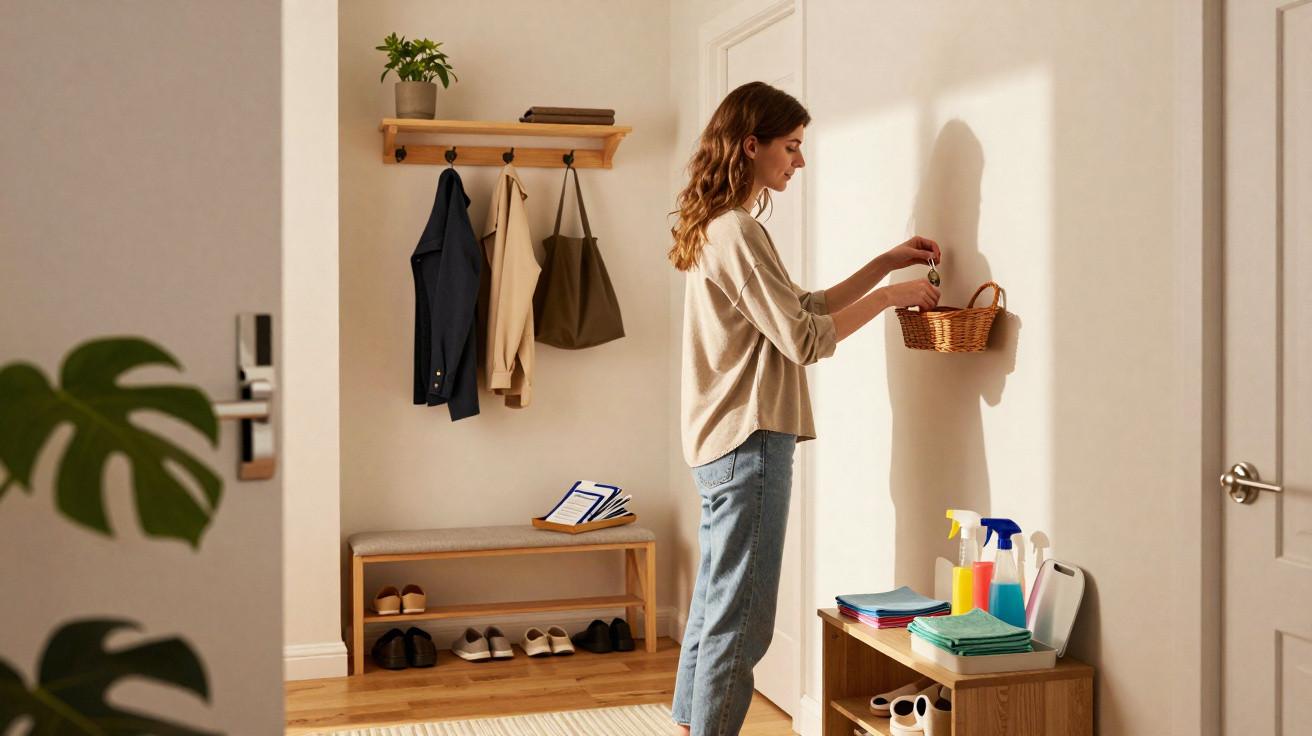
Rather than battling those instincts, incorporate them into the system. Put a hook by the door, a tray for keys and a small wall file for post.
Each “landing zone” becomes deliberate rather than accidental.
Your home begins to support you instead of working against you.
One frequent trap is thinking you need a “perfect” organisation system before you can make any changes. Colour-coded labels, matching storage containers, a picture-perfect pantry.
That imagined ideal can leave you stuck for years.
Most people do not need a more attractive version of the same faulty arrangement. They need fewer categories, fewer decisions and fewer steps.
Use three baskets rather than twelve. Choose “Return”, “Donate” and “Rubbish” instead of creating fifty tiny zones.
We all know the moment: you look at a cluttered shelf and think, “I’ll deal with it when I have time.” Spoiler: that imaginary free weekend is not on its way.
Begin scrappily. Build the system first; make it look beautiful later.
I realized my system was working the first time I came home exhausted, dropped my bag, and-without thinking-hung it on the new hook instead of the floor.
That tiny, automatic gesture felt like proof: something inside the house had quietly been rewired.
- Create “homes” before you declutter. Decide where items will live permanently, including papers, toys and chargers, so that when you clean you are not merely moving clutter around but returning it to its place.
- Start with one “hot zone” only. Choose the area that irritates you each day: the kitchen worktop, hall table or desk. Set up a system there before moving on to the rest of the home.
- Use friction as your secret tool. Make the actions you want easy to do. Make the actions you want less of mildly inconvenient. Keep snacks on a high shelf, for example, and place the laundry basket exactly where you undress.
- Make systems survivable on your worst day. If it works only when you feel motivated, it is not a system; it is a mood. Create it for tired-you, not ideal-you.
- Test, don’t judge. When an area becomes chaotic again, it is not evidence that you have failed. It is feedback that the system needs to be closer, simpler or more visible.
Living in a home that does not fight you
A quiet sense of calm appears once your surroundings begin taking on some of the work. Dishes will still occasionally pile up, and washing will still seem to multiply, but the disorder no longer feels like a personal failing.
You start to see that “messy” days are easier to recover from. Ten minutes of tidying can genuinely transform a room because every item has a route back home.
You are not recreating order from nothing; you are simply restarting the system you have already created.
Gradually, the old belief - “I’m just not the kind of person who can keep things tidy” - begins to lose its hold.
You may find yourself adjusting little details in the way you would fine-tune a playlist. A basket shifts closer to the sofa, a laundry hamper moves to the place where clothes actually land, and the children’s art box is lowered so they can help with the reset.
You are not trying to create a magazine spread. You are adapting your space to suit your real life: your energy, your timetable and your brain.
The truth is that a good system is never truly complete. It changes as you change.
New job, new baby, new routine, new rules.
Your home ceases to be a fixed project and becomes a living framework that can be adjusted.
The real change comes from recognising that a messy house is not a moral failure. You are experimenting.
You are laying invisible tracks beneath daily life, so that on days when you are tired, stressed or simply human, everything does not fall apart completely.
Some people will see themselves in every sentence here. Others may need only one idea - a hook by the door, a system for one hot zone or a kinder definition of “good enough” - to begin making a change.
The question remains: if cleaning is not the problem, which tiny system could you alter this week that your future self will quietly appreciate?
| Key point | Detail | Value for the reader |
|---|---|---|
| Systems beat motivation | Create routines and spaces that function even when you are tired or distracted | Reduces guilt and makes tidying feel easier and quicker |
| Start with hot zones | Focus on one area that is constantly untidy and create a simple structure around it | Quick wins that build confidence and visible progress |
| Make clutter “paths” intentional | Convert natural drop-off spots into official landing zones using simple tools | Stops mess spreading and keeps everyday life running smoothly |
FAQ:
- How do I know if I have a system problem and not a cleaning problem? If your home looks untidy again within a day or two of a major clean, and you feel as though you are beginning from zero each time, you lack underlying systems. Cleaning clears surfaces; systems determine where belongings live and how they get back there.
- Where should I start if my whole home feels overwhelming? Pick the one place that frustrates you every day, usually the entrance, kitchen worktop or bedroom floor. Focus exclusively on that spot until there is a simple, repeatable way for items to land and be put away.
- Do I need to buy lots of organisers or containers? No. Begin with what you already have: boxes, old baskets, trays or even shoe boxes. Once the system has proved useful and reliable, you can replace the containers if you would like a smarter look.
- What if my family doesn’t follow the new system? Keep it visible and extremely simple: fewer steps, clear labels and easy access. Explain it to them, put things where they naturally drop their belongings and expect it to take time. Systems become habits through repetition, not announcements.
- How long does it take for a new system to feel natural? Most people begin to notice a shift after two to three weeks of using a new arrangement consistently. The important thing is to adjust what fails rather than give up. Once it fits real life, it starts operating almost by itself.



Comments
No comments yet. Be the first to comment!
Leave a Comment