
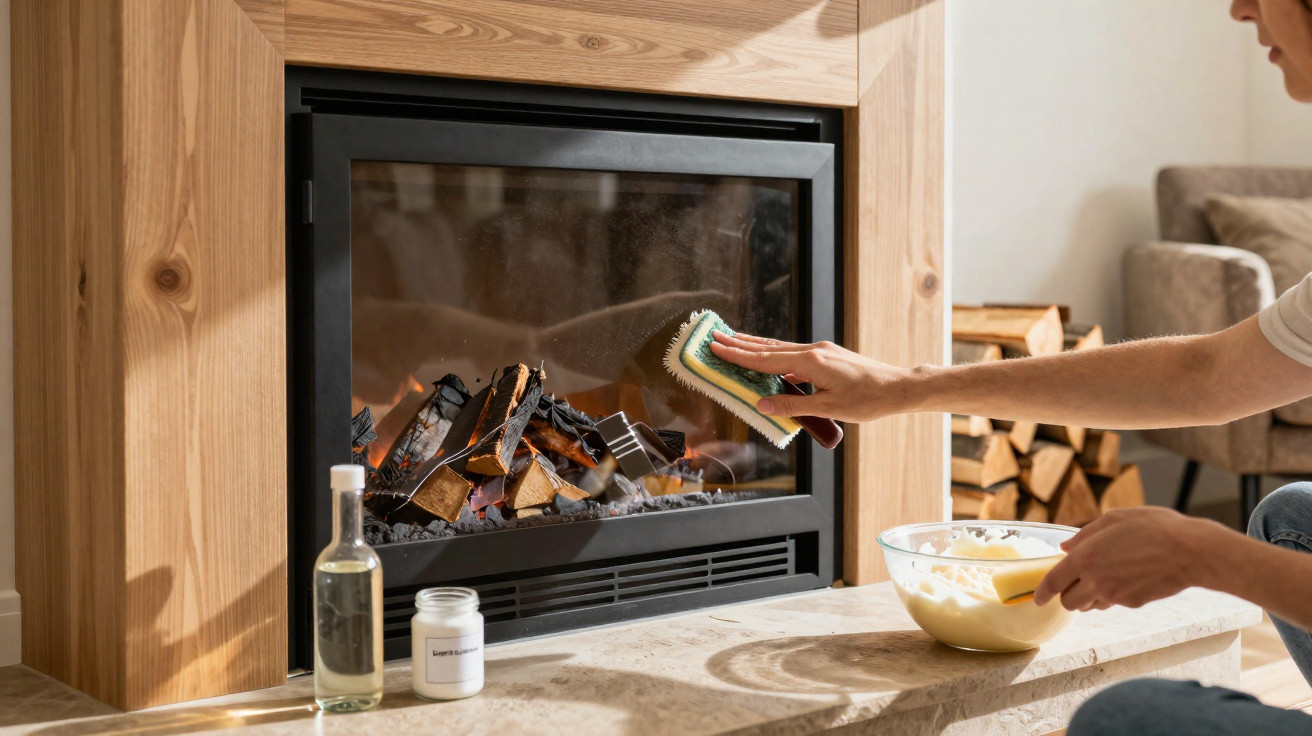
Many owners of fireplace and pellet stoves will know the sight all too well. Rather than a cosy display of flames, they are faced with a grey-black pane after only a few days. The usual advice from friends is: “Just use ash to clean it.” Yet there is a far easier, cleaner and quicker way, using products that most people already keep in their cleaning cupboard.
Why a fireplace viewing window turns black so quickly
Before reaching for a cloth, it is worth understanding the causes. Knowing what creates the build-up can save a great deal of cleaning later on.
- Poor-quality or damp wood: Wet wood creates more smoke. Particles from that smoke settle on the glass as a dark coating.
- Incomplete combustion: If the fire burns too cool or receives too little oxygen, it produces more soot particles, which cling to the glass and inside the firebox.
- Incorrect air supply setting: When the air vent is closed too far, the flame is effectively starved, producing extra smoke and heavier deposits.
- Running continually on a low setting: Many people keep their stove turned down to save fuel. However, this extends the period in which the flames merely smoulder, creating ideal conditions for smeary deposits on the glass.
The poorer the wood and combustion, the faster the glass becomes cloudy – sometimes after just one evening by the fire.
The no-ash trick: clean stove glass with two kitchen staples
Rather than bringing ash into the process and spreading dust through half the living room, one particularly practical method relies on two straightforward ingredients: clear household vinegar and bicarbonate of soda.
Why this combination works so well
- Household vinegar breaks down grease and soot: Its acidity acts on organic residue and softens the black layer.
- Bicarbonate of soda provides gentle abrasion: Its fine particles help lift deposits without scratching the glass.
- The mixture fizzes when combined: This small bubbling reaction further loosens the build-up, much like a micro-exfoliant for the stove window.
The advantage is that both products are inexpensive, non-toxic and usually already available at home – with no specialist chemicals or unpleasant-smelling sprays needed.
How to clean the stove glass in a few steps
Step 1: Prepare the mixture
Important: the stove must be fully cool, and both the glass and metal should feel cold to the touch.
- Pour two parts clear vinegar into a small bowl.
- Add one part bicarbonate of soda.
- Allow the mixture to foam briefly, then stir it gently with a spoon.
It should remain thick and creamy rather than runny. This helps it stay on the glass instead of immediately trickling down.
Step 2: Apply it and leave it to work
- Dip a soft cloth or the soft side of a sponge into the mixture.
- Wipe across the glass in circular motions, working from bottom to top.
- Apply a slightly thicker layer to heavier soot marks around the sides and leave it for one to two minutes.
Many people notice on the very first wipe that the black film starts to lift and the glass becomes see-through again.
Step 3: Wipe with a damp cloth and polish dry
- Remove the remaining mixture with a lightly dampened cloth.
- Then buff the glass with a dry, lint-free cloth until no streaks remain.
If preferred, old newspaper can be used for polishing. It often gives the glass a light sheen, much like when cleaning windows.
Alternative household remedies for the fireplace window
If you do not have bicarbonate of soda or vinegar available, other tried-and-tested options can be used. They are not quite as lively as the vinegar and bicarbonate of soda combination, but they work reliably for everyday cleaning.
- Black soap: Diluted with a little warm water, it removes greasy and sooty deposits very gently.
- Methylated spirits: Suitable for stubborn marks that are difficult to rub away. Always ensure good ventilation.
- Hot water and newspaper: Sufficient for light dirt, particularly when the glass is cleaned regularly.
A quick comparison of the methods
| Method | Level of dirt | Effort |
|---|---|---|
| Vinegar + bicarbonate of soda | light to heavy | low |
| Black soap | light to medium | medium |
| Methylated spirits | medium to heavy | medium |
| Water + newspaper | light | low |
How to prevent fresh soot layers for as long as possible
Anyone who has to deal with the glass after every second fire will get little enjoyment from their stove. A few adjustments can make a considerable difference.
- Use dry hardwood: Beech or oak with low residual moisture burns hotter and cleaner than fresh or resin-rich logs.
- Allow enough air: Restricting the air supply too much may save fuel, but it also produces more smoke and smeary deposits.
- Heat the stove properly after lighting it: During the first few minutes after ignition, the stove should burn strongly so that the firebox reaches temperature.
- Clean regularly, but briefly: A quick wipe every few days is better than having to scrape off a thick crust once each season.
Those who keep an eye on the fire, air supply and wood quality usually need to scrub the stove glass far less often.
Why many households avoid chemical cleaners
Shops sell sprays and foams that claim to clear stove glass in record time. They often contain strongly alkaline ingredients. Over time, these products can attack the glass coating, put stress on seals and release unpleasant fumes when residues burn off during the next heating cycle.
Vinegar and bicarbonate of soda, by contrast, use comparatively mild substances. They are less likely to irritate the airways and do not add a burden to household waste. Families with children or pets in particular therefore often choose these cupboard-based solutions.
What you should always keep in mind during use
Even when using household remedies, a few basic rules are needed to achieve a good result and avoid damage:
- Always make sure the stove has cooled down completely.
- Do not use abrasive scouring pads or wire wool, as they leave fine scratches in the glass.
- Wipe seals and painted metal parts only lightly and without applying much pressure.
- Carefully remove every residue after cleaning before starting the next heating cycle.
If the glass remains dark despite cleaning
If brownish shadows or dull patches remain after cleaning, this may indicate baked-on deposits or older damage. In such cases, professional cleaning by a stove installer can sometimes help – or, in the longer term, a replacement viewing window may be needed. At that point, it is also worth checking the instruction manual to see whether the model's air flow is correctly set.
With a little routine, a soot-covered fireplace window can soon become a thing of the past. Wiping the glass briefly with vinegar and bicarbonate of soda every few days, and not constantly running the stove at its very lowest flame setting, lets you enjoy the view of the flames for much longer – without harsh chemicals, a grey-black haze or hours of scrubbing.





Comments
No comments yet. Be the first to comment!
Leave a Comment