
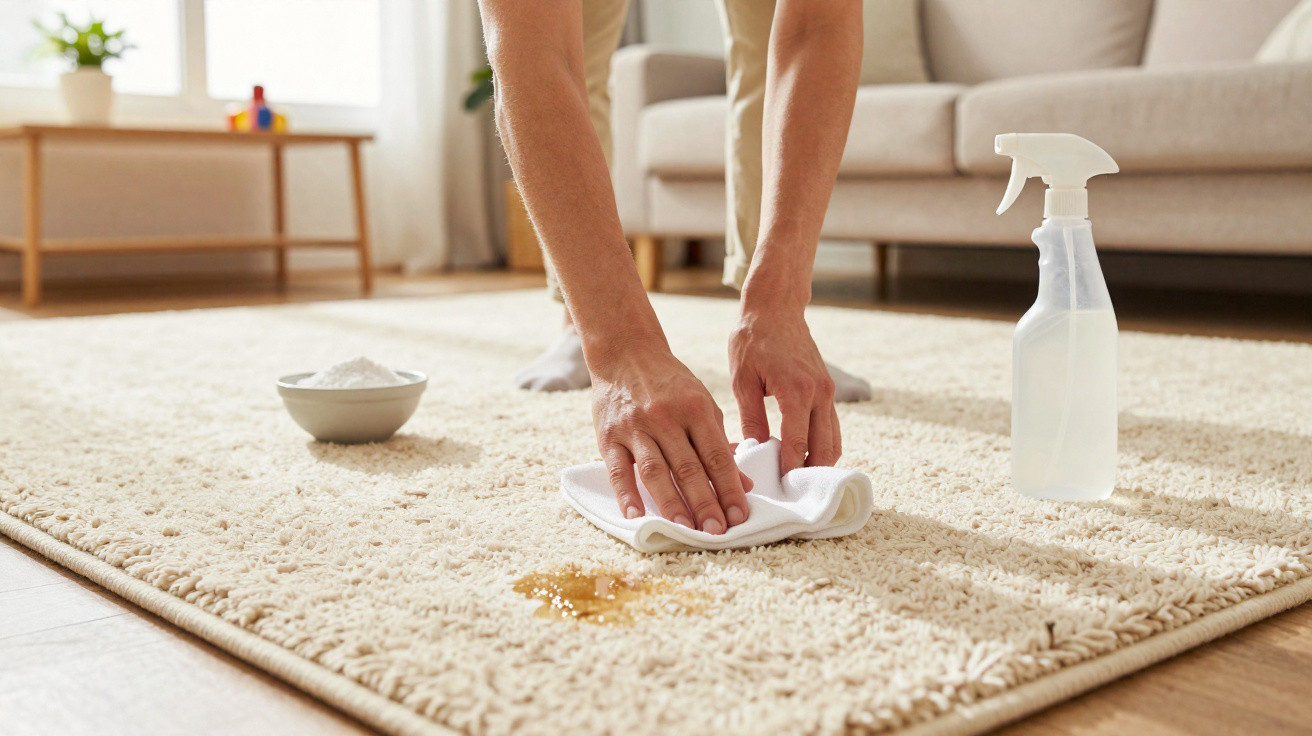
You spot it five minutes before your guests are due to arrive.
A beige rug that used to look like “soft sand” now has a dark coffee ring stamped across it, or a small orange halo left by last week’s curry. Once you have seen it, you cannot unsee it. Your mind immediately starts calculating: scrub too forcefully and it may spread; reach for a bucket and you could drown the stain - together with any hope of drying the rug before someone comes through the door.
You crouch down and blot it with kitchen roll, but the mark simply looks back at you.
There must be a more sensible solution than saturating the whole rug.
The quiet disaster of one stain on a pale rug
Pale rugs are unforgiving. They reveal every mishap: coffee, muddy paw prints, or a splash of red wine that has lodged in the fibres like evidence at a crime scene. On a darker rug, the incident soon disappears from view. On cream, ecru or off-white, every error is put centre stage.
What no one mentions when you fall in love with that lovely “oat milk” rug is that spills do not merely remain on top. They seep downwards, spread out and can leave a subtle shadow that returns days later when handled incorrectly. At that point, soaking stops being cleaning and starts acting like a “refresh” button for the stain.
Imagine a couple in a compact flat, delighted with their minimalist sitting room and its large, soft, nearly white rug. One Sunday morning, their toddler does what toddlers do and knocks over a full glass of berry juice.
They panic, fetch a bowl of water, soak the patch and scrub as though there is no tomorrow. The surface improves, so they breathe a sigh of relief. Two days afterwards, a broader, duller mark rises back through the fibres. The juice had travelled into the backing, combined with dust and returned like a ghost. The rug no longer merely appears stained; it looks worn out.
Flooding a rug is appealing because water feels like the answer to everything. Surely more water means better cleaning? In reality, rugs are layered sponges. When you saturate them, you force pigment into the backing and sometimes even into the floor beneath. The fibres can slacken, the backing may weaken, and drying can take hours or even days.
That lingering moisture creates ideal conditions for odours and, more seriously, mould. The real goal isn’t to drown the stain, it’s to lift it out gently before it spreads its roots. Once you regard stains as stealthy travellers rather than accidents confined to the surface, your approach changes completely.
A dry or nearly dry method for pale rug stains
Begin with the calmest possible response: blot rather than rub. Hold a clean white cloth or sheet of kitchen roll against the stain, moving from the outer edge towards the middle. Your aim is to absorb the liquid, not drive it further into the rug.
Next, use an understated household helper: bicarbonate of soda or cornflour. Cover the damp patch generously and leave it for at least 15–20 minutes; allow up to an hour for greasy or strongly coloured spills. These powders work as miniature sponges, drawing moisture and pigment from the fibres without soaking the rug. When they have had time to work, vacuum slowly with a clean attachment. Often, the mark will be noticeably lighter before you have used any wet product at all.
If a trace remains, move on to an almost-dry technique. In a bowl, combine a small amount of mild washing-up liquid with warm water, then dip only the corner of a cloth into the mixture. It should be nearly dry rather than dripping wet. Dab gently at the stain, again progressing from the edges towards the centre. Afterwards, use another cloth dampened with clean water and wrung out almost completely to “rinse” away the soap.
Treat it as though you were cleaning spectacles, not washing a T-shirt: small, measured movements and very little moisture. Pat the patch dry with a towel, place a second dry towel over it and stand on it briefly to draw out the remaining dampness.
This is the stage at which many people go wrong: impatience leads them to pour straight from the bottle. They use half a bottle of carpet cleaner or scrub with a drenched sponge, believing extra product means extra cleaning power. The stain may seem to vanish temporarily. Days later, however, dirty footprints start sticking to the same area because soap left in the fibres has become a dust-attracting glue.
In truth, hardly anyone follows a cleaning routine every day. Most of us tackle stains when we are late, tired and a little irritated. That is precisely why having a straightforward dry-first routine ready makes such a difference. It prevents that “oh no, what have I done to my rug?” moment.
Sometimes the best cleaning trick is not what you add, but what you refuse to flood.
- Always begin dry: Blot first, then apply absorbent powders before using any liquid.
- Test a concealed corner: A quick patch test can prevent unexpected discolouration or changes in texture.
- Use very small amounts of product: Choose lightly damp cloths instead of soaking-wet sponges.
- Work from the outside towards the centre: This stops the stain spreading into a large blurred halo.
- End with complete drying: Use towels and airflow, or a cool hairdryer held at a distance when necessary.
Living with a pale rug in a real home
Having a light-coloured rug in a lively household is a little like wearing a white shirt on a windy day while holding a coffee. Something is bound to happen. You can either worry constantly or change the way you play the game. When you stop soaking spills and begin treating them as minor emergencies requiring small, accurate actions, your relationship with that rug becomes far more relaxed.
You could put a washable runner in the busiest area. You might also keep a “stain kit” close by, containing bicarbonate of soda, a spray bottle of diluted washing-up liquid and two old cotton cloths. You will begin dealing with marks early, while they are still fresh and discreet rather than embedded in the backing.
There is also a quiet satisfaction in recognising that a rug used by real people will never look gallery-perfect. There may be a faint tea mark beside the sofa, a softened patch beneath a plant pot or a slightly worn area where the dog prefers to sleep. These are not shortcomings; they form a map of how the room has been lived in.
The key is deciding which marks can remain as memories and which should be carefully lifted away, without turning the sitting room into a flooded cleaning area. That balance offers more freedom than any promise of “pristine forever”.
After trying the no-soak method a few times, you may notice a change. You need fewer products. Your movements are slower, yet the task takes less time. Your rug does not curl at the edges, smell faintly damp for two full days or appear to age by ten years after one clumsy Sunday.
You may even become confident enough to keep that pale rug around children, pets, friends and all the crumbs and glasses that come with them. If a stain eventually wins one day, you will know it was not because you lacked a strategy, but because the rug belongs to a life that is genuinely being lived.
| Key point | Detail | Value for the reader |
|---|---|---|
| Begin with dry methods | Blot, then use bicarbonate of soda or cornflour before any liquid | Restricts stain spread and protects the rug backing |
| Use minimal moisture | Use a lightly damp cloth with mild soap, followed by an almost-dry rinse | Lifts stains without soaking the rug or causing odours |
| Dry carefully at the end | Towels, airflow and cool air where required | Helps prevent mould, warping and stains returning |
FAQ:
- Question 1 Can I use white vinegar on a light-coloured rug without soaking it?
- Answer 1 Yes, provided you dilute it and apply it sparingly. Combine one part white vinegar with three parts water, dampen a cloth without letting it drip, and gently dab the stain. Always test a hidden corner first, then blot the area with a dry towel.
- Question 2 What if the stain is old and already dry?
- Answer 2 You can still take a dry-first approach. Vacuum the spot, then lightly brush the fibres to release any residue. Add bicarbonate of soda, leave it in place, vacuum once more and then progress to the lightly damp cloth method. Older stains may fade rather than disappear entirely, but they can often become much less noticeable.
- Question 3 Are shop-bought carpet sprays suitable when I do not want to soak the rug?
- Answer 3 Some are, provided you apply a light spray and blot rather than scrub. Choose products labelled for “spot cleaning” and never saturate the area. Use only a small amount, then follow with a dry cloth.
- Question 4 How can I dry a treated patch without going too far?
- Answer 4 Place a clean, dry towel over the patch and apply gentle pressure, or stand on it. Use a fresh dry part of the towel and repeat until it no longer absorbs moisture. Air circulation can then complete the drying, or you can use a hairdryer on a cool setting from a distance.
- Question 5 When is it time to contact a professional cleaner?
- Answer 5 A professional is a sensible choice if the rug is especially valuable, made from wool or silk, or has a large, smelly stain such as pet urine. They use extraction machines to remove moisture from deep layers without leaving the rug soaked for days.



Comments
No comments yet. Be the first to comment!
Leave a Comment