
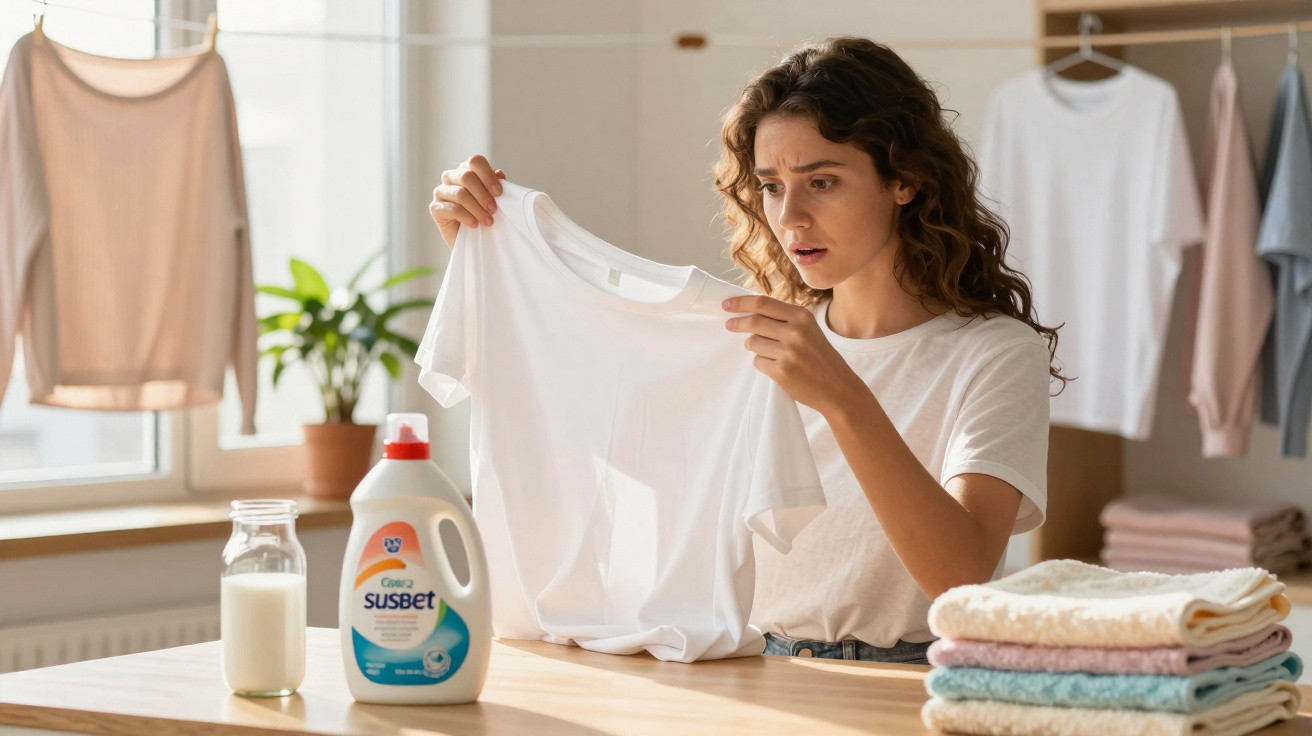
The T-shirts emerged from the washing machine looking flawless: bright colours, no marks and a smell worthy of a television advert. You picked one up to fold it and then… crunch. The material was stiff, almost like cardboard, as though it had aged by ten years during a 40°C wash. You bend the sleeve between your fingers, mildly irritated, and wonder whether the washing machine is failing or the water has somehow become chalk dust.
Perhaps you switched detergents. Perhaps you put the blame on hard water. You may even have thought about replacing the machine.
Yet the likely culprit is much more everyday - and it is sitting in plain sight.
The overlooked product that makes soft laundry feel like cardboard
Here is the simple answer: that unexplained stiffness is often caused by fabric softener, the product we add almost automatically. The same liquid that claims to make towels fluffy and T-shirts cloud-soft can eventually create precisely the opposite effect.
Fabric softener does not simply disappear during the rinse. It leaves a fine, wax-like coating over the fibres, intended to smooth them. As this coating accumulates, fabric can become heavier, less breathable and surprisingly rigid. Your clothes may look freshly washed, yet feel oddly worn-out to the touch.
Imagine a busy parent running three loads of washing back-to-back on a Sunday. With every cycle, they add a generous splash of softener, “just to be safe”. The towels leave the machine scented like a meadow of artificial flowers, but when the children use them after bathing, they no longer absorb water properly.
When dry, the towels are crunchy and can almost squeak as they are folded. A few weeks later, the parent notices that the rinse cycle no longer seems to rinse thoroughly. The drum has a faint unpleasant smell, rather like old perfume. They assume the washing machine requires a deep clean. In fact, fabric softener has gradually taken over the laundry and the machine.
The reasoning is straightforward. Many fabric softeners are oil-based or use cationic surfactants, which adhere to textile fibres. You will barely notice the effect after the first use. By the tenth, the coating is more substantial. By the thirtieth, your clothes may begin to lose their natural suppleness.
This build-up can hold on to detergent residue, dust and even hard-water minerals. Once dry, that combination creates the stiff, “crispy” feel found in T-shirts, towels and bed sheets. It may also clog the microfibres in sportswear and cleaning cloths, explaining why a once “magic” cloth starts smearing instead of cleaning. The softener has not gone away; it has remained and built up layer by layer.
How to restore stiff laundry without replacing it
Fortunately, stiffness caused by softener is not permanent: it is build-up that can be removed. Begin with a reset wash. Put the stiff clothing and towels through a cycle with no fabric softener and half your normal amount of detergent. Pour one cup of white vinegar into the softener compartment. Vinegar can help break down residue and rinse the fibres more cleanly.
There is no need to worry about the odour, as it disappears while the laundry dries. Once the cycle has finished, rub a towel between your fingers; it may already feel lighter. If the stiffness is longstanding, repeat this process once or twice during later washes to slowly remove the film and allow the fabric to breathe again.
The next step is the real change in routine. Leave out fabric softener altogether for several loads. Choose a mild detergent and use a slightly lower spin speed, so the fibres are not spun excessively. Shake each item before hanging it up, or tumble-dry it briefly with wool dryer balls.
We have all had that moment of adding “a little more” of everything to the drawer in the hope of getting extra-clean washing. Honestly, hardly anyone measures every cap exactly as the label instructs. That is how the balance slips. Using too much fabric softener will not create clouds; it will only leave fabric coated and stiff, while making your washing machine begin to sulk.
“I thought my towels were worn out,” admits Laura, 37, who lives in a hard-water area. “I was ready to replace them all. I stopped using softener for a month and did a couple of vinegar rinses. Suddenly they were soft again, and my sports leggings stopped feeling like plastic.”
- Cut back on, or stop using, fabric softener: try half a dose, then use it every other wash, and see whether you miss it at all.
- Use white vinegar as an occasional rinse aid: add roughly one cup to the softener compartment for stubborn loads.
- Clean the washing machine drawer and rubber seals each month to stop residue accumulating again.
- Dry thoughtfully: use dryer balls, shake garments before hanging them and avoid overfilling the tumble dryer so air can circulate.
- Keep fabric softener for particular items only, such as some cotton bed sheets, rather than adding it to every load.
Rethinking “soft” laundry and the meaning of fresh
Once you spot the connection between fabric softener and stiffness, it becomes difficult to ignore. You might compare an old towel that has been “treated” for years with a newer one washed using less product. The newer towel may not have such an intense scent, but it dries you more effectively and feels livelier in your hands.
There is a subtle change when you realise that real freshness is not chemical fragrance, but fabric that moves freely beneath your fingers.
It may also alter the way you shop. You start looking more closely at labels that promise “extra softness” and “intense fragrance”. You begin to question what those claims mean for the fibres, your skin and the inside of the washing machine over time. You might opt for simpler routines or try traditional methods your grandparents used before major softener brands dominated television advertising.
You experiment, make adjustments and pay attention again to the sound and feel of your clothes. Less crunch, more movement. Less coating, more fabric.
The stiffer your laundry becomes, the more it is telling you about what has coated it. Once you recognise that message, you may start treating clothes less as disposable items and more as everyday companions that need room to breathe.
You may still decide to use a favourite fabric softener on selected items. Or you may switch to vinegar, dryer balls or no additive at all. Either way, a small choice at the detergent drawer affects how your clothes wear, how your towels perform and how your home smells when you take freshly washed laundry from the drum. That is where the experiment begins: with the next load.
| Key point | Detail | Value for the reader |
|---|---|---|
| Fabric softener causes stiffness | A waxy or oily coating builds up on fibres, leaving fabric rigid and less breathable. | Helps you identify the real reason for “cardboard” laundry rather than blaming the washing machine. |
| Reset and strip the fibres | Use softener-free washes, less detergent and white vinegar rinses to dissolve residue. | Provides a practical, inexpensive way to restore softness to clothes and towels you already own. |
| Change long-term habits | Use less fabric softener, clean the machine and rely on drying methods and simple routines. | Prevents later build-up, extends the life of garments and improves everyday comfort. |
FAQ:
Question 1: Can fabric softener really make towels less absorbent?
Yes. The coating left on the fibres can fill tiny spaces that would normally take in water, meaning towels may initially feel “soft” but become less absorbent over time.Question 2: Is white vinegar safe for my washing machine?
When used in moderate quantities - around one cup in the softener compartment - white vinegar is generally safe and may help dissolve residue, particularly during the rinse cycle.Question 3: Should I stop using fabric softener on all my clothes?
You do not need to stop entirely. Many people avoid it for towels, sportswear and microfibre, while using small amounts on cotton clothing or bed sheets if they enjoy the result.Question 4: Why do my clothes smell strong but still feel stiff?
A powerful fragrance usually indicates that a lot of product has remained on the material. That scented coating can include detergent and fabric softener residue that makes the fabric rigid.Question 5: How long does it take to reverse the stiffness?
One or two reset washes can sometimes be enough. With heavily coated items, several cycles using less product and occasional vinegar rinses may be needed to restore full softness.




Comments
No comments yet. Be the first to comment!
Leave a Comment