
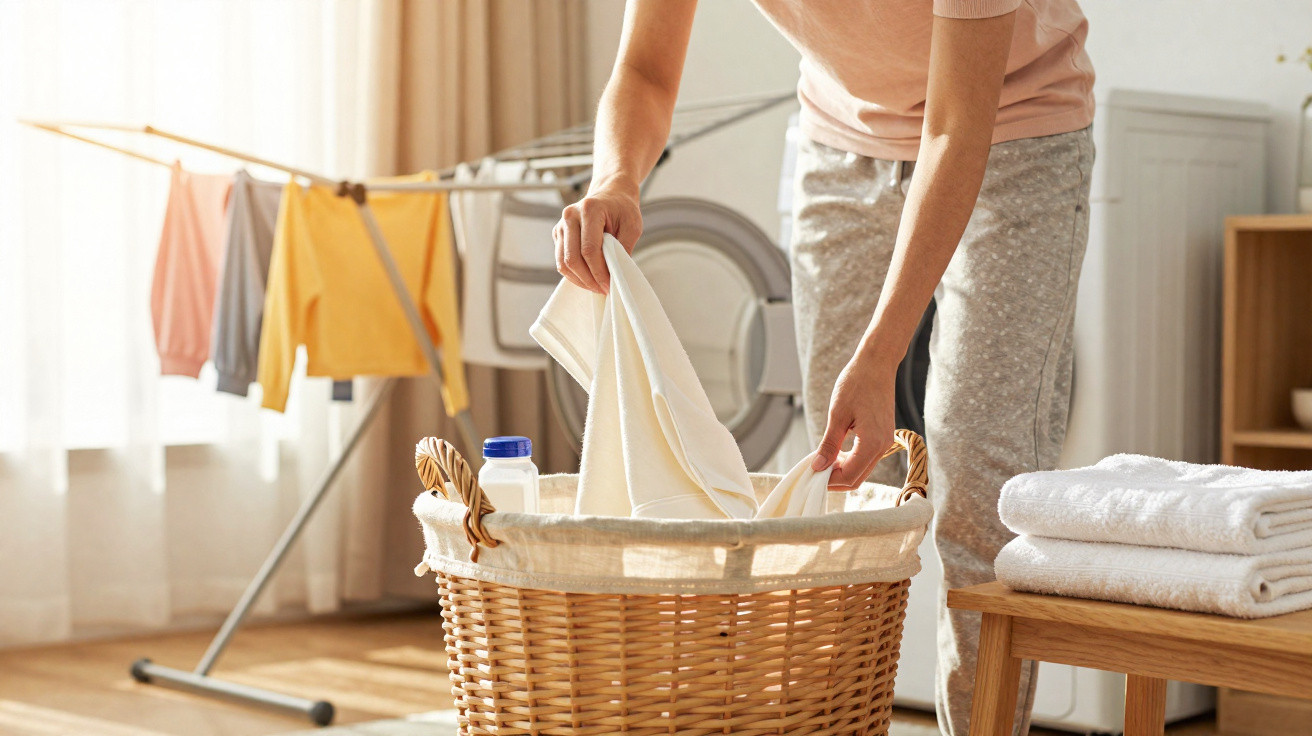
The smell seems to arrive every Sunday evening. You lift the laundry basket lid, ready to load the washing machine, and there it is: a warm, sour blast of changing-room odour that makes you tilt your head back and breathe through your mouth. T-shirts that were fine two days earlier suddenly smell as though they have had three separate lives. Towels used only once feel questionable. Even the clean socks beside them seem guilty by association.
So you light a candle, spray something floral and shut the lid a touch too forcefully, as though that could contain the problem. The following week, though, it happens again: the same basket, the same smell and the same minor sense of defeat.
The frustrating truth is that one small habit largely determines whether that laundry basket smells at all.
Why laundry baskets start to smell
Most laundry baskets are not unpleasant at first. Gradually, and without anyone noticing, they become small indoor compost bins. It might begin with a damp towel placed on top “for a minute”, followed by a gym top that has not quite dried, then a dishcloth that should really have gone directly into the wash.
Those damp fibres are compressed together in a dark spot with hardly any airflow. That is when bacteria begin their night shift - and they are very happy there.
Anyone living with teenagers or exercising regularly will know that the basket can seem to develop a personality of its own. One reader told me she can now “smell” her son’s football training timetable simply by passing his bedroom door. Another said that her partner’s work uniforms, left in a closed hamper for a week, made the entire hallway feel like “a low-budget locker room.”
Home décor magazines may not mention it, but this is ordinary domestic life. The odour may be subtle, yet it affects how a home feels.
Behind the closed lid, sweat and skin bacteria become trapped in the fabric. If clothes remain damp and tightly packed, the bacteria multiply and give off volatile compounds - the same family of odours associated with gyms and old shoes. With a full basket, air cannot move around the contents, so nothing can dry properly.
Once this pattern is established, newly added clothes can absorb the smell too. In effect, everything is marinating together in a warm, mildly humid microclimate. The basket can start retaining the odour itself, particularly when it is plastic or has a synthetic-fabric lining.
The one habit that stops laundry basket smell
The straightforward, slightly dull and genuinely transformative rule is this: do not put genuinely damp or sweaty items into the laundry basket. Not for “a few hours”, and not “until tomorrow morning”.
Instead, wash them immediately or hang them somewhere until dry before they ever reach the hamper. That is the entire rule.
The moment you stop adding moisture to the basket is the moment it stops creating its own smell.
It sounds obvious in theory, but daily life rarely works that neatly. You return from a run, take off your top and the nearest place to throw it is the laundry basket. Someone showers and drops in a towel “just this once”. Late at night, a wet kitchen cloth lands on top of everything because you are exhausted and want to go to bed.
Honestly, no one manages this perfectly every day. Yet when a household quietly adopts the principle that damp items never stay in the basket, the difference can be clear within a week. The stink simply… does not come back.
The reasoning is simple: odour needs moisture to flourish. No dampness means no party for bacteria. By allowing towels and clothes to dry first - on a hook behind a door, over the shower rail or on a folding airer - you break the whole odour cycle.
The fabric may still be dirty, but it is no longer a warm buffet for microbes. The basket becomes somewhere to store dry, worn clothes rather than a slow cooker for smells. It is a small behavioural change that works as an invisible air freshener around the clock.
Making the dry-first habit automatic at home
Begin by making “dry first, then basket” as effortless as possible. Put hooks where people actually get undressed, rather than where you would like them to. A row of over-the-door hooks in the bedroom or bathroom can completely alter what happens to damp towels and gym tops.
Keep a basic drying rack permanently set up in a quiet corner with little foot traffic. Then the easiest option is no longer the hamper but the rack. When you arrive home sweaty, you are more likely to use whatever is directly in front of you.
One frequent misunderstanding is to see the basket as the main culprit. People buy elaborate bamboo hampers, linen-lined versions and even models with fragrance capsules. Then they put a wet swimming costume inside and wonder why the odour returns. The container can help, but its contents are what matter most.
Another issue is shutting the lid straight away. It may look tidy, but it traps humidity inside. If your basket has a lid, leave it slightly open or choose one with ventilation holes. The purpose is not to conceal the laundry; it is to allow just enough air around it.
“We stopped putting damp towels in the hamper and started hanging them on a cheap rack in the hallway,” a reader from Manchester told me. “It’s not Pinterest-perfect, but for the first time in years, our laundry basket smells like nothing. And ‘nothing’ is the dream.”
- Hang damp towels over doors, rails or a radiator before they go anywhere near the basket.
- Create a designated drying spot for gym kit close to the entrance or bedroom.
- Select a basket with holes or mesh to allow air to circulate.
- Give the hamper a quick wipe or wash every few weeks.
- If the basket has a history of odours, scatter a little bicarbonate of soda in the bottom.
Living with a laundry basket that does not smell
When this routine becomes part of life at home, a subtle change follows. The laundry corner no longer becomes the place you hate passing at the end of a long day. Carrying shopping into the house no longer comes with a blast of yesterday’s workout in the hallway.
When guests visit, you do not have that sudden worry about whether they will notice the basket smell when they use the bathroom. That low-level background stress simply… disappears.
There may still be piles of washing, stray socks and the one mystery T-shirt that nobody claims. This will not turn your home into a showroom. Everyone knows the moment when clothes cover every chair and the washing machine is already full.
What changes is that the smell stops taking control. The basket becomes neutral again: simply a container, rather than a warning sign.
This is the sort of practice that seldom appears on glossy household checklists, despite changing daily life more than a new detergent fragrance ever could. It needs no specialist products or epic cleaning weekends. It only requires an agreement with yourself - and, ideally, everyone you live with - that damp fibres need a separate stop before the hamper.
Once you experience a genuinely odourless laundry basket, you are unlikely to want to return to the old way.
| Key point | Detail | Value for the reader |
|---|---|---|
| Keep damp items out | Dry wet towels and sweaty clothes before placing them in the basket | Prevents odour at its source and keeps the hamper smelling neutral |
| Let air circulate | Choose ventilated baskets and avoid shutting lids immediately | Lowers humidity and slows bacterial growth |
| Support the habit | Add hooks, use a drying rack and clean the basket regularly | Keeps the routine simple, including on busy days |
FAQ:
- Question 1 My basket already smells terrible. Do I need to replace it?
- Answer 1 Not necessarily. Clean it with hot, soapy water - or put it through a washing-machine cycle if it is fabric - dry it fully, then leave it in fresh air for several hours. If odour has deeply penetrated old plastic, it may be worthwhile replacing it with a ventilated model.
- Question 2 What kind of laundry basket is best to avoid smells?
- Answer 2 Pick a basket with holes, mesh sides or a breathable fabric liner. Steer clear of completely enclosed plastic tubs without airflow. A basic open-weave hamper often performs better than costly sealed designs.
- Question 3 How long can clothes stay in the basket before they start to smell?
- Answer 3 When everything inside is dry, you will generally get several days without significant odour. Add something damp, however, and smells may develop within 24–48 hours, particularly in warm rooms.
- Question 4 Does using scented beads or fabric spray solve the basket smell?
- Answer 4 They may cover the odour temporarily, but they do not address its cause. If damp fabrics are still being added, the smell will return beneath the perfume. Drying items first does the hard work; fragrance is only an extra.
- Question 5 What if I don’t have space for a drying rack?
- Answer 5 Try over-the-door hooks, the shower rail, chair backs or a folding rack brought out only when required. Even one or two well-placed hooks near the bathroom can keep the worst offenders out of the basket.

Comments
No comments yet. Be the first to comment!
Leave a Comment