

You get home from work, put down your bag, and before your shoes are even off, the familiar inner voice begins. The breakfast dishes. The shoes in the hallway. The crumbs beneath the table that only become visible when the sun catches them at that odd 6:37 p.m. angle. You are worn out, yet you are already reaching for the sponge, vacuum cleaner or laundry basket. Not because you want to, but because it feels like something you ought to do.
Meanwhile, your evening to yourself dwindles to almost nothing.
You stand in the kitchen scrolling on your phone, half-following a series while polishing an already spotless worktop. Quietly, you start to wonder who this is all really for.
The question lingers in the room like dust floating through a shaft of sunlight.
When “a quick tidy” quietly consumes your whole life
Daily cleaning rarely starts as an explicit rule. Instead, it gradually takes hold. Perhaps it is a remark from your mother-in-law, a TikTok featuring a woman with a beige sofa and labels on every shelf, or a reel about “non-negotiable daily resets”. Bit by bit, the idea sinks in: if your home is not immaculate every day, you are somehow failing at being an adult.
So, each evening, you pursue dust that will simply return tomorrow.
The bed has to be flawlessly made, the kitchen must gleam and the bathroom mirror needs every splash removed. More strangely still, the tidier your home becomes, the greater the pressure to preserve it that way.
Picture a completely typical Tuesday. You wake up running late, but still find ten minutes to “reset” the living room because you have read that visual clutter creates mental clutter. You arrive home exhausted, and rather than sitting down, you sort through post, clear away toys and put on a wash “just so it doesn’t pile up”.
By the time you finally settle on the sofa, it is 9:45 p.m. You scroll with your eyes half-shut, telling yourself that there was no time today to read, phone a friend or return to the hobby you keep promising yourself you will restart. The harsh reality is that the time was there. It was simply offered up to the cause of a crumb-free floor.
This obsession with daily cleaning is powered by one thing: social pressure. It is the myth of the “good” adult, the “good” parent and the “organized” person who never allows anything to slip. An immaculate house becomes a performance: an unspoken CV displayed to visitors, neighbours and, sometimes, strangers online.
Most people who enter your home, however, will not remember whether you vacuumed yesterday or three days earlier. They will remember whether you seemed stressed, detached or too busy rushing about to sit with them.
Let us be honest: nobody truly keeps this up every single day.
Instead, we pretend, compare ourselves with others and privately feel guilty when our actual lives fail to match an invisible and unattainable standard.
What changes when you stop chasing crumbs every day
The first move is radically simple: decide what genuinely needs doing each day. Not what Instagram tells you. What suits you, your life and your energy.
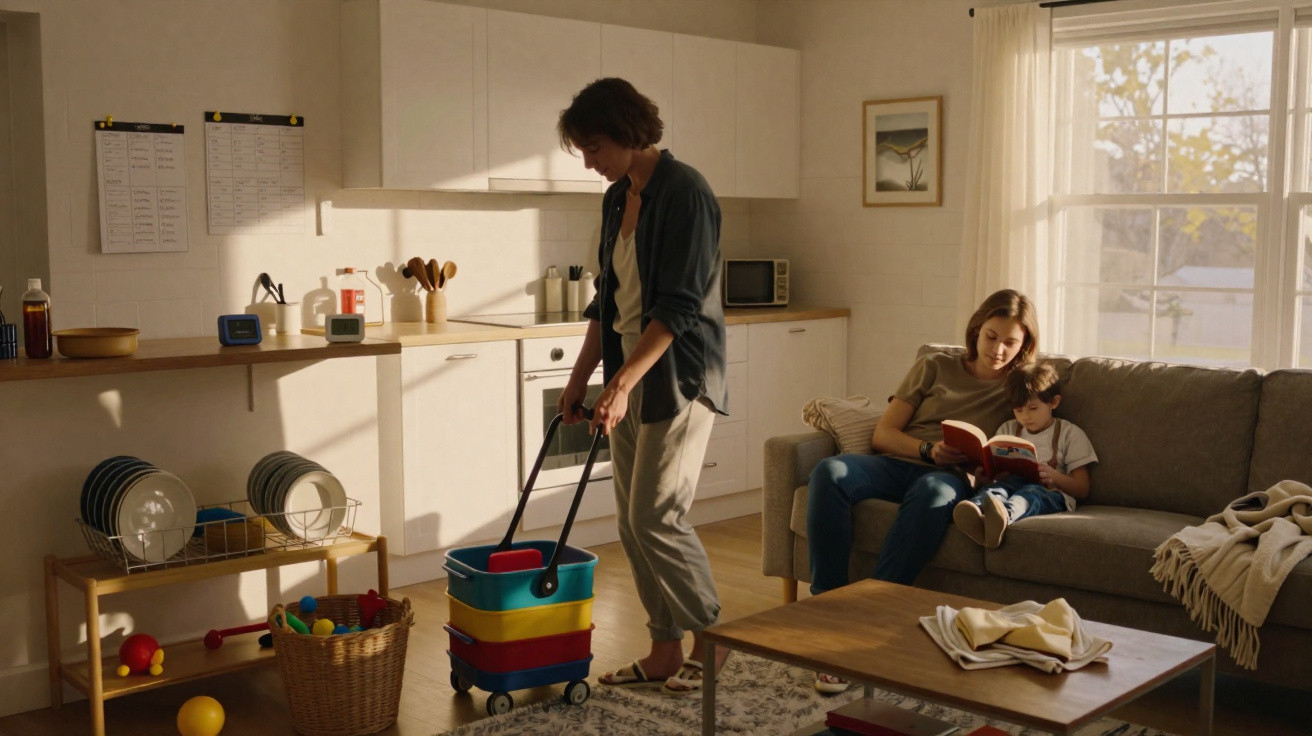
You may settle on three jobs: the dishes, the rubbish and a quick clear of the main table. Nothing more. Everything else can move to a weekly or twice-weekly routine.
Once that boundary is in place, evenings begin to feel different. You rinse the plates, switch on the dishwasher, then stop. The vacuuming can wait. The bathroom can wait. The endless heap of “things that need putting back” can wait as well.
You are not a hotel. You are a person living in a home, not styling a showroom.
Many of us get caught in the “since I’m at it” loop. You pick up a single sock from the floor and, before you know it, you are reorganising the entire wardrobe at 10 p.m. On a Thursday. In silence. While resentment quietly builds in your chest.
That resentment comes at a price. It erodes time with your partner, time alone, sleep and creativity. You may begin snapping at children for leaving Lego around, not because of the Lego itself, but because you feel stuck in an endless, unpaid second job.
Guilt is no help, either. It tells you that, if you were genuinely organised, you would clean a little every day “without even noticing”. That is not laziness. It is a system that keeps you endlessly running in circles.
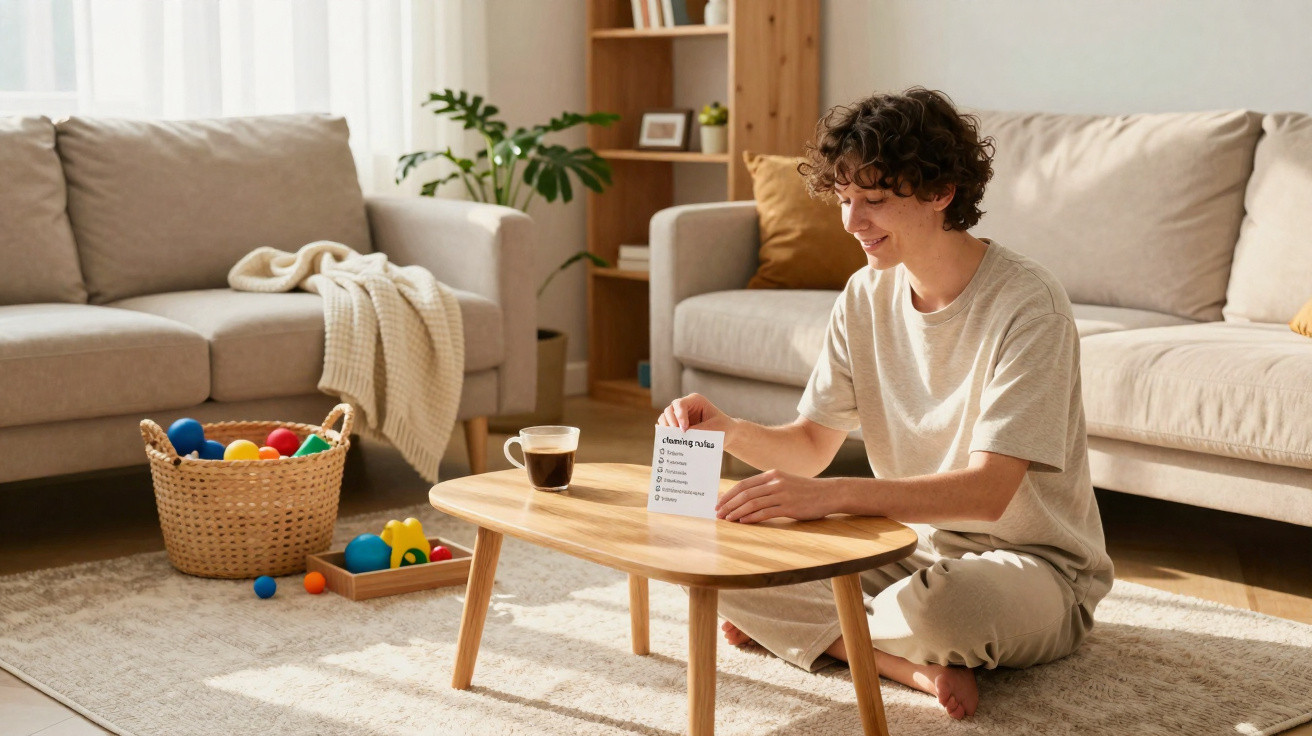
The real mental adjustment is accepting that a home which is lived in will look… lived in. A mug left on the coffee table. A basket of clean but unfolded washing. Some dust on the television stand that nobody will inspect through a magnifying glass.
We have all had that moment when someone unexpectedly rings the doorbell and we spend four frantic minutes shoving things into the nearest drawer. Yet when you visit a friend, you do not judge their unfolded washing. If anything, it feels oddly reassuring.
“Your home doesn’t need to be impressive. It needs to be kind to the people who live in it.”
- Set your true priorities - Sleep, health, connection, hobbies, children’s homework and rest.
- Cap daily cleaning tasks - Allow 10–20 minutes at most, set a timer and stop when it ends.
- Plan weekly “heavier” tasks - Use one block of time instead of scattering tiny jobs across every day.
- Let go of shame narratives - A little mess is not a moral failing.
- Keep one “no cleaning” evening - Make it non-negotiable time for yourself or the people you love.
Let your home support your life, rather than daily cleaning controlling it
Eventually, the question changes from “How can I clean more quickly?” to “What am I giving up for this illusion of control?” You only get one Wednesday evening each week, one leisurely Sunday afternoon and the occasional quiet morning. If every spare moment is absorbed by wiping, sorting and folding, what remains of you beyond maintenance work?
It can be uncomfortable to acknowledge how much of this concerns appearance. Not wanting to be the person with the “messy place”. Childhood voices that taught you a clean home proves discipline, respect or even worth.
Yet your most meaningful memories are unlikely to feature perfectly polished floors. They are conversations around slightly crumb-covered tables, film nights with unfolded blankets and pancakes made in a kitchen still carrying the chaos of the day before.
Perhaps the true act of rebellion, then, is not purchasing a new robot vacuum. It is deliberately lowering the standard. Saying: my home will be reasonably clean, not obsessively managed. Some of my time will go towards upkeep, but it will not all be surrendered to it.
That change will not create satisfying before-and-after TikToks. There is no dramatic reveal, soundtrack or product placement. There is simply you on the sofa at 8 p.m., rather than 10:30, reading, speaking to someone you love or staring at the ceiling and doing absolutely nothing.
And, oddly enough, on those evenings the little dust bunnies in the hallway no longer look like failures. They become proof that your life is slightly bigger than your vacuuming schedule.
| Key point | Detail | Value for the reader |
|---|---|---|
| Question daily cleaning | See it as social pressure rather than a natural necessity | Less guilt and a more realistic standard |
| Limit “non-negotiables” | Retain only a small number of daily jobs and move the rest to weekly tasks | More free evenings and mental space |
| Accept a lived-in look | Move away from performance towards comfort and connection | Less stress and more time for what truly matters |
FAQ:
Do I really harm anyone by cleaning every day?
Not directly, but you could be harming yourself by losing time, rest and peace of mind. When daily cleaning feels burdensome or compulsory, the “harm” lies in that invisible pressure.Is a slightly messy home bad for kids?
No solid evidence suggests that children need a spotless setting. They need safety, basic hygiene and emotionally available adults. Pursuing perfection can actually make parents less present.What if I genuinely enjoy cleaning?
In that case, it is not a problem. The important distinction is choice. If you sometimes want to leave it but feel unable to, it has become social pressure rather than pleasure.How often should I really clean?
There is no universal rule. Many people manage well with a light daily reset (10–15 minutes) and a deeper clean once a week, or even once every ten days. Your energy and lifestyle are better guides than online routines.How do I handle visitors if my place isn’t perfect?
You can be open and relaxed: “We live here, so you’ll see real life.” Most guests are more at ease in a home that feels human rather than staged. Their comfort depends on your attitude, not your skirting boards.


Comments
No comments yet. Be the first to comment!
Leave a Comment