
You tend to spot the marks only when you eventually sit down. There is a faint ring where somebody once set down a glass of water, or a coffee shadow beside the armrest. Seen closely, your fabric sofa can suddenly appear worn, uneven and slightly neglected. You reach for a bowl of soapy water and dab at it with confidence; ten minutes later, the stain may be fainter, but a large watermark halo now catches the light whenever you pass. The harder you scrub, the worse it appears.
At that point, it is easy to wonder whether the issue is not the stain, but how you are trying to remove it.
Why fabric sofas develop unsightly water marks
Most people tackle a sofa stain as though it were on a T-shirt: a little washing-up liquid, warm water, a sponge and plenty of determination. That may sometimes work on clothing. On a fabric sofa, however, it is an ideal way to create pale, crisp-edged rings that never fully disappear. The material dries inconsistently, its fibres become stiff, and every small splash leaves a noticeable trace.
This can be especially unforgiving on pale-coloured sofas. The stain may lift, but the outline of the cleaned section remains like a ghostly circle. You then clean again to “blend it in”, extending the damp area further and further. Before long, the original mark has vanished, while the entire seat is a different shade.
There is another, less visible problem: the filling beneath the upholstery. If you saturate the fabric with water, the foam or wadding absorbs it like a sponge. It will not dry at the same rate as the surface, and that lag produces darker or paler patches that can look permanent. Cleaning products can also travel with the moisture and dry unevenly, creating subtle “map shapes” across the sofa.
Most of us have experienced that moment of stepping back and discovering that a quick tidy-up has become a visual mess. Once daylight reveals those halos, they are impossible to ignore. Even in an otherwise immaculate room, they can make everything feel less fresh.
Textile specialists offer a straightforward explanation: fabric sofas are made for everyday use, not for being drenched. Unlike removable covers that can go into a washing machine, upholstery fabric is pulled tightly over and attached to the padding. When water touches it, it does not simply evaporate evenly. It moves through the material, spreads dust and detergent, then dries in a pattern that is immediately noticeable.
For this reason, professional cleaners use controlled moisture rather than buckets of water. They rely on fine sprays, absorbent towels and targeted products, working more like make-up artists than household cleaners. Looking at your sofa in this way changes the whole approach.
How to clean a fabric sofa without leaving halos
The essential rule is simple: use “minimal water, maximum blotting”. Before applying any liquid, vacuum slowly and thoroughly. Fit the upholstery attachment, then work along the seams, beneath the cushions and over the full surface. A surprising amount of what appears to be staining is actually dust lodged in the texture of the fibres.
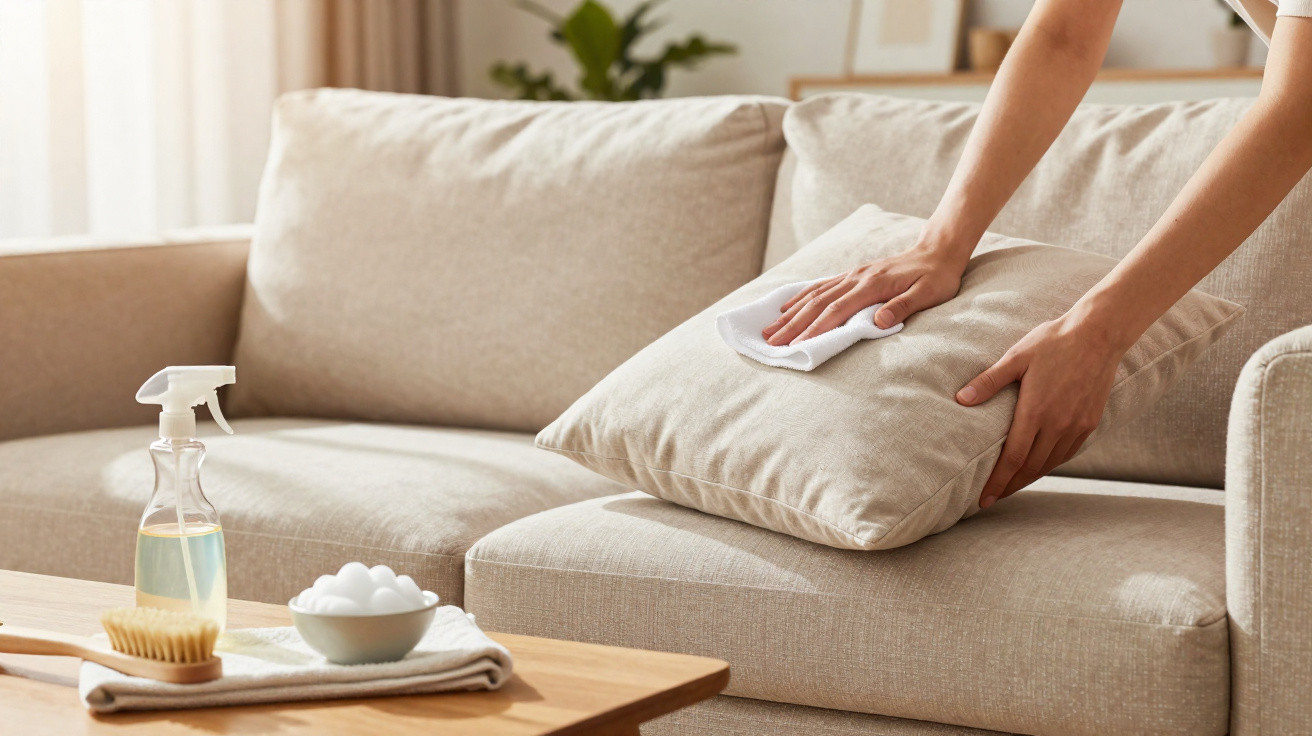
Then check the cleaning code on the sofa label: W, S, W/S or X. For most water-safe materials, marked W or W/S, combine lukewarm water with one small drop of mild washing-up liquid or a dedicated upholstery cleaner. You want gentle bubbles, not a foam party. Dip a clean microfibre cloth into the mixture, wring it out until it is nearly dry, and dab the stain from the outer edge towards the centre using light pressure.
This is the stage at which many people make a mistake. They rub backwards and forwards as if scouring a pan. That roughens the fabric and pushes the stain deeper into the fibres. Instead, tap and lift rather than scrub and smear. After every set of dabs, use a second, dry microfibre cloth straight away to take up as much moisture as you can. Treat it as a relay: one cloth applies, while the other absorbs.
Realistically, hardly anyone does this perfectly every day. Sofa marks are usually tackled in a hurry, just before visitors arrive or after the stain has already set. That is exactly why limiting water matters so much. The less liquid you use, the less likely you are to create a hard, visible boundary when the area dries.
“The secret isn’t in the magic product, it’s in how fast you remove moisture from the fabric,” explains a professional upholstery cleaner. “People are shocked when they see we barely wet the sofa and still get rid of most stains.”
To follow this professional logic at home, keep a small kit ready so there is no need for panic cleaning. Store the following in a box near the living room:
- A vacuum cleaner with an upholstery nozzle
- Two or three clean microfibre cloths
- A mild, fabric-safe cleaner or gentle washing-up liquid
- A spray bottle that produces a fine water mist
- Bicarbonate of soda for odours, plus a soft brush
This small collection can make all the difference when a glass is knocked over on a Sunday evening.
Drying, refreshing and protecting your sofa after cleaning
How the sofa dries is every bit as important as the cleaning process. Once you have finished dabbing and blotting, do not sit on the damp section, even if it feels almost dry. Open the windows to encourage air circulation and, if you have a fan, aim it gently at the sofa from a distance. Airflow allows moisture to evaporate more evenly.
If the upholstery still looks slightly marked after it has dried, a gentle brush may be all that is required. Use a soft clothes brush, or even a clean, dry flannel, to comb the fibres in one direction. This simple step evens out the texture and subtle sheen, and many pale halos vanish because light no longer strikes the fibres unevenly.
For larger areas, avoid treating one small circle in the centre of a cushion. Instead, lightly mist and clean a somewhat wider section, so that the drying line follows a seam or the cushion’s natural edge. Your eye is less likely to notice a change at a border than in the middle. It may seem counterintuitive to enlarge the area in order to hide the stain, but visually it is effective.
Dry-cleaning methods are also often underestimated. On water-sensitive upholstery carrying an S code, a solvent-based cleaner or professional foam, used sparingly and blotted away, can rescue a sofa that does not tolerate tap water. When in doubt, a tiny test on the back of a cushion can save you a very big regret.
Sofas have demanding lives: children, pets, remote controls and dinners eaten in front of a series you said you would not binge-watch. Over time, it is not usually the occasional spill that changes their appearance, but the combination of dust, oils, crumbs and rushed cleaning.
You may find that the best-looking sofas are not necessarily those that never get dirty. They are the ones cleaned calmly, using the right techniques, before minor mishaps become disasters. The quiet routine of vacuuming weekly, blotting spills as soon as they occur and allowing the fabric to dry undisturbed does more for your living room than any new cushion cover.
There is something surprisingly satisfying about bringing a dull, stained sofa back to life with a few cloths, some patience and less water than you would use to rinse a mug. It is not glamorous, but the difference is immediate: the room seems brighter, the fabric feels softer and the colours look truer. Suddenly, that old sofa no longer looks tired.
| Key point | Detail | Value for the reader |
|---|---|---|
| Control water, don’t flood | Use slightly damp cloths, blot with a dry one right after | Reduces halos and prevents damage to padding |
| Prep before cleaning | Vacuum slowly and test a hidden area first | Makes stains easier to remove and avoids bad surprises |
| Think about drying | Promote airflow, avoid sitting on damp zones, brush fibers | Gives a more even finish and keeps the sofa looking new longer |
FAQ:
- How do I clean a fresh water stain before it leaves a ring? Blot it at once with a dry microfibre cloth, pressing rather than rubbing. If a mark begins to form, dab lightly with an almost dry damp cloth, blot again with a dry cloth and allow it to air-dry.
- Can I use a steam cleaner on my fabric sofa? Only when the label permits it, using a low-moisture, gentle setting. Always test an inconspicuous area first, and keep the steam head moving so that one spot is not saturated.
- What about baking soda for stains and odors? Bicarbonate of soda works well to neutralise odours. Scatter it over dry fabric, leave it for several hours, then vacuum it up. By itself, it is less effective on stains and should be used alongside careful spot cleaning.
- Why does my sofa look worse after drying? The fabric or padding was probably too wet, or detergent residue was left behind. Lightly re-cleaning the whole cushion with minimal moisture, followed by even drying and brushing, can often blend the marks.
- When should I call a professional? Contact a professional if the fabric is delicate, such as velvet or linen blends, carries an “S” code, the sofa is very expensive, or the stain is old and extensive. Professional cleaning once every few years can extend the life and appearance of a good sofa by a decade.


Comments
No comments yet. Be the first to comment!
Leave a Comment