
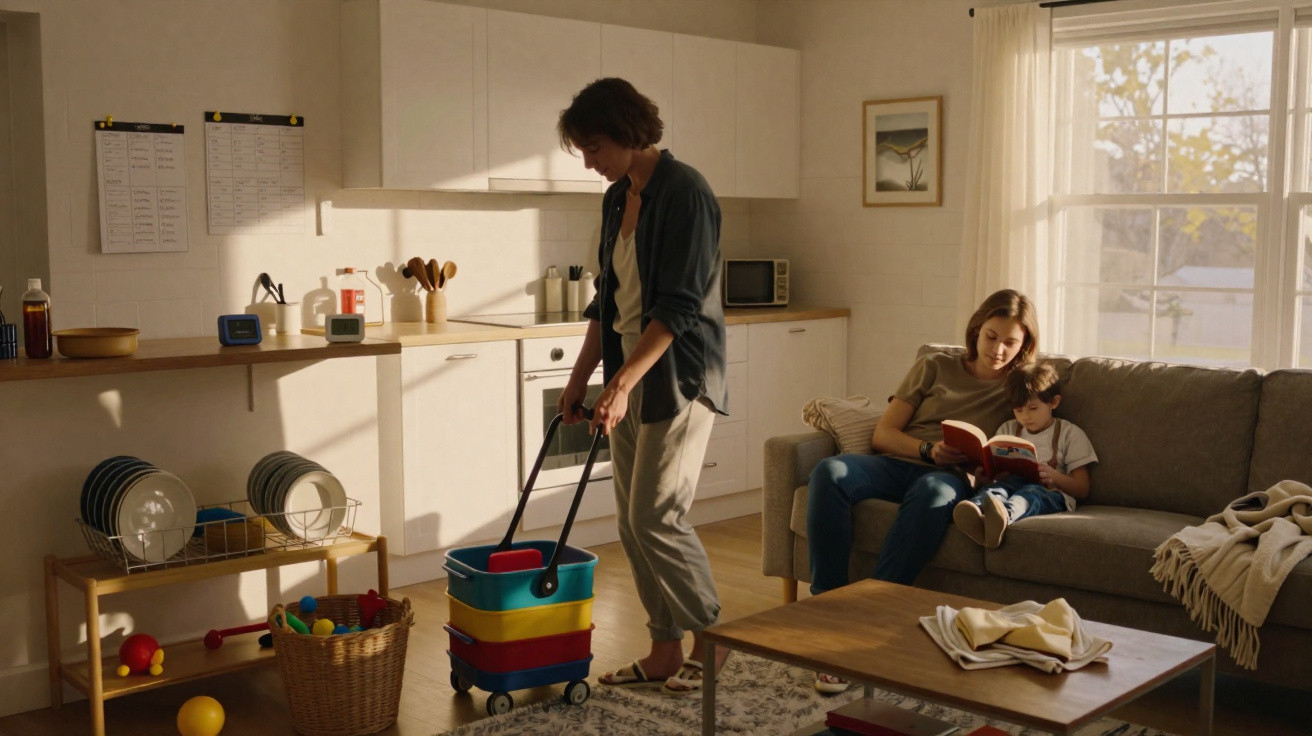
The evening I realised my cleaning routine had become excessive, I was kneeling behind the toilet, rubbing at a mark no one would ever notice. My dinner was going cold on the table. My phone was buzzing constantly. I was sweating over a dust bunny that had likely been sitting there contentedly for months without any help from me.
When I got up and looked around, I spotted the oddity: the flat was already clean. It was not pristine enough for a magazine spread, but it was… ordinarily clean. Still, a voice in my head said: “You didn’t do the skirting boards today.”
That evening, I left the skirting boards alone. Nothing terrible happened. It felt like a genuine revelation.
When “daily clean” quietly becomes a full-time job
There is a barely noticeable point at which wiping down a worktop stops being a quick action and turns into mental pressure. It is not always obvious when it happens. One morning, you are doing a small tidy-up after breakfast; before long, you are scrubbing tiles at 10 p.m. because they are “on the list”.
Partly, this is driven by the avalanche of immaculate homes online. There are sparkling sinks, towels folded into precise thirds, and people claiming that they mop “every single day”. You compare that with the real-life disorder around you and decide that you are falling behind.
So the number of daily jobs grows. Then it grows again. Eventually, your mind is never truly off duty when you are at home.
My friend Clara had a handwritten “daily cleaning” checklist stuck to her fridge. It began modestly: washing up, worktops and a quick sweep. Over time, she added jobs from cleaning reels: wiping doors, vacuuming the sofa, sanitising remote controls and cleaning inside the microwave.
One evening, she rang me, laughing and exhausted in equal measure. “I just spent 18 minutes cleaning the crumbs in the cutlery drawer before bed,” she said. “I’ve turned into a part-time maid in my own home.”
She was devoting nearly 90 minutes each day to supposedly “daily” cleaning. The weekends were set aside for “deep cleaning”. By Sunday evening, she was more exhausted than refreshed.
There is a reason this burden feels so weighty. Our minds are not made to hold endless open loops. Every tiny job marked as “daily” lingers like a notification bubble at the back of the mind. You may ignore it, but it remains there.
Multiply that feeling by 10 or 15 jobs and the home becomes a never-ending to-do list. Some tasks genuinely require frequent care: dishes, rubbish and kitchen hygiene. Yet many others can comfortably follow a weekly, or even monthly, routine without your life falling apart.
Honestly, nobody truly does all of this every single day. And if someone says that they do, another part of their life is likely paying the price.
The shift: from daily guilt to smart rotations
My own turning point came when I did something that felt almost radical: I made a “non-daily” list. I wrote down everything I believed I ought to do every day, then asked myself, “What’s the worst that happens if this waits?”
The toilet? Every two or three days. Floors? Deal with marks daily when necessary, then vacuum properly twice a week. Mirrors, doors and skirting boards? Weekly, or even once every fortnight. Spoiler: the bathroom did not turn into a horror movie.
Instead, I began rotating jobs. I did one small “extra” each day rather than ten. Monday: the bathroom sink and mirror. Tuesday: change the bedding. Wednesday: dust one room. The flat remained equally liveable. I was the person who changed.
Many of us get caught by all-or-nothing thinking. If we do not complete every task every day, we feel that we have failed. As a result, we either do far too much or shut down completely, only to panic-clean once things become unmanageable.
A kinder approach is to choose a daily time allowance rather than write a daily task list. Set a timer for twenty minutes. Tackle what matters most that day: dishes, surfaces and a quick sweep. When those twenty minutes are over and the skirting boards are still dusty, they can wait for Skirting Board Thursday, or whatever ridiculous name you choose for it.
The result is a home that stays reliably “good enough”, instead of one that is “perfect” for one anxious hour and stressful for the remainder of the week.
An expert in home organisation once told me something that immediately made me feel freer.
“A home is meant to be lived in, not audited,” she said. “If you pass some imaginary inspection every night, you’ll fail at living there.”
The small but important mental change is asking: “Is this hygiene, or is this aesthetics?” Hygiene may need daily attention, such as food surfaces, the bathroom sink and rubbish. Appearance-related tasks can often happen less often without any meaningful consequences.
- Daily: dishes, kitchen worktops, obvious spills
- 2–3 times a week: bathroom wipe-down, quick floors
- Weekly: dusting, mirrors, changing bedding
- Every 2–4 weeks: skirting boards, windows, deep appliance cleaning
- Occasionally: the things nobody sees, such as behind the fridge
Living in a “good enough” home without feeling like you’ve given up
There is a subtle skill in seeing a small mess and consciously choosing not to deal with it right then. It is not laziness; it is a decision. That sock on the floor can wait for the next “reset moment”. Toothpaste on the mirror can go on tomorrow’s short list, rather than becoming tonight’s source of guilt.
A practical approach is to establish clear visual checkpoints: the kitchen island is mostly clear, the sofa is ready to sit on, and the bathroom sink would not be embarrassing if an unexpected guest arrived. If those things are in order, you are finished for the day. You are allowed to sit down.
You’re maintaining a living space, not curating a showroom.
A frequent error is trying to replicate routines designed for people whose lives are unlike yours. The influencer who wipes the glass shower screen after every use may also have no children, no pets and a partner who cooks no more than twice a week. A home with three children, dog hair and lots of meal preparation follows different rules.
There is no prize for completing more daily chores than required. However, there is a quiet kind of burnout that develops when every evening disappears into “just one more thing”. If wiping up crumbs makes you resentful, it suggests that the chore schedule is wrong, not that you are.
Move the blame away from yourself and on to the system. Then redesign that system to suit a real human life.
“Once I stopped pretending I could keep everything spotless every single day, I started actually enjoying the moments when I did clean,” a reader told me. “It stopped feeling like punishment and started feeling like care.”
One helpful technique is to group priorities, both mentally and visually:
- Health-critical: Fridge, food surfaces, bathroom hygiene, rubbish
- Daily comfort: dishes, a clear table, a sofa you can use
- Aesthetic extras: shiny taps, folded blankets, empty laundry basket
- Deep background: oven interior, window tracks, behind furniture
- Zero-urgency: that mysterious cupboard you open once a month
Once tasks are viewed in these layers, it is easier to give some of them breathing room instead of pursuing them every day.
A home that’s clean enough for life, not for judgment
The real change is not about mops or sponges; it is about permission. Permission to live in a home that reflects your actual pace, including busy weeks and lazy Sundays, rather than an algorithm’s version of “daily reset perfection”.
Once you stop obeying the idea that every corner needs attention each day, something notable happens. You notice other things: an additional half-hour of sleep, a conversation that is not cut short by “I should go clean the bathroom”, or a walk that you genuinely take. Dust stays quietly on a shelf for another day. Your life starts moving again.
We have all experienced that point when we realise we have been scrubbing to impress absolutely nobody. That is often when a cleaning routine becomes less about control and more about support. It is also when you finally see that some jobs deserve a place in everyday life, while others can perfectly well wait their turn.
| Key point | Detail | Value for the reader |
|---|---|---|
| Separate hygiene from aesthetics | Daily effort goes to dishes, food areas, bathroom basics; looks-focused tasks move to weekly | Less stress without sacrificing health or basic cleanliness |
| Use time budgets, not endless lists | Set 15–20 minutes for “daily reset” instead of 15 different tasks | Creates a clear stopping point and reduces guilt |
| Rotate non-daily chores | One small “extra” each day instead of trying to do everything | Home stays consistently “good enough” with less burnout |
FAQ:
- Question 1 How often should I really clean the bathroom if I’m not doing it daily?
- Answer 1 For most homes, a light wipe-down of sink and toilet every 2–3 days, with a deeper clean once a week, is plenty. Daily can be useful in large families, but not mandatory for everyone.
- Question 2 Is it “dirty” if I don’t vacuum every day?
- Answer 2 No. Many people vacuum twice a week and spot-clean visible mess in between. Pets, allergies, or toddlers might push that to more frequent, but daily is a choice, not a rule.
- Question 3 What are the few things that actually deserve daily attention?
- Answer 3 Dishes, kitchen counters, obvious spills, trash if it smells, and a quick visual reset of your main living area. Those are the tasks that impact hygiene and mental load the most.
- Question 4 How do I stop feeling guilty when I skip a chore?
- Answer 4 Decide in advance what’s truly daily and what isn’t. When you “skip” something that’s on a weekly rotation, you’re not failing; you’re following the plan.
- Question 5 Can a home still look presentable without constant cleaning?
- Answer 5 Yes. Focus on visible surfaces, entry points, and one or two “anchor zones” like the sofa and dining table. When those are calm, the whole place feels under control, even if the baseboards are patiently waiting their turn.




Comments
No comments yet. Be the first to comment!
Leave a Comment