
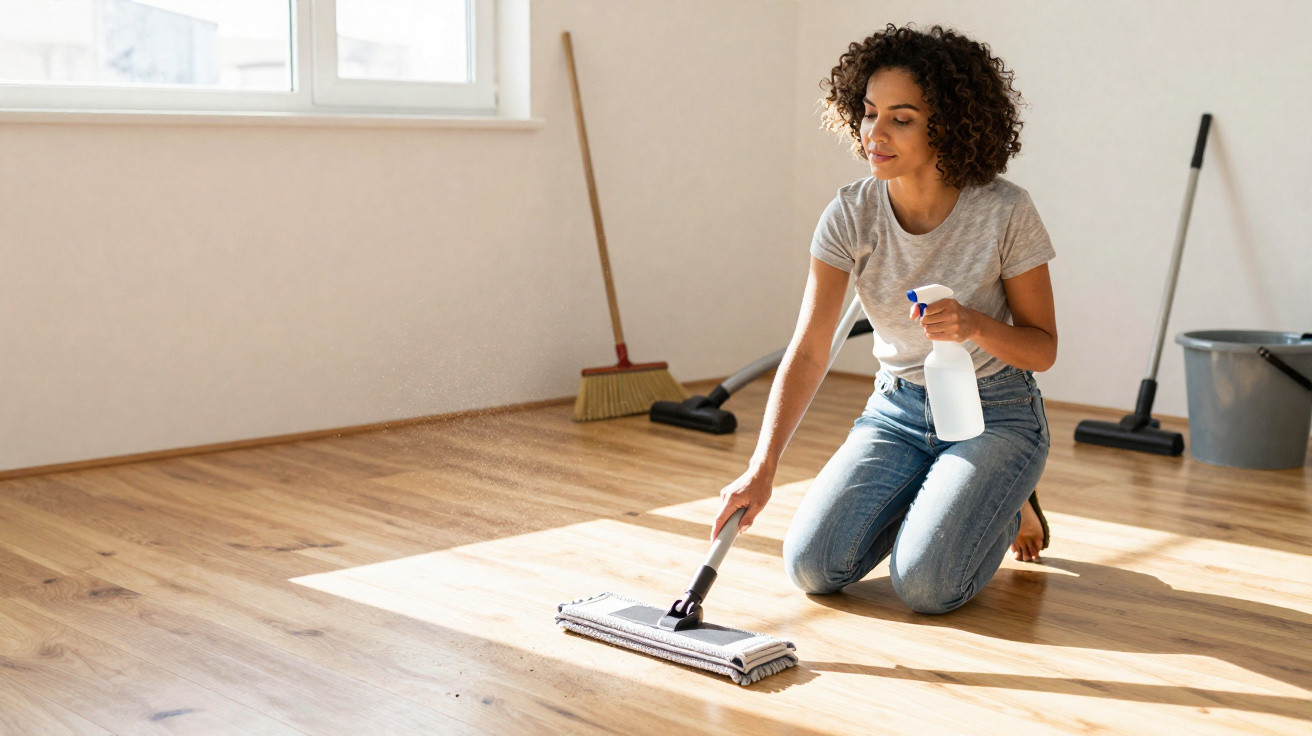
The moment I understood that my floors were not truly “dirty” but simply being cleaned badly, I was on my knees in the hallway, looking into a shaft of sunlight. It fell across the floorboards at exactly the right angle, revealing every tiny mote of dust drifting through the air as though it belonged there. I had mopped the previous day. I had vacuumed that morning. Yet a soft grey film was already returning along the skirting boards, beneath the sofa and behind the plant I routinely forget to water.
I blamed the city, the cat and the ageing wooden floors. Perhaps my vacuum was the problem. Perhaps I simply expected too much.
Then, during one visit, a professional cleaner watched me for precisely three minutes and delivered the sentence that changed how I cleaned.
“You’re moving dust around, not removing it.”
Why dust keeps coming back even when you clean all the time
Once you notice this pattern, it is impossible to ignore. You pull a dry broom or fluffy mop across the floor, feel oddly pleased as a little grey line gathers ahead of it, and assume you are making progress. By the following morning, though, your socks are dirty once more.
The reality is rather less rewarding. Any dust that is not captured gets thrown back into the air. It floats around for a while, the room seems to smell “fresh”, then it settles quietly in the very places where it started. It is the same dust in a new layer: a different day, but the same cycle.
A cleaning company owner explained this while I held my old string mop like an embarrassing secret. She told me that most homes she visits follow the same pattern: people put in effort, but not strategically. They vacuum in a rush, miss the corners, use one increasingly cloudy bucket of water across three rooms, then consider the job done.
Afterwards, they cannot understand why the hallway looks dull again by Thursday, why the children’s socks become grey or why the narrow strip beside the skirting board never looks properly clean, however often they “go over it quickly”.
We are not lazy; we are simply repeating the habits we watched growing up, even when they do not suit the dust or cleaning products in today’s homes.
Dust is deceptive. It includes more than the visible debris: skin cells, fabric fibres, cooking soot, pollen, pet dander and microscopic grime brought in on shoes all form part of it. If you sweep too quickly or mop with dirty water, you are effectively coating the floor with a thin soup made from all of these things.
The real problem is using unsuitable tools in the wrong sequence. Dry sweeping a glossy floor disperses static-charged dust. A vacuum with a blocked filter sends fine particles straight back out. Cleaner that is too diluted can leave behind a tacky residue that catches every speck passing over it.
For an hour, the floor may appear “clean”. Then the light changes, and the late-afternoon sun exposes what is really there.
The method that finally stopped the endless dust cycle
The cleaner’s first move in my living room was almost offensively straightforward: she slowed down. There would be no more frantic, whole-house mopping session completed in 12 minutes. Instead, she began by vacuuming properly, using the hard-floor setting and cleaning right to the edges and beneath furniture rather than merely circling around it.
She then did something I had never once considered: vacuuming the skirting boards and rug edges as well. “This is where the dust sits and waits,” she said. Only then did she use a flat microfibre mop, which was barely damp rather than soaking, working in straight lines from the far end of the room towards the door.
She also pointed out the error I had made for years: continuing to mop the entire flat with water that had turned grey after the first room. In effect, I was applying a thin muddy glaze to every floor. Realistically, nobody does this perfectly every day, but she replaced the water halfway through and again before the final room.
Her preferred order was equally clear: clear clutter first, vacuum thoroughly, mop with clean water and an appropriate product, then allow the floor to dry fully before anyone walks on it. The drying stage is important. Walk over a partly wet surface in slightly dusty socks and you have stamped that dirt straight back into the boards.
Her blunt observation felt both like a slap and a wake-up call.
“Floors don’t need harder work, they need smarter layers: remove loose dust, then trap micro-dust, then protect the surface.”
She reduced the process to a straightforward routine, almost like following a recipe:
- Choose a good vacuum with a clean filter and a hard-floor head rather than a dry broom.
- Use a slightly damp microfibre mop afterwards, not one that is dripping wet, and move it in straight lines.
- Replace the mop water regularly so that dirty water is not being redistributed.
- Clean skirting boards and beneath low furniture at least every second or third clean.
- Schedule a monthly “deep dust day” for corners, behind doors and under rugs.
Living with floors that actually stay clean for more than one day
During the first week of following this new routine, the difference felt almost unnerving. The familiar “dust ridge” beneath the TV unit simply did not appear. The kitchen floor remained brighter for longer, especially around the cooker, where it had previously started to turn grey by the middle of the week. When that same hallway sunbeam appeared, I could see perhaps two or three floating particles rather than an entire galaxy.
The biggest change was not the products themselves. It was the order of the steps, the slower pace and the choice to clean in order to remove dirt rather than disguise it.
We all know the feeling of looking around the house and thinking, “How is it messy again? I just cleaned.” Discovering that my floor-cleaning routine was feeding that loop was unexpectedly liberating. Rather than angrily scrubbing every Sunday, I began doing small, focused tasks: carefully vacuuming high-traffic routes, quickly damp-mopping the space in front of the sofa, or running over the hallway skirting boards while the kettle boiled.
Clean floors no longer feel like a performance; they become a quiet source of comfort in the background.
Your version may look different. You may have more rugs, a baby who crawls or a dog that sheds. Perhaps most of your dust gathers beside one large window, or just inside the entrance where outdoor dirt meets everyday indoor life.
The foundation is unchanged: remove the loose layer first, capture the fine layer next and do not spread around what you have just picked up. Everything else is about rhythm rather than perfection.
You do not need to become someone who mops every day. You only need to stop battling your floors with the wrong approach.
| Key point | Detail | Value for the reader |
|---|---|---|
| Begin by removing dirt, not adding shine | Vacuum thoroughly - including edges, skirting boards and beneath furniture - before the mop touches the floor | Keeps less dust circulating in the air and floors stay clean for longer |
| Use suitable tools in the proper sequence | Hard-floor vacuum + damp microfibre mop + clean water and an appropriate cleaner | Limits dull film, sticky residue and rapid dust build-up |
| Follow a realistic routine | Maintain high-traffic areas quickly, with a monthly deep “dust day” for corners and concealed areas | Saves time and energy while making the home look and feel more hygienically clean |
FAQ:
- Why do my floors look dusty again the day after I clean? Usually, the dust has not been completely removed; it has only been shifted elsewhere. Dry sweeping, dirty mop water and vacuums with clogged filters all send fine particles into the air, where they can settle again within a few hours.
- Is vacuuming better than sweeping for dust? Yes, particularly for hard floors. A quality vacuum with a hard-floor head and clean filter captures dust rather than scattering it. Sweeping can help with larger debris, but it often sends fine dust airborne.
- How often should I actually mop my floors? In most homes, mopping high-traffic spaces once a week is sufficient, alongside spot-mopping spills. Bedrooms and other low-traffic rooms can often be mopped every two weeks without becoming grimy.
- What kind of mop is best to reduce dust build-up? A flat microfibre mop used slightly damp is generally the most effective option. It captures fine dust instead of pushing it about. Traditional string mops often leave too much water and may smear dirt into joints and grout.
- Why does my floor feel sticky or dull after mopping? This is usually caused by using too much product, using dirty water or failing to rinse the mop properly. Over time, this creates a film that attracts dust and leaves floors looking cloudy rather than clean.




Comments
No comments yet. Be the first to comment!
Leave a Comment