
The doorbell goes, and your heart sinks. You scan the living room: partly folded washing on the chair, shoes lined up by the entrance, and children’s artwork slipping from the coffee table. It is hardly a catastrophe, but it certainly does not resemble the Pinterest images you scroll through at midnight. You make a frantic 30-second pass, piling things onto the closest available surface and hoping your visitor will not spot them.
Yet, rather oddly, once they come inside, your home looks less “messy” than simply… lived in. Some homes manage this effect all the time. They are not immaculate show homes, but they still seem peaceful and well arranged, even on a Tuesday evening after work.
The distinction often rests on one straightforward cleaning habit that subtly transforms everything.
The habit that changes how your home looks in 5 minutes
Homes that consistently appear organised are not always cleaner than yours. Their owners simply do one thing another way: they reset surfaces. They do it repeatedly throughout the day, almost without thinking. It is not a thorough clean or an afternoon spent scrubbing skirting boards. It is a brief routine of returning flat areas to an “empty” state whenever daily life permits.
Kitchen worktops, coffee tables, hall consoles, bedside tables and bathroom basins are a home’s visual focal points. When they are uncluttered, the entire house feels more settled. Once they become crowded, everything seems chaotic, even when the rest is technically “tidy”.
Consider the last time you entered someone’s home and thought, “Wow, it’s so organized here.” In your recollection, look more closely. There may have been a couple of toys on the floor or a coat draped over a chair. However, the dining table could be seen, the kitchen island was not covered, and the bathroom worktop held only essentials.
Now picture the reverse situation. You call on a friend whose floor is completely free of clutter… while every surface is buried beneath post, schoolwork, candles, chargers, tote bags and mugs. The floor space is identical and the same number of people live there, but the atmosphere is entirely different. Your mind interprets “overloaded surfaces” as “mental overload”.
There is a clear explanation for this. Large horizontal spaces are where our eyes look first. They act like billboards for the whole home. Leave them clear and your mind unwinds; cover them and your mind signals “mess”, even if the remainder of the room is not especially untidy.
Psychologists refer to “visual noise”: an excess of objects all competing for attention simultaneously. Like dust, visual noise collects on surfaces. Making it a habit to reset them to a default appearance is about more than cleaning. It lowers the volume on your entire day. A modest action can have an enormous effect on perception.
How to reset surfaces like people whose homes always look put-together
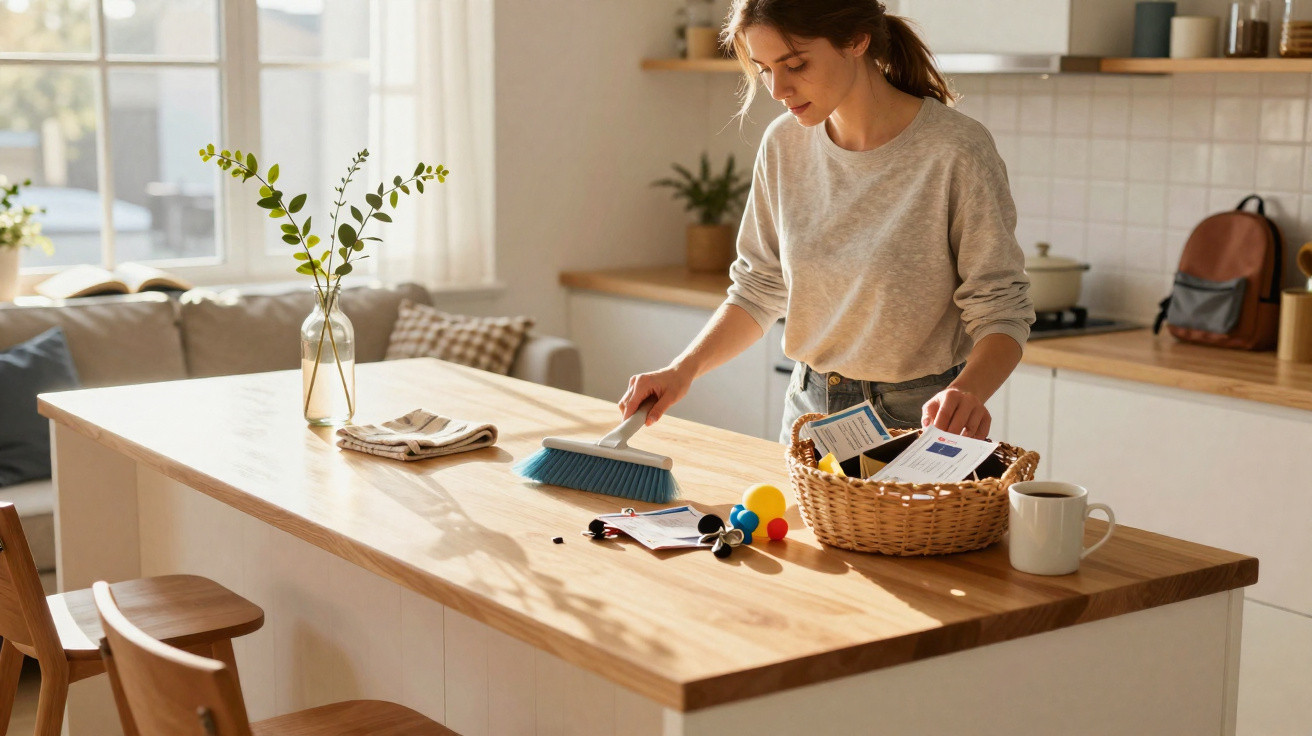
In practical terms, a “surface reset” is spending 3–5 minutes returning one important area to its usual appearance. On a kitchen worktop, this could involve putting dishes away, pushing appliances back, wiping up crumbs and removing stray post. For a coffee table, it may mean placing remote controls where they belong, taking cups to the sink, folding a throw and leaving just one or two decorative pieces.
The key is to connect the habit to points already built into your day: after breakfast, before heading to work, as the kettle boils, during your children’s bath time or immediately before bed. Rather than waiting for designated “cleaning time”, add the reset to routines that are already in place.
A common assumption is that this routine must be done perfectly for it to help, and that is the first pitfall. There is no need to clear every surface in the house each day. Begin with one or two “hero” surfaces, such as the kitchen island and coffee table. They are often the first areas you notice on arriving home and the first your guests see.
Realistically, no one manages this unfailingly every day. On some evenings you are exhausted and the worktop wins. That is perfectly acceptable. The life-changing part is not maintaining a perfect run; it is establishing a new default: “end of the day = quick surface reset, as best I can”.
The emotional shift is subtle, but it’s real: your home stops feeling like an endless project and starts feeling like a place that recovers quickly from chaos.
- Choose your priority zones
Identify the 2 surfaces that are visually most bothersome to you. For one week, concentrate exclusively on them. - Set the “default look”
Work out what genuinely belongs there, whether that is a lamp and plant or a tray and keys. Anything else is temporary clutter. - Make a landing place
Put a basket, tray or small box nearby for items you intend to deal with later, so they do not spread across the surface. - Limit the reset time
Use a timer for 3 to 5 minutes. Stop when it sounds, even if the result is not flawless. Progress matters more than perfection. - Maintain the habit kindly
If you share your home, explain that you would like to keep these 1–2 surfaces as “sacred zones” that remain clear on most days.
Living in your home and liking how it looks, at the same time
There is a gentle sense of relief in recognising that a home is there to be lived in, rather than staged. Children will abandon rucksacks, and adults will leave bags, emails and partly finished coffees on every flat area available. That is simply everyday life. The reset habit does not oppose that reality; it accommodates it. Mess is permitted, but it does not have to remain everywhere at all times.
Once small resets become part of your routine, an unexpected shift takes place: you begin to view your home as a partner rather than a source of guilt. It gets untidy, you reset one zone, and it looks presentable again. It becomes a small, considerate exchange rather than a weekly argument.
| Key point | Detail | Value for the reader |
|---|---|---|
| Focus on surfaces | Clearing the principal horizontal areas alters the feel of the whole home, even when other areas are not perfect. | Immediate visual calm with less work than a complete clean. |
| Attach resets to routines | Connect 3–5 minute surface resets to moments such as breakfast, bedtime or making coffee. | Turns tidying into something automatic rather than another task to remember. |
| Define a “default look” | Establish what belongs on every surface and what should be considered clutter. | Cuts decision fatigue and prevents mess from quietly accumulating. |
FAQ:
Question 1 What surface should I tackle first when my home feels overwhelming?
Start with the area you see first on entering the house, often a console, kitchen worktop or dining table. Clearing just that one spot can change how you feel about the entire space.Question 2 How often should I reset surfaces each day?
Doing it once is already a success. Many people prefer a brief morning reset followed by an even shorter evening one, but one reliable reset is enough to develop the habit.Question 3 What should I do with items that do not belong on the surface but have no proper home yet?
Keep a temporary basket or box marked “find a home for this”. Empty it weekly rather than every day, so it does not interrupt your quick resets.Question 4 How can I encourage family members or housemates to take part?
Choose one or two “no clutter” surfaces and explain that keeping only those areas clear helps you feel calmer. Request help with those specific spots, rather than the entire house.Question 5 Is this habit sufficient if my home is very cluttered overall?
It is not a replacement for a more substantial declutter, but it is an effective place to begin. Protecting a few clear zones gives you the energy and motivation to address larger projects gradually.



Comments
No comments yet. Be the first to comment!
Leave a Comment