
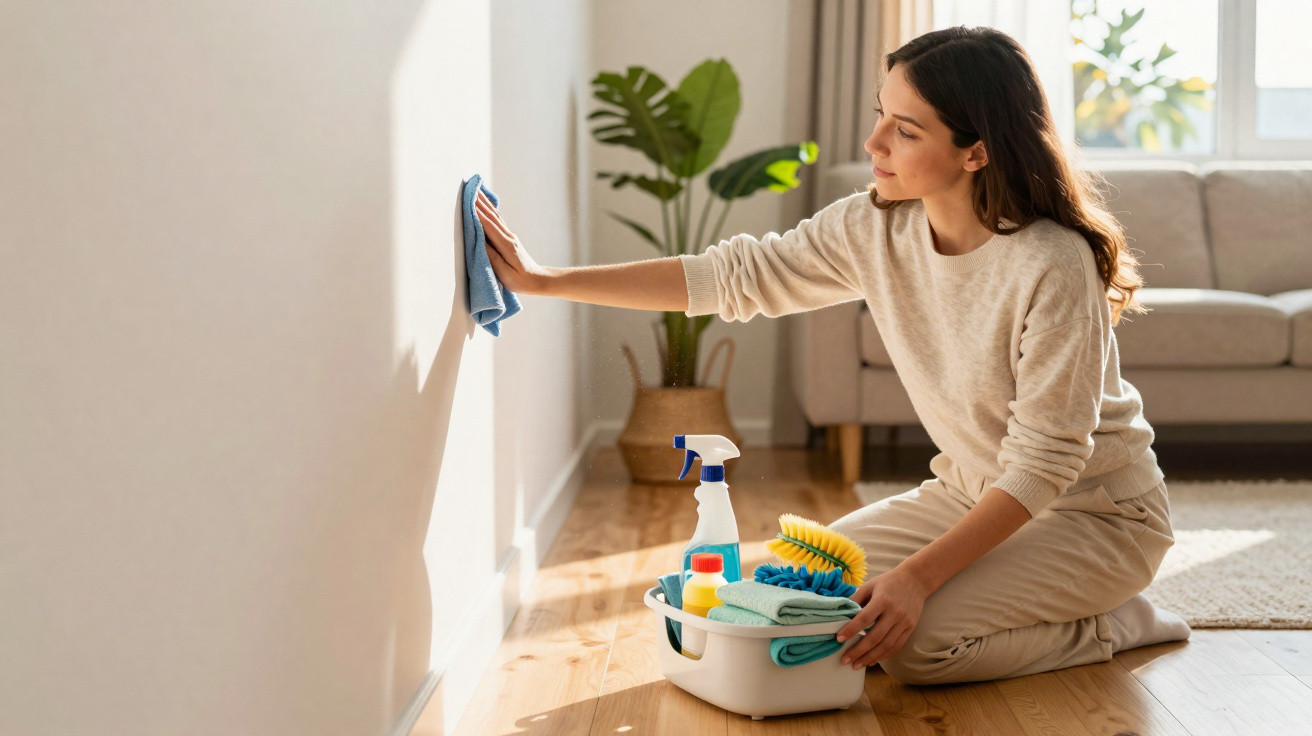
A fuzzy grey stripe traces the bottom of the wall, like a little bank of mist settled around the edge of the room. You have just washed the floors, plumped up the cushions and perhaps even burned a candle with an expensive-hotel scent - then dusty baseboards spoil the entire effect.
You bend down, run a finger over the trim and immediately wish you had not. There is dust, hair and that odd sticky patch in the corner that you would rather not investigate. All at once, the room no longer seems clean; it merely looks “surface clean”.
This is the point cleaning experts often mention: the unseen threshold where a home goes from genuinely clean to “nice from a distance”. Their advice is remarkably consistent: you have begun in the wrong spot.
Why cleaning experts swear by baseboards first
When professional cleaners arrive at a house, they frequently make for the room’s least appealing feature first: the baseboards. They do not begin with the sofa, coffee table or kitchen worktops, but with that narrow piece of trim running alongside the floor. It may seem like an insignificant, almost decorative detail, but it has a quiet influence on the feel of the entire space.
Baseboards are positioned precisely where dust, pet hair and crumbs tend to settle. Whenever someone walks by, shuts a door or turns on a fan, the fine layer of dirt is stirred up and sent back into the room. So, when professionals say “start with the baseboards”, they are not simply being particular. They are stopping the mess where it begins.
After noticing them as a cleaner would, it becomes difficult to ignore them again. They form the dividing line between a room that has been tidied and one that feels genuinely fresh. They also alter the way you approach every other part of the clean.
Recall the last time you gave a room a thorough clean before visitors arrived. You may have hurried through the visible jobs: hoovering, wiping surfaces and putting miscellaneous clutter into a basket. It looked perfectly acceptable in photographs. Then a friend bent down to plug in their phone, and you suddenly saw them: dusty streaks on the skirting boards, a faint drip mark beside the door and a cobweb hidden in the corner.
That small oversight diminished the whole room. Because the baseboards had been missed, the grime remained there, quietly undoing all your hard work. Professional cleaners say this is a major reason clients feel that their homes “never look fully clean”, even after a substantial cleaning session. Our eyes work in surprising ways: they are drawn to edges and lines more often than we think.
Some cleaning firms even treat baseboards as part of their quality control. At the end of a job, they do not just inspect the gleaming worktop or polished floor. They look along the lower wall edges. When these are fresh, the rest of the room usually is too. If they appear streaky or covered in fluff, the work is not truly complete.
There is also an unexciting but practical reason professionals work low down first: gravity. Anything disturbed while dusting will fall. Wiping a shelf sends microscopic dust particles onto the surfaces beneath it. Passing a duster over picture frames creates a gentle fall of dust onto the skirting and floors. Leaving baseboards until the end means cleaning in the wrong order.
Experts describe the method as “top-to-bottom, then edge-to-centre”. In practice, this means doing ceilings, shelves and surfaces first, then cleaning the room’s outer perimeter - including the baseboards - before dealing with the centre of the floor. Miss that outer edge and your hoover can smear a gritty line of dust along the point where the wall meets the carpet or hard flooring.
Hygiene matters too. Baseboards collect anything that rolls or drifts towards them: pet hair, pollen, tiny food particles and even moisture from mopping. If left in place, this combination becomes mildly sticky. Once it is sticky, it catches still more dirt. What cleaners mean by “always start with baseboards” is simple: interrupt the cycle early, while the dust can still be removed easily.
How to clean baseboards first without turning it into a huge task
Adding baseboards to your routine may sound tiring, but professionals seldom scrub them on their hands and knees. Their approach is quick and, admittedly, a little lazy-looking. One easy technique is to wrap a dry microfibre cloth or microfibre mop head around an old broom or flat mop. Glide it lightly over the top edge and front of each baseboard, working from room to room.
This initial dry pass removes most loose dust and hair in less than five minutes. It requires no chemicals, bucket or fuss. For scuffs and marks, follow with a slightly damp cloth misted with a mild all-purpose cleaner, or use warm water with a drop of washing-up liquid. Use brief, gentle strokes rather than an intensive scrub. The aim is not flawless perfection; it is getting rid of the grime that continues to spread.
Begin by the door and work steadily in one direction so you always know where you are. Once the baseboards are finished, vacuum or mop the floor. The entire room immediately looks crisper, much like cleaning smudges from a pair of glasses.
When you have plenty of energy, the job can even feel calming. On an exhausting day, it can seem dispensable, and skipping it is tempting. That is completely normal. Nobody gets up in the morning thrilled at the prospect of cleaning skirting boards. At a human level, they are among the least rewarding areas to clean because they do not catch your eye like a gleaming sink or an uncluttered dining table. Their benefit is understated.
This is where the experts are realistic. They do not carry out a complete deep-clean of every baseboard each time either. Many divide the task into zones: the living room one week, the hallway the next, and bedrooms when the sheets are changed. Let us be honest: nobody really does this every day. And that is perfectly fine.
The key is to connect baseboard cleaning with an existing habit. When wiping the bathroom sinks, run the cloth along the skirting beneath the vanity unit. Before hoovering the hallway, quickly swipe around the edges. Treat these as small additions rather than separate “projects”. This makes the task feel less like a spring-cleaning chore and more like an ordinary part of cleaning.
One professional cleaner shared advice that stays with you:
“If you clean your baseboards first, your floor stays clean for longer. People think it’s the other way round, but the dust keeps falling from the walls, not the floor.”
Put that way, the reasoning becomes clear. You are not “over-cleaning”; you are removing the strip of grime that continually feeds dirt back into the room. That five-minute diversion suddenly seems less excessive and more like a useful trick your future self will quietly appreciate.
Here is a quick reference to save on your phone:
- At the beginning of a cleaning session, dry-dust the baseboards before hoovering.
- Use a cloth attached to a stick or mop handle, rather than kneeling for every section.
- Tackle scuffs individually with a mild cleaner, and do not soak wooden or painted trim.
- Alternate between rooms so that you are not cleaning the entire house every time.
- Pair baseboard cleaning with a task you already complete each week.
Why this small baseboards habit transforms the feel of your home
Once you begin paying attention to baseboards, it is clear they are more than just trim. They act as a kind of emotional boundary within the home. If they are dusty, a room can feel slightly worn-out regardless of how attractive the cushions or candlelight may be. When they are clean, everything else appears fresher, even without going overboard elsewhere.
From a practical perspective, cleaning them first helps end the frustrating cycle of “I’ve just cleaned and it already looks grubby again”. Dust is not mysteriously reappearing overnight. It is drifting from the corners and edges you left untouched. Break that pattern and your cleaning visibly lasts longer. The room retains its freshness for days rather than hours.
On a more personal level, beginning with baseboards is a modest kindness to your future self. Spend five minutes now and, the following week, you will not look around feeling defeated by the same ring of dust. We have all experienced the moment when the mess seems greater than our energy. Literally moving your starting point to the edges of the room can make that feeling more manageable.
Perhaps that is why so many cleaning experts become slightly evangelical about this small strip of wood and paint. It is not glamorous. Nobody will praise your “immaculate skirting” over dinner. Yet it is the sort of quiet, unflashy habit that shifts the atmosphere of a home. Sometimes, that is what we are really cleaning for.
| Key point | Detail | Benefit for the reader |
|---|---|---|
| Start with the baseboards | Baseboards collect dust that later falls onto the floor | Cleaning stays visibly effective for longer |
| Keep cleaning quick and light | Make a dry pass, then carry out a few damp touch-ups | Achieve a noticeable result without spending all day on it |
| Use a zone-by-zone schedule | Spread rooms across several weeks | Keep the routine realistic and manageable |
FAQ:
- Must I clean baseboards every time I clean? Not always. For most homes, a light dust every few weeks and deeper spot-cleaning whenever marks appear is sufficient.
- What is the quickest way to clean baseboards without kneeling? Wrap a microfibre cloth around a flat mop or broom, fasten it with an elastic band and gently run it along the trim.
- Can floor cleaner be used on painted baseboards? Yes, provided it is mild and diluted. Apply it to the cloth rather than spraying the wall directly, which helps prevent drips and streaks.
- What should I do with very grimy or sticky baseboards? Use warm water with a drop of washing-up liquid, wring the cloth thoroughly and work in small sections, drying each area with a second cloth.
- Is cleaning baseboards worthwhile in a rented home? Absolutely. It makes the property feel fresher every day and may also help when inspections or moving-out time comes around.
Comments
No comments yet. Be the first to comment!
Leave a Comment