
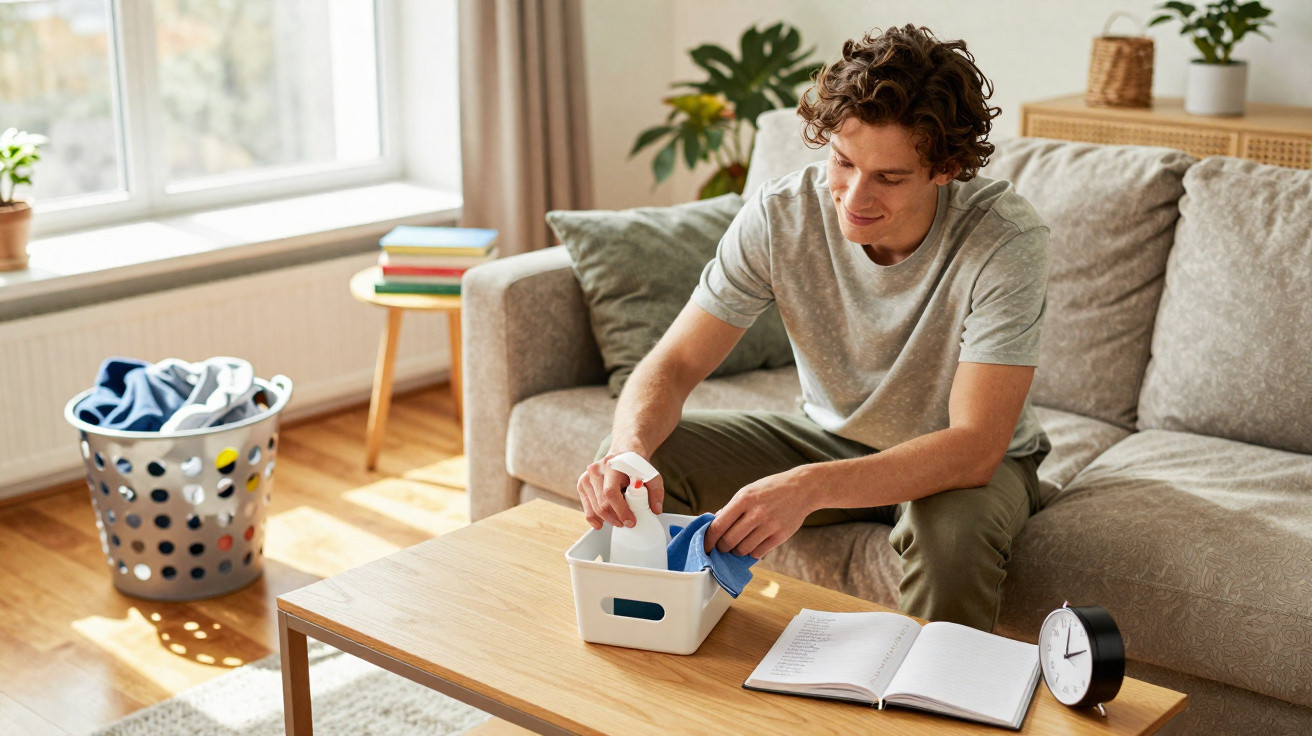
The washing basket is somehow full again, and you could swear you did a load only yesterday. There are crumbs under the table, a suspicious sticky spot by the fridge, and a chair that’s become a permanent “I’ll deal with that later” pile - so long since anyone actually sat on it that it barely counts as furniture. Your home isn’t in meltdown, but it never quite feels… under control.
You flick past cleaning clips where impossibly polished people float around with coordinated spray bottles to a soothing soundtrack, and you feel worn out just looking at it. You’re not aiming for a showroom. You just want a home that functions - without feeling like a full-time cleaner.
There’s a small, quiet shift in mindset that can change everything.
The hidden cost of trying to keep a perfect home
What hardly anyone says out loud is that pursuing a spotless house can become a socially acceptable way to punish yourself. You tell yourself you’re simply being “tidy”, while your mind runs a constant, silent inventory of everything you still haven’t scrubbed.
You move from room to room and, rather than noticing a life being lived, you see a list of jobs. Plates murmur “lazy”, toys scattered on the floor yell “disorganised”, and laundry left unfolded needles you with “you’re behind again”. The house turns into a scorecard - and you’re always down by three.
Living this way doesn’t only tire you physically; it quietly conditions your brain to never feel finished.
Consider the familiar Sunday cleaning marathon. You get up determined to “reset the house”. A few hours later the floors gleam, the worktops are clear, and the bed is made with those hotel-style corners.
Then Tuesday night arrives: shoes reappear by the door, school letters spread across the table, and a damp towel is abandoned in the hallway. By Thursday, the bathroom sink is already dotted with toothpaste constellations. That slow, simmering irritation kicks in: “Didn’t I just clean this?”
It’s a cycle many people recognise. A 2023 UK survey from the cleaning brand Kärcher found that over half of respondents feel guilty when their home is messy, and a big chunk admitted that this guilt actually stops them from resting. That’s the cost nobody posts on Instagram.
The issue isn’t that we’re incapable of cleaning. It’s the way we think about it. We handle cleaning like a large project to complete, rather than a gentle rhythm that supports everyday living.
If you treat your home as a series of “before and after” photos, you’ll keep chasing the “after” and resenting the “before”. Real homes don’t stay frozen in the “after”. They move. They breathe.
A functional home isn’t the one that looks flawless on a Tuesday at 11:00 a.m. A functional home is the one where you can locate your keys, make dinner, sit down and relax, and not feel like you’ve failed because there’s a sock on the stairs.
The mindset shift: clean for function, not for approval
A practical way to reframe things is to stop asking, “Is this clean?” and start asking, “Is this working?” That tiny swap alters how you look at every space.
Rather than fighting the whole kitchen, you ask: can I cook here without moving ten items out of the way first? Instead of fixating on toy storage, you ask: can the children find what they want and put it back without a meltdown?
Cleaning for function means aiming for flow, not flawlessness. You spend less time buffing areas nobody uses, and more time maintaining the bits that keep the day running.
Imagine a parent of two walking in at 6:30 p.m. The place isn’t magazine-ready, but the worktops are mostly clear, there are only a few dishes in the sink, and there’s a single basket in the hallway where all the “random stuff” ends up.
When the children drop their bags, the bags go into the same corner every day. Dinner happens at a table that still carries a watercolour stain from last weekend, yet there’s enough room for plates. The laundry isn’t fully folded, but everyone has clean underwear and a clear place to grab it.
No one would photograph this home for a catalogue, but the evening feels oddly calm. That’s the quiet strength of a functional mindset: less friction, and more energy left for life.
From a psychological point of view, this shift helps ease what experts call “decision fatigue”. Every item out of place creates a tiny decision: deal with it now or later, move it or ignore it, keep it or donate it. When you’re trying to maintain visual perfection, those micro-decisions multiply.
When you clean for function, you create steady defaults and stop renegotiating with every sock. Keys live in one bowl, post goes in one tray, dirty dishes go straight into the sink or dishwasher - not “somewhere near”. The home starts running on systems, not sheer willpower.
Let’s be honest: nobody manages this perfectly every single day. But even putting a few areas of your home into “autopilot” mode can be enough to lower that constant background mental noise.
Practices that keep your home livable without draining you
Begin with a “bare minimum routine”, not the idealised one. Ask yourself: if I could only manage three things on a packed day, what would genuinely keep the house functioning? For many people, that comes down to dishes, clear surfaces, and keeping laundry moving.
In practice, that might mean: five minutes to clear and wipe the table after meals, five minutes to reset the sink before bed, and one small load of laundry on most days - even if it doesn’t get folded straight away. Simple, repetitive, a bit dull. That’s exactly why it works.
The magic isn’t in intensity, it’s in consistency. A 10-minute daily baseline beats a three-hour monthly explosion every single time for mental load.
A common trap is deciding you’ve “failed” the routine the instant you miss a day. That’s how burnout creeps in. You miss Wednesday, feel guilty on Thursday, overdo it on Saturday, then promise you’ll “start fresh on Monday” - and the loop begins again.
Instead, think of routines like public transport. If you miss one train, you don’t abandon the entire journey - you catch the next one. Skipped yesterday’s reset? Fine. Do a half-version today. Lower the bar until it’s almost impossible not to step over it.
A compassionate truth: your home is allowed to show that a busy, imperfect human lives there. You are not unpaid hotel staff. You’re a person.
We’ve all been there, that moment when you stand in the middle of the living room, spin slowly, and don’t even know where to start. A gentle mindset whispers: “Anywhere is fine. One thing is enough.” Someone once told me, “Clean like you’re helping a friend, not judging a stranger.” That sentence alone can soften your whole approach.
Pick your non‑negotiables
Decide on 2–3 daily actions (such as clearing the sink, a quick sweep of the floor, or one load of laundry) that keep your home basically functional - even on your hardest days.Use containers as boundaries
Rather than arguing with clutter, use baskets, trays, or boxes as “zones”. When a zone is full, that’s the signal to sort, donate, or bin items - not when you reach breaking point.Match tasks to your real energy
Keep “heavy lifts” (like deep-cleaning the bathroom) for medium-energy days. On low-energy days, switch to micro-tasks: wipe one shelf, clear one drawer, reset one surface.
From spotless fantasy to sustainable reality
When you loosen your hold on the fantasy of a permanently spotless home, you start to notice different markers of success. Not the dust on the skirting board, but the fact you can invite a friend round on a Tuesday night without a three-hour panic clean. Not the toy on the sofa, but the child quietly playing while you can actually find the remote.
You begin shaping your home around how you live now, not how you imagine you’d live in an alternate universe. Perhaps that means a shoe rack by the front door even if it “ruins the aesthetic”, or a laundry basket in the living room because that’s where clothes migrate anyway. Practical function beats curated lifestyle content every time.
This mindset tends to ripple outwards. When cleaning stops being a silent test of your worth, the people you live with can feel the difference. You can share jobs without turning them into resentment maths. You can say, “I handle the dishes, can you handle the rubbish?” without preparing a full TED Talk on mental load.
You may even start stating the standard you’re aiming for: safe, clean-ish, comfortable - not pristine. Say it out loud. It becomes a shared goal rather than a private fixation.
And, oddly, once the pressure eases, people often chip in more. It’s easier to join a “let’s make this workable” atmosphere than a “don’t ruin my perfect system” one.
A functional home doesn’t mean abandoning beauty or order. It means choosing sanity over spectacle. It means accepting that some days the bathroom mirror has streaks, but you still have time to read one chapter in bed. That the floor might have crumbs, but dinner still felt like a moment together - not a sprint to get everything “back under control”.
Keep this simple rule in mind: if the way you clean your home leaves you with no energy to live in it, the method is wrong, not you.
Maybe the new standard isn’t “a perfect house”. Maybe it’s a house that quietly has your back.
| Key point | Detail | Value for the reader |
|---|---|---|
| Shift from perfection to function | Focus on whether spaces “work” for daily life rather than look flawless | Reduces guilt and mental load, makes cleaning feel realistic and sustainable |
| Create a bare minimum routine | Two or three small, repeatable daily actions like dishes, surfaces, and laundry in motion | Keeps the home basically under control without long, exhausting marathons |
| Use simple systems and boundaries | Set default homes for objects, use containers, and match tasks to real energy levels | Makes tidying faster, cuts down on decisions, and prevents burnout over time |
FAQ:
- How clean should my home realistically be day‑to‑day?Think “safe, mostly clear, and functional”, not spotless. You should be able to cook, sleep, shower, and relax without major obstacles, even if there’s visible clutter.
- What if my standards are higher than my partner’s?Talk about it as a shared comfort issue, not a moral one. Agree on a baseline (like clear counters and clean dishes) and split tasks so nobody carries the invisible mental load alone.
- How do I stop feeling guilty when I rest instead of cleaning?Decide your non‑negotiables, do them, then tell yourself, “The rest is bonus.” Once the basics are met, rest is maintenance for you, just like cleaning is maintenance for the house.
- Is it better to deep clean once a week or do a little every day?A light daily rhythm usually causes less stress. You can still have a weekly “focus task” (like bathroom or floors), but the daily micro-routines keep things from spiralling.
- What if my home is already overwhelming-where do I start?Choose one small zone that affects your daily life the most: the sink, the bed, or the entryway. Reset just that area for a week. Once it feels stable, add one more tiny habit.


Comments
No comments yet. Be the first to comment!
Leave a Comment