
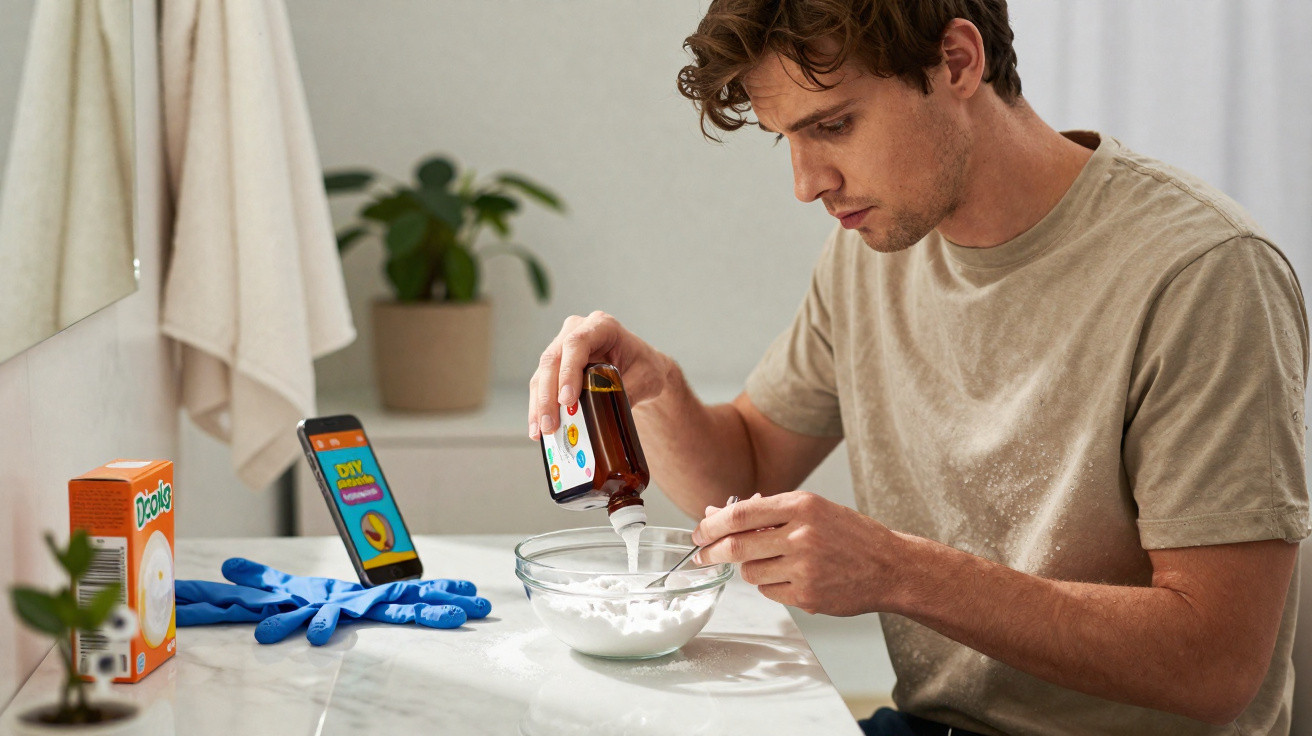
On TikTok and Pinterest, the transformation looks almost like magic: a teaspoon of baking soda, a splash of hydrogen peroxide, and suddenly the sink turns bright white, grout looks brand new, teeth appear to glow, and a chopping board seems as if it has never touched raw chicken. The clips are quick, satisfying and strangely hypnotic.
Away from the camera, dermatologists, toxicologists and dentists are cringing. They are the ones seeing the chemical burns, sore and inflamed gums, worn enamel, and asthma flare-ups that never make it into a 12-second montage. Beneath the viral soundtrack and neat overhead shots, real people are dealing with the fallout from “miracle” hacks that were never tested like proper products.
As the science starts to catch up with the trend, the picture looks far less glossy.
And it is not the story viewers think they are watching.
The “miracle duo” that jumped from the kitchen cupboard to your body
Step into any chemist and you will spot hydrogen peroxide down on a lower shelf in its brown bottle, looking innocuous. Elsewhere, baking soda sits in the grocery aisle: inexpensive, familiar, the same box many people remember seeing at the back of the fridge. Separately, they feel safe largely because they feel everyday.
Online, that sense of familiarity has been turned into a selling point. Influencers combine the two in ramekins and mason jars, describing it as non-toxic, “chemical-free” and “safer than store-bought”. It fizzes and foams, looking like science happening in your bathroom sink - and that is often the moment when problems start.
Clinics see what social media does not. A London-based dermatologist I spoke to described a patient who applied a baking soda–peroxide paste as a weekly “detox mask”. Initially, her skin seemed smoother. After that came the sting, then red patches, then flaky areas that no amount of moisturiser could bring back under control.
In the US, dental surgeries are reporting teenagers brushing with the same mixture “for that whitening filter effect”. One hygienist described enamel scratches visible under the light - tiny grooves where sensitivity can take hold and cavities can more easily develop. Cleaning professionals are also sharing similar accounts, describing clients with sore throats and irritated lungs after scrubbing bathrooms with DIY peroxide mixes in small, steamy rooms.
Researchers are not surprised. Baking soda is alkaline and abrasive; hydrogen peroxide is an oxidiser that, at higher strengths or with repeated use, can stress cells and irritate tissue. Used together, they can rapidly alter pH on skin or enamel and release more oxygen - dramatic to watch, but capable of inflaming delicate surfaces.
Products that are regulated and contain either ingredient are put through stability checks, irritation testing and concentration controls. A viral bowl mixed up in the kitchen comes with none of that: no safety data, no reliable dosing, no meaningful instructions. Most people underestimate how wide the gap is between “this foams in my sink” and “this is safe on my body”.
How to clean and care safely without playing chemist at home
If you like the low-cost, low-waste appeal of cupboard staples, you do not need to abandon them entirely. What you do need is a firm boundary: baking soda for gentle abrasion on hard surfaces, hydrogen peroxide for targeted disinfection - seldom together, and almost never on skin or teeth. Treat them as colleagues who work well separately but should not share the same workstation.
For brightening grout or freshening chopping boards, use diluted hydrogen peroxide on its own: spray, allow it time to work, then rinse thoroughly and ventilate the area. For stubborn grime, a simple paste of baking soda and water is often sufficient, followed by a proper rinse. Keeping their jobs separate makes the routine straightforward and reduces risk.
When it comes to your body, the limits are tighter. Dentists recommend peroxide-based whitening options that are formulated with stabilisers and explicit time guidelines, rather than kitchen mixes. Baking soda toothpastes do exist, but the grit size and pH are controlled. A DIY teaspoon stirred in a bowl is not.
For skin, dermatologists tend to favour fragrance-free cleansers, evidence-based acne treatments and mild exfoliants. That burning “deep clean” sensation people report from a baking soda–peroxide mask is often micro-damage, not detoxification. And, realistically, hardly anyone keeps this up daily: they overdo it for a week, panic when their face reacts, then stop - without ever telling the algorithm it backfired.
The specialists I spoke to were unexpectedly sympathetic about why this trend took off. People are worn down by long ingredient lists and greenwashed marketing. They want control, simplicity and cheaper solutions at a time when everything feels overpriced.
“Baking soda and hydrogen peroxide are not evil,” says Dr. Marta R., a toxicologist who reviews household products for a European regulator. “They’re just being used wildly out of context. The problem is not the ingredient existing. The problem is a recipe gaining millions of views without any of the boring safety checks we demand from companies.”
- Use each ingredient for its lane – Baking soda as a mild scrub for hard surfaces, peroxide as a disinfectant or stain remover, preferably diluted.
- Keep them off skin and enamel for DIY “treatments” – especially on kids, sensitive skin, or already damaged teeth or gums.
- Ventilate and protect yourself – gloves, open windows, and short contact times cut down on irritation and fumes.
- Follow product labels over online hacks – commercial products with these ingredients are tested for stability, dosage, and chronic exposure.
- Listen to your body’s early warnings – stinging, tightness, coughing, or unusual sensitivity are all signals to stop, not to “push through.”
Between viral hacks and real-life harm: where do we draw the line?
Most people recognise the moment: a smug little cleaning or beauty trick appears in your feed and you think, “Could this actually work?” There is a quiet buzz in using a 99-cent box of powder and a generic bottle of peroxide to outmanoeuvre expensive brands. It feels clever - almost defiant.
But the research now emerging around repeated exposure, irritation and misused concentrations is like the lights slowly coming on at a party. All at once you notice the peeling paint, the misted mirrors, the cough that lingers after “deep cleaning” day. And the question becomes hard to ignore: when did the boundary between clever and careless get so indistinct?
The experts criticising the baking soda–peroxide craze are not scolding from a distance. Many were raised on the same home remedies. They understand why familiar names feel comforting, and why long chemical names breed distrust. Their frustration is rooted in watching the internet rework old ingredients into new Franken-recipes that nobody has tested beyond a 30-second clip.
This is where our responsibility as users changes. It is not about becoming fearful of every hack; it is about pausing to add one question before mixing and applying: who tested this, on what, and for how long? It is not a question that fits neatly in a caption - but it could spare a face, a set of teeth, or a pair of lungs.
Perhaps the real “miracle duo” is less showy: curiosity and caution. It is not as clickable as foaming grout or as satisfying as an extreme before-and-after - but it is more sustainable. The next time you see that pleasing fizz in a bowl, you may still want to try it.
You may also notice another feeling: a quiet decision not to let your body become the test site for someone else’s engagement metrics. That small shift, repeated across millions of kitchens and bathrooms, could change trends faster than any new ingredient ever will.
| Key point | Detail | Value for the reader |
|---|---|---|
| Hidden risks of the “miracle duo” | New research links repeated baking soda–peroxide use to irritation, enamel wear, and respiratory issues. | Gives readers a reality check before copying viral hacks on their bodies or in poorly ventilated spaces. |
| Safe, simple alternatives | Separate uses for baking soda and peroxide, plus guidance on when to rely on regulated products. | Offers practical ways to clean and care without losing the low-cost, minimalist appeal. |
| How to judge online recipes | Key questions to ask: who tested this, for how long, and on what surfaces or tissues? | Empowers readers to filter dangerous trends and protect themselves and their families. |
FAQ:
- Is it safe to brush my teeth with baking soda and hydrogen peroxide? Most dentists say no for regular use. The combo can be too abrasive and too oxidizing, stripping enamel and irritating gums over time.
- Can I use baking soda and peroxide on my face as a mask? Dermatologists strongly advise against it. The sudden pH shift and oxidative stress can damage your skin barrier and trigger redness or burns.
- Is it okay to clean grout or tiles with the mixture? Occasional use on hard, non-porous surfaces might not destroy your bathroom, but experts still prefer using each ingredient separately with good ventilation.
- What concentration of hydrogen peroxide is safer for home use? Most households rely on 3% for disinfecting. Higher concentrations are for professional or specialized use and carry a bigger risk of burns and irritation.
- Are “natural” or DIY cleaning hacks always safer than store-bought products? Not necessarily. Many commercial products undergo strict safety tests. Unregulated DIY mixes can be harsher or more unstable than they look in a video.

Comments
No comments yet. Be the first to comment!
Leave a Comment