
The bathroom door closes with that muted click you only hear in quiet hotel corridors, where someone has clearly paid attention to carpets, door closers and hinges.
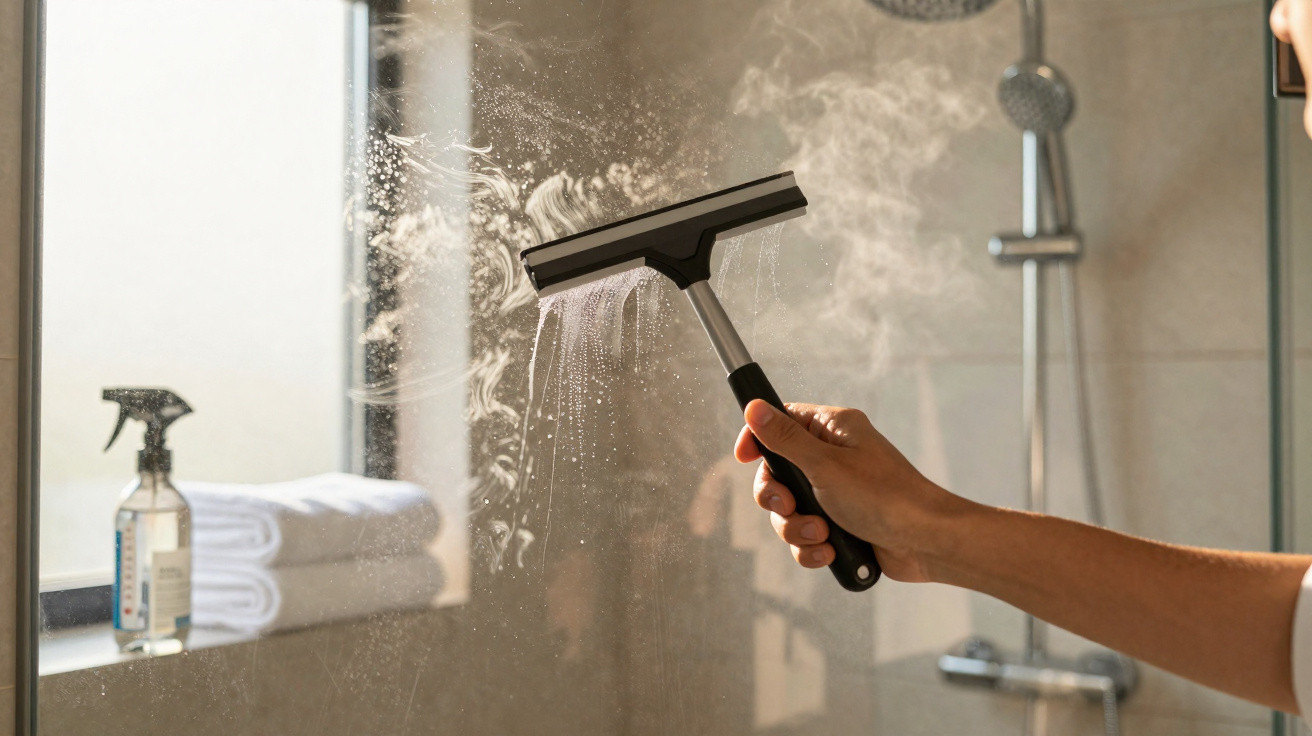
In the bathroom, the shower still holds its warmth and the steam softens the edges of the glass screen. A housekeeper in a tidy navy uniform gets to work with the ease of a routine repeated hundreds of times: squeegee, cloth, a small turn of the wrist.
Barely two minutes later, the screen looks untouched-no streaks, no spots, no hazy film. Just glass you can almost forget is there.
If you’ve ever wondered how hotels manage that when your own shower screen at home starts resembling frosted privacy glass after three days, you’re not alone.
That routine has become well known on TikTok and in cleaning forums. Yet there’s an unspoken drawback.
A drawback that comes down to something you can’t see: the precise temperature of the water.
The hidden flaw in the “hotel method”
The so‑called hotel method for gleaming shower screens is appealingly straightforward: rinse with hot water, then run a squeegee or microfibre cloth over the glass while it’s still warm. Some people tip in a dash of vinegar; others rely on a tiny drop of washing‑up liquid. The claim is always identical-shiny glass with very little effort.
In short clips online, it looks almost like a trick. Steam curls upwards, a hand slides down the pane, and the dullness disappears in a single clean sweep. Back at home, plenty of people copy the steps and still end up with curved streaks and water spots that seem to materialise after the fact.
Most of the time, it isn’t the cloth or the product that’s different. The real difference is a detail hotels manage obsessively: exactly how hot the water runs-and how consistently.
Look closely at what forms on the glass. In hard‑water areas, minerals such as calcium and magnesium are carried in the droplets; when the water evaporates, they’re left behind as tiny pale specks. Meanwhile, soap, shampoo and body wash can leave a thin film that only becomes obvious once light hits the surface at the right angle.
In hotels, the water system is set to stay within a stable band. Showers commonly sit around 40–43°C (104–109°F), and many housekeeping teams use slightly cooler water for the final rinse. That narrow temperature range influences everything: how fast droplets dry, how products behave, and how long mineral residue has to effectively “bake” onto the glass.
At home, most of us vary wildly-nearly scalding one day, barely warm the next-depending on preference, the boiler, or who showered before. Those swings undermine the very conditions the hotel method depends on.
So you follow the same routine and get a completely different result. And it can feel like the glass is laughing at you.
When the magic breaks: real bathrooms, real water
Imagine a compact city flat with strong water pressure and seriously hard water-the kind that leaves a crusty line in the kettle after a week. A couple there decide to try the hotel method after watching a clip with three million views.
They turn the shower up full heat to “steam the room”, as the video suggests. Tiles dampen, the mirror disappears behind fog, and the screen turns cloudy with condensation. One of them wipes it down with a microfibre cloth, feeling impressively professional. In that steamy blur, it looks fine.
Then, an hour later, harsh afternoon daylight tells the truth: faint ghost streaks, outlines where droplets dried, and chalky little freckles scattered across the pane. By overheating the water and missing the timing, they’ve effectively driven the minerals further into place.
Elsewhere, in another home a few suburbs away, someone with soft water gets the reverse experience. They follow a hotel cleaner’s advice almost unintentionally: keep the water warm rather than scalding, rinse quickly, then wipe straight away as the fog begins to lift.
Their screen ends up impressively transparent with very little effort. They assume it must be the new cloth. In reality, the quiet advantage is their water profile and the way the temperature drops at the end.
There’s evidence behind this, too. Facilities managers in chain hotels monitor bathroom complaints much like airlines track delays. Several large groups have found that keeping guest showers below roughly 43°C and training staff to rinse glass around 30–35°C reduces visible spotting and speeds up daily cleaning.
Put simply: when the water is too hot, droplets evaporate quickly and unevenly, fixing minerals onto the surface before you can clear them. When it’s too cool, soap doesn’t break down as well and leaves a draggy residue that smears instead of lifting. The “sweet spot” is tight-and hotels operate inside it day in, day out.
The exact temperature window that makes it work
The hotel method only acts like the hotel method when three small factors line up: the water is warm enough to loosen residue but not so hot that it flash‑dries; the bathroom isn’t turned into a sauna; and the final rinse is cooler than the shower itself. It sounds picky, but it can be turned into a simple habit at home.
Start by showering as usual at whatever temperature you find comfortable. Right at the end, turn the heat down until the water feels noticeably warm but no longer “hot”-roughly 32–36°C (90–97°F) if you had to estimate. Rinse the glass for 20–30 seconds with this gentler water.
Switch the water off and pause for 20–40 seconds. You’re aiming for the larger beads to begin sliding, but you don’t want everything to evaporate. Then act quickly: pull a clean squeegee from top to bottom in overlapping passes, and finish with a dry microfibre cloth around the edges and the handle area.
Timing is just as important as temperature. Thick steam plus very hot glass creates ideal conditions for minerals to cling. Slightly cooler glass and milder rinse water slow the process enough that a simple wipe can beat it.
The biggest mistake is the instinct that “more is more”. People push the temperature to the maximum, assuming heat equals hygiene and shine. In practice, the glass doesn’t need a sauna-it needs consistency. That hotel look comes from repeating the same controlled routine, not from the occasional blast of very hot water followed by a half‑hearted wipe.
Let’s be honest: almost nobody truly does this every day. Most of us wipe when we remember-often on a Sunday-using half a roll of kitchen paper and whichever spray happens to be under the sink. That’s also why leaning on the hotel method as a one‑off miracle can be maddening: homes don’t run on checklists and room‑turnover targets.
A more realistic approach is to treat it as a “reset” two or three times a week. Keep your shower temperature moderate, add the quick cooler end‑rinse, and make the wipe‑down a 90‑second habit rather than a magic fix. Miss a day and you haven’t ruined everything-you’ve simply made the next wipe a little harder.
The same errors crop up again and again in ordinary households: leaving the extractor off so humidity hangs around for hours; cleaning the screen after a blazing‑hot shower with the door shut; using the same damp cloth for weeks, quietly smearing a greasy layer back onto the glass each time. None of these mistakes are dramatic, but each one chips away at what makes the hotel method efficient.
Seen this way, it stops feeling like magic and becomes a set of small, slightly boring guardrails: warm rather than boiling; quick rather than rushed; consistent rather than extreme. The glossy before‑and‑after shots are simply the visible outcome of a routine carried out quietly, every day, in thousands of hotel bathrooms.
“We don’t have special glass,” a housekeeping supervisor in a four‑star London hotel told me. “We have hot water limited by the boiler, timers on how long it runs, and staff who do the same moves over and over. The shine comes from the system, not from a secret spray.”
Once you understand that “system”, you can adjust it to suit your own situation instead of copying it blindly. If your water is extremely hard, you may need a weekly descaling spray alongside the temperature routine. If the glass is already etched, it may never look showroom‑new again-and accepting that can save you a lot of unnecessary guilt.
- Keep shower water “comfortably hot”, not scorching; finish with a warm, cooler rinse on the glass.
- Wipe within one minute of turning the water off, before droplets fully dry on the surface.
- Use a clean squeegee for broad strokes, then a dry microfibre for edges and hardware.
- Vent the room: leave the door open or put the fan on to cut lingering humidity and new spots.
- Once a week, reset with a descaling cleaner if your water is hard or stains are visible.
Why this tiny detail changes how we see “clean”
A shower screen has a strangely honest way of showing itself. You notice it most in the morning, when light from a small window catches every faint ring and streak. On a hectic weekday, those marks barely exist. On a slower Sunday, they can feel like a judgement on how “together” your life is.
Online, the hotel method spreads as a promise of control: do one tidy trick and your bathroom will look like a fresh check‑in every day. When it doesn’t work, people often assume they’ve failed-wrong spray, poor technique, not disciplined enough. More often than not, the missing ingredient is simply that invisible variable: water temperature, and how strictly hotels keep it in check.
On a human level, it can be oddly reassuring to realise you’re not “bad at cleaning”. You’re just dealing with a home where kids take too‑hot showers, the boiler fluctuates, the fan is underpowered, and the glass has a history that no 30‑second wipe can erase. The fantasy of spotless, hotel‑style clarity meets real life-messy, rushed and compromised.
Once you recognise the role of controlled heat, you get to choose how far you want to go. Perhaps you’ll lower the boiler by a few degrees. Perhaps you’ll just add the cooler end‑rinse and a fast squeegee on evenings when you’ve got the energy. Perhaps you’ll pass the tip on to a friend who’s been battling a cloudy screen and blaming themselves.
What shifts isn’t only the glass. It’s the story you tell yourself when you slide that shower door open and catch your reflection-clearer, imperfect, and a little more kind.
| Key point | Detail | Why it matters to you |
|---|---|---|
| Controlled temperature | Moderate shower water, with a warmer-but-cooler final rinse (32–36°C) | Understand why the hotel method works… or doesn’t at home |
| Drying timing | Wipe within a minute of turning off the water, before full evaporation | Cut streaks and limescale without harsh products |
| A realistic ritual | A short routine 2–3 times a week, plus a weekly “reset” | Fit a professional method into real life, without unnecessary pressure |
FAQ:
- Why does very hot water make my shower screen look worse?Because it speeds up evaporation in uneven patches, leaving minerals and soap to “bake” onto hot glass before you can wipe them away.
- Can I still use the hotel method if I have extremely hard water?Yes, but you’ll likely need a weekly descaling product and a stricter temperature window to prevent rapid spotting.
- Is a squeegee really necessary, or will a cloth alone work?A cloth can work, but a squeegee removes bulk water more evenly and makes the final microfiber pass faster and less streaky.
- Do I need to measure the water temperature exactly?No. Use feel as your guide: shower at your usual comfort, then rinse the glass with water that feels clearly cooler but still warm, not cold.
- What if my glass is already cloudy and etched?Deep etching from years of mineral buildup won’t fully reverse with the hotel method; you can improve clarity, but some haze may be permanent without polishing or replacement.


Comments
No comments yet. Be the first to comment!
Leave a Comment