
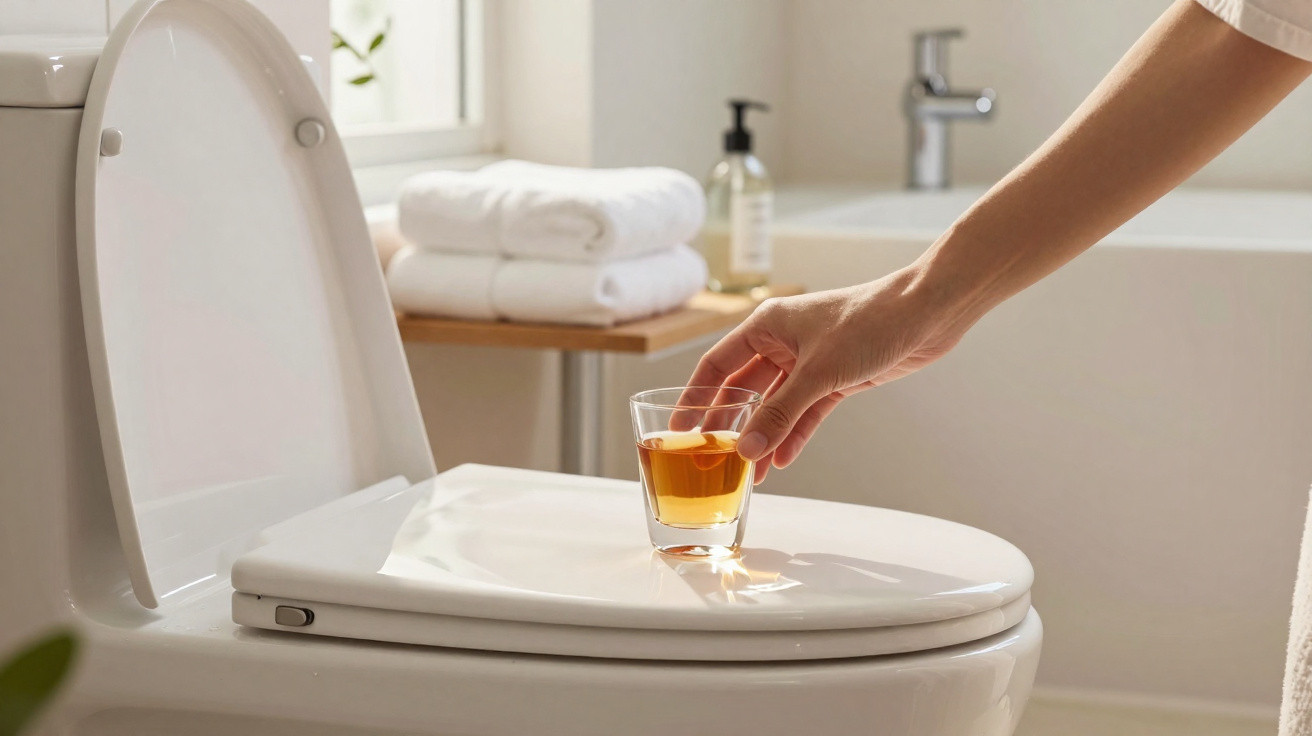
The girl in the TikTok clip doesn’t say a word. She simply sets an ordinary drinking glass on the toilet cistern, unscrews the lid of a tiny perfume bottle, and mists the inside with slow, almost suspicious care. Next, she pours in water, places the glass down like it’s a candle, and leaves the room.
Two hours later, people in the comments insist they can “smell the screen”.
It’s easy to imagine the effect: that faint, hotel-lobby cleanliness meeting you as soon as you push the bathroom door open, even though nothing looks any different. No sleek diffuser, no oversized flowers-just a random glass beside a half-used pump of hand wash.
It looks almost comically cheap. Almost too effortless to be believable.
So is this the point where that quietly luxurious bathroom smell actually starts?
The oddly powerful glass-on-the-toilet trick
At face value, the whole “perfume in a glass” idea seems like the sort of social media stunt made purely for views: clear glass, a few sprays, a splash of tap water, then a cut before the scent has to prove itself.
And yet it’s hard not to picture doing it yourself right before guests arrive.
Bathrooms may be the smallest rooms in the house, but they deliver one of the strongest first impressions. One lingering hint of damp towels or that stale residue around the toilet brush, and suddenly the whole space feels less clean. Anything promising subtle luxury without a renovation is bound to hit a nerve.
Especially when it relies on something many of us already have: the neglected perfume you never really liked wearing on your skin.
Online, the storyline is often identical.
Someone says their bathroom always smells “a bit… lived in,” no matter how often they scrub.
Then the reel: a “before” shot, an awkward expression, and a jump cut to a glass perched on the cistern. A few generous sprays, water swirling, and a casual line like, “Omg my bathroom smells like a spa now.”
Below it: thousands of saves. Friends tagged with, “We’re doing this before Saturday.”
A woman in London wrote that she tried it with a cheap vanilla perfume and, for the first time, a guest asked what “diffuser brand” she used. She laughed and changed the subject. Secretly, she knew she’d just elevated a £4 body mist into silent-luxury territory.
When you break it down, it’s not as ridiculous as it sounds. Perfume isn’t simply posh alcohol-it’s a concentrated blend of aromatic molecules designed to evaporate slowly. Spritz it into a glass, dilute it with water, and you’ve essentially made a budget fragrance bowl.
Add in the bathroom’s constant temperature shifts, plus the airflow created every time the door opens and closes, and those scented particles start to move. The shape of the glass holds a little pocket of fragrance, then releases it gradually.
It won’t rival a high-end candle in a mansion-sized living room, but in a small tiled bathroom? It performs far better than you’d expect.
The truly “suspicious” thing isn’t that it works-it’s that hardly anyone thought to do it a decade ago, while we were stockpiling reed diffusers and pretending we enjoyed potpourri.
How to do the glass trick without turning your bathroom into a chemical storm
The method itself is straightforward.
Take a clean glass or a sturdy tumbler-ideally one you’re not sentimental about, in case the scent clings.
Spray the inside 5–10 times with a fragrance you enjoy smelling, even if it’s not one you wear. Soft florals, gentle citrus, cotton, and “clean laundry” style scents tend to work particularly well. Fill the glass halfway with cool water, then set it somewhere stable and flat, away from direct splashes: the back of the toilet, a sink corner, a high shelf.
After about 20–30 minutes, the scent should begin drifting through the room like a discreet hotel corridor.
This is also where people overdo it. Twenty sprays of an ultra-sweet perfume in a tiny bathroom won’t read as “luxury spa”-it’ll feel more like “teenager’s first nightclub”. You’re aiming for a light veil, not a cloud you can taste.
Start gently. Only add a couple more sprays if, after an hour, you genuinely can’t smell anything.
We’ve all had that moment of thinking, “Just a bit more,” and then ending up with a headache and the windows flung open in January.
And there’s one plain reality to keep in mind: let’s be honest, hardly anyone refreshes bathroom fragrance every single day. Choose an effort level that matches your real life-not the fantasy version where you’re always guest-ready.
The creators who get the best results usually pair the hack with calmer, old-school habits. A home stylist I spoke to said she doesn’t treat it as magic-just a lift for a room that’s already being looked after.
“I use the perfume glass like a finishing touch,” she explained. “Clean surfaces, dry towels, lid down, window cracked if I can. The glass is the last 5%. It’s the ‘oh wow, this smells nice’ moment people remember, even if they can’t spot where it’s coming from.”
Alongside the glass, she keeps a mini checklist taped inside a cabinet:
- Open the window or run the fan for 10 minutes after showers
- Swap hand towels twice a week, more often with kids
- Keep a closed box for the toilet brush and extra rolls
- Use unscented or mild cleaners, then layer scent on top
- Refresh the glass trick before guests or once the smell fades
All of a sudden, “luxury” sounds less like a secret hack and more like a small daily choreography.
Maybe the real luxury isn’t the glass at all
Once you start paying attention, bathroom scent says a lot about how we live now. We’re chasing hotel energy in homes that also function as offices, gyms, and storage units. We want a fragrance that quietly signals “calm, tidy, under control” even if there’s laundry draped over the shower rail.
Part of the trick’s appeal is how unobtrusive it is. It isn’t a branded diffuser dominating the corner, and it isn’t a candle you must remember to blow out. It’s a humble object doing something slightly sneaky in the background.
That soft whisper of scent tells visitors someone considered this space-someone cares about the details.
That may be why people get oddly emotionally invested in it. It taps into a bigger wish: that our homes could feel gentler, smoother, a touch more curated, without the budget for a full renovation.
If your bathroom smells expensive-even if the tiles date back to 1998-it creates a tiny sense of upgrade. A private, quiet upgrade, just for you when you shut the door for three minutes between Zoom calls.
You might end up testing different perfumes, or even trying essential oils, until you land on something that feels like yours. Not the generic “ocean breeze” of supermarket sprays, but a scent your guests start to associate with your home.
So what happens when a simple glass of scented water becomes part of your home’s identity? That’s the question lingering the next time you open the bathroom door and realise-without quite knowing why-that it suddenly feels like you’ve checked in somewhere else.
| Key point | Detail | Value for the reader |
|---|---|---|
| Simple setup | Glass + 5–10 sprays of perfume + water in a small bathroom | Easy, low-cost way to upgrade the room’s atmosphere |
| Right fragrance choice | Light, clean scents work better than heavy or overly sweet ones | Reduces risk of headaches and “cloying” smell |
| Part of a routine | Combine with airing out, clean towels, and discreet storage | Creates a consistent, quietly luxurious impression |
FAQ:
- Question 1: Does the perfume-in-a-glass trick actually last more than a few hours?
In a small bathroom it typically hangs around for several hours, depending on the fragrance strength and how much air movement there is. Stronger scents and warmer rooms usually last longer, but it won’t carry on for days.- Question 2: Can I use essential oils instead of perfume in the glass?
Yes. Add a few drops of essential oil to water, but you’ll need to stir it and refresh it more often. Some oils also cling to glass, so it’s best to keep one cup dedicated to this.- Question 3: Is it safe to have a scented glass near the toilet?
Generally, yes-so long as it sits on a stable surface where it won’t be easily knocked over. Avoid very low ledges if you have children or pets.- Question 4: Will this trick replace cleaning products or air fresheners?
No. It won’t mask strong, stubborn odours or mould. Treat it as a finishing touch on top of ventilation and regular cleaning, not a substitute.- Question 5: What if my guests are sensitive to fragrance?
Pick very light, neutral scents and use fewer sprays, or skip the trick entirely if you know someone fragrance-sensitive is visiting.
Comments
No comments yet. Be the first to comment!
Leave a Comment