
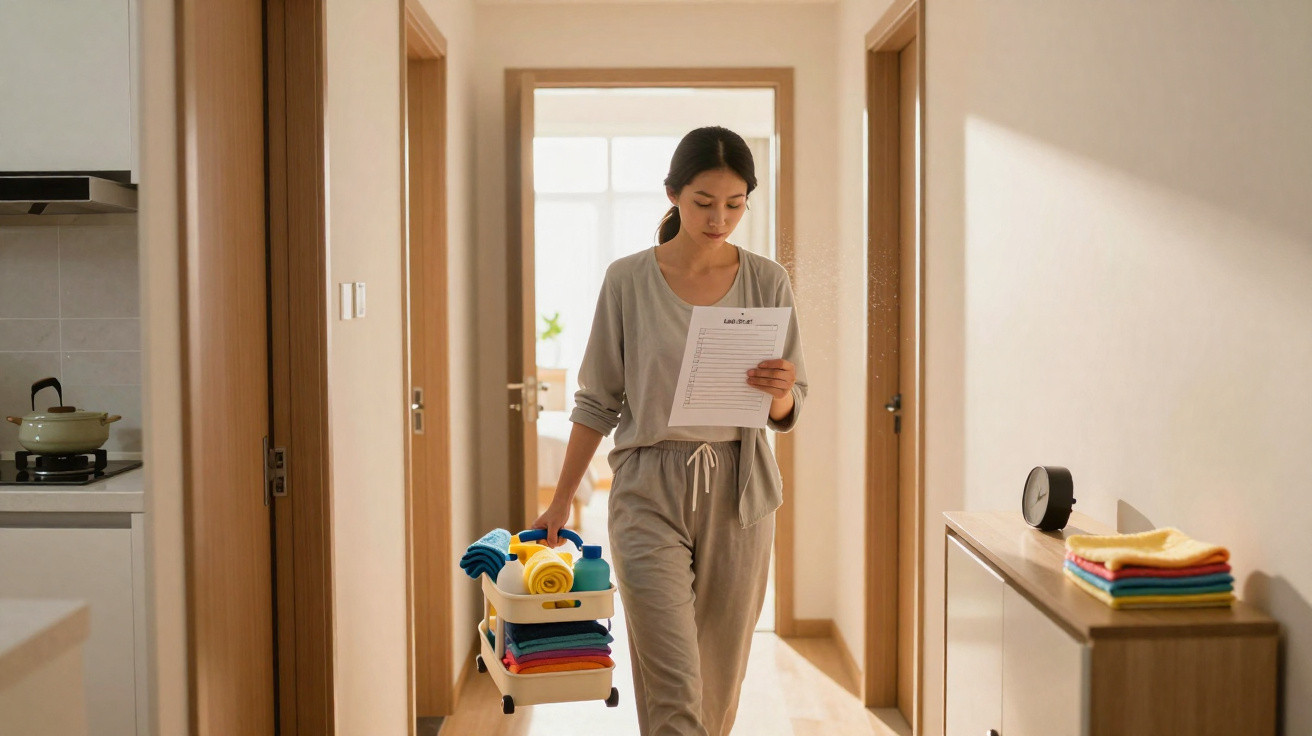
The day I discovered that my cleaning routine was not working, I was in the hallway with a half-filled laundry basket, a dripping sponge and a phone buzzing in my hand. The kitchen was only partly finished, I had barely begun the bathroom, and I had already spent two hours “tidying”.
I glanced around and felt that same weary frustration: why was this taking up my entire Saturday while still failing to resemble those serene, minimalist Instagram homes?
I was not lazy, and I was not untidy. I was simply tackling everything in the least effective order.
One small adjustment changed everything.
The real issue is not dirt - it is the order
Most people clean as they learned to in childhood: beginning with whatever appears to be the biggest problem.
You spot a stack of washing-up and head straight for the kitchen. Or you notice a mountain of laundry and decide that has to come first.
That approach seems sensible, yet it is a trap.
You end up darting between rooms, responding to whichever mess is shouting loudest, without ever letting your mind settle into a rhythm.
When you finally stop, you are worn out, still noticing isolated bits of clutter, and the home looks “kind of” clean.
It is not terrible, but it is not satisfying either.
A friend who works as a hotel housekeeper once watched me clean and nearly laughed.
“You’re doing everything backwards,” she said kindly, taking the sponge from my hand as though it were something dangerous.
She told me that hotels do not clean each room in a random sequence.
Instead, they use a strict system that reduces walking, saves time and lowers the mental effort involved.
Floor by floor, zone by zone, top to bottom.
So we tested that approach in my flat as a small experiment.
We altered just one thing: the order in which I completed each job.
The products, tools and mess were all exactly the same. Only the route changed.
This is what happened.
A job that normally took nearly three hours fell to one hour and fifteen minutes.
There was nothing magical involved: no productivity app and no outrageous TikTok cleaning trick.
There was simply less rushing back and forth, fewer choices to make, and a sequence that genuinely worked.
That was when I understood that I was not “bad at cleaning”.
It was the chaotic order draining my brain, rather than the wiping and vacuuming themselves.
Cleaning began to feel less like a fight and more like following a playlist.
The cleaning order change that makes all the difference
The straightforward rule that transformed my Saturdays was this: clean by task, rather than by room.
Complete one job throughout the whole home, then move to the next task in a set sequence.
This is the precise order I now follow:
First, I remove clutter from surfaces in every room.
Next, I dust and wipe from the top down.
Then I clean the kitchen and bathroom surfaces.
After that, I vacuum the entire home.
Finally, I mop.
It may seem obvious when written down, but putting it into practice feels completely different.
You work more quickly, make fewer decisions and avoid leaving anything only “half” finished.
Previously, I would complete one room entirely before moving to the next.
I would clean the kitchen from top to bottom, begin again from scratch in the living room, then repeat the process in the bedroom.
Each room became an entirely new challenge.
There was a different sponge, product, position and set of tiny decisions every time.
Now I pick up one tool and stay with it.
First every surface is cleared, then all dusting is done, followed by all the vacuuming.
It is the same repeated movement, almost like muscle memory.
Let us be realistic: nobody truly cleans this way every single day.
However, doing it this way makes even a weekly clean feel achievable.
There is a reason this method suits the brain so well.
Repeating a single task makes it easier to move into autopilot.
You use less energy asking, “What now?” and spend more of it simply getting on with the job.
It also means less wandering in circles carrying products that you hardly need.
There is an emotional benefit too.
Once you have cleared every surface, your home already looks better within ten minutes.
That early sense of relief gives you a small boost and helps you carry on.
By the time you start vacuuming, the home feels 80% transformed.
Mopping at the end becomes the final, pleasing brushstroke.
A practical cleaning routine to try today
If you would like to test this method, here is an uncomplicated version for real life.
Set a timer for 5 minutes, then walk through each room carrying a laundry basket or tote bag.
Collect anything that should not be left on surfaces, including mugs, socks, receipts and stray cables.
This is not the moment to “organise your life”; you are only clearing the way.
Put those items on the bed or in one corner, ready to sort at another time.
On the next round, dust and wipe every surface as you loop through all the rooms again.
Only after that should you tackle the more demanding areas, such as the bathroom sink or hob.
Vacuum the whole home in one session, and then mop if you have hard flooring.
The main mistake people make is treating cleaning like an endurance test in multitasking.
You begin wiping the table, spot a plant that needs watering, find yourself in the kitchen filling the watering can, notice the washing-up, and fifteen minutes later the table is still dirty.
This is not a flaw in your character.
It is simply how attention works when your surroundings keep presenting a thousand little alerts.
Give yourself one rule instead: do not change tasks until you have completed the current one in every room.
No “just this one drawer” and no “quick email check”.
You are either on the “dusting track” or the “vacuum track”, and nothing else.
Be gentle with yourself if your attention wanders.
Just recognise it, smile slightly, and return to the task you were doing.
“I always thought I was messy,” a reader told me after trying this method, “but it turns out I was just cleaning like a browser with 28 tabs open.”
- Begin with what you can see
Clear and tidy surfaces first to get an immediate visual reward. - Stick with one tool
When the vacuum is in your hand, complete every room before putting it away. - Follow short, firm loops
Travel around your home in the same direction each time, so you are not doubling back. - Save the finer details for later
Deep-cleaning the oven or folding every T-shirt perfectly can wait for a separate day. - Finish with a task that feels like a win
For many people, vacuuming or mopping works well because the before-and-after difference is so clear.
When the order changes, home feels different too
Changing the sequence affects something else that is harder to count in minutes or measure with checklists.
Your home stops feeling like an endless project and starts becoming somewhere you can properly live.
You may find yourself less annoyed on Sunday evenings.
You can sit on the sofa without mentally listing every corner you “should” be cleaning.
You begin to trust that, when the next mess appears, you know precisely how to move from chaos to calm without giving up half the day.
The mess does not disappear by magic.
Life still happens, children still scatter crumbs, and work can still turn into heaps of paper across the table.
But there is now a route through it: a routine your body can remember even when your mind is tired.
Perhaps that is the quiet revolution in this approach.
It is not about a perfect home or becoming a different person, but about a different order that gives back a little time, pride and peace.
| Key point | Detail | Value for the reader |
|---|---|---|
| Clean by task, not by room | Declutter, then dust, then kitchen/bathroom, then vacuum, then mop | Saves time and energy by reducing decision fatigue |
| Use a fixed route | Always move through rooms in the same direction and sequence | Creates autopilot habits and prevents going in circles |
| Prioritise visible wins | Clear surfaces first for quick visual improvement | Boosts motivation and makes the rest of cleaning feel lighter |
FAQ:
- Question 1 What is the best first step when my home feels overwhelmingly messy?
- Answer 1 Begin with a 5–10 minute “surface sweep” in each room: take a basket, gather anything that does not belong on tables, worktops or the floor, and leave it all in one place to sort later. This provides instant breathing room and makes the rest of the routine feel less daunting.
- Question 2 How frequently should I use this full cleaning order?
- Answer 2 For most small and medium-sized homes, completing the full loop once a week is enough. During particularly busy weeks, use a shorter version: declutter + vacuum only, then leave deeper bathroom or kitchen scrubbing for another occasion.
- Question 3 What happens if I live with people who do not clean in this order?
- Answer 3 Consider dividing tasks by type instead of room: one person declutters, another vacuums, and another deals with bathroom surfaces. Explain the fixed order so that everyone can follow the same rhythm, even if their individual styles vary.
- Question 4 Does this approach work in very small flats or studio apartments?
- Answer 4 Yes - it can work even better. A studio has a shorter route, so the time-saving benefit can be especially noticeable. The principle remains unchanged: complete one task at a time, follow the same sequence, and do not jump between small projects.
- Question 5 What tools or products are needed for this to work?
- Answer 5 Nothing elaborate is necessary. A basket for clutter, an all-purpose cleaner, a microfibre cloth, a sponge for the kitchen and bathroom, a vacuum and a mop will do. The real improvement is not the equipment, but the sequence you use.


Comments
No comments yet. Be the first to comment!
Leave a Comment