
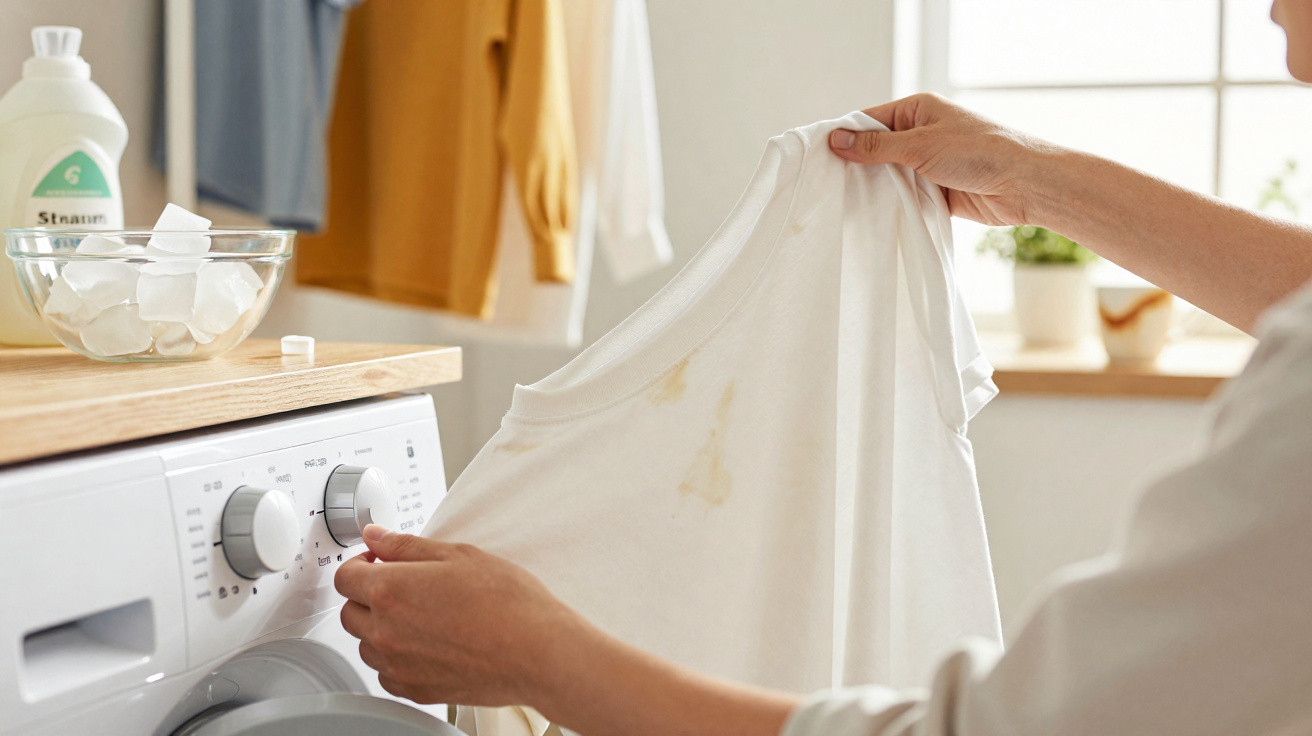
The washing machine gives its familiar beep at 10 pm, precisely when you are too exhausted to make sensible decisions.
You toss in a white shirt marked with coffee, shut the door, and turn the dial to “hot wash” because hotter surely means tougher, doesn’t it? Forty minutes later, the shirt emerges… and the mark appears even more fixed. More beige. More “you’ll never get rid of me”.
The following day, somebody at work mentions, “You should have tried cold water first.”
You brush it off with a laugh, yet the thought stays with you. How could the milder option, the setting that seems almost half-hearted, outperform a steaming, “powerful” hot wash?
That night, you hold a similar stain under cold water. No steam, no fuss. This time, the mark genuinely starts to disappear.
It is like learning that your washing machine has been hiding a secret all along.
When hot water makes stains worse
Most of us were raised on one simple belief: hot water = cleaner washing.
So, when a stain looks even slightly alarming, we increase the temperature, whether it is tomato sauce, red wine, or the strange grey mark spotted only when you are already running late.
But fabrics do not follow the rules we learnt as children.
Heat affects certain stains much as a frying pan affects an egg: it cooks them, sets them, and makes them grip the fibres more firmly. What feels like “deep cleaning” may actually seal the stain into place.
Cold water does not put the fabric through the same shock.
It leaves proteins loose rather than setting them, giving detergent longer to work before the stain starts to feel inseparable from the material.
Imagine dropping scrambled egg onto your favourite black T-shirt just before you leave the house. You panic, blot it with kitchen roll, then quickly rinse it beneath hot tap water. The mark turns slightly white, spreads a little, and the affected part of the fabric becomes stiffer.
When you return, you put it through a short hot cycle.
What happens? The egg stain is lighter, but somehow more “baked in”. Scrubbing does not seem to shift it. The smooth, firm section of fabric reveals the problem: the proteins have cooked, just as they did in the frying pan at breakfast.
Now picture the same mishap, except you rinse it straight away with cold water.
The egg begins to lift, you rub the fabric gently, and a little washing-up liquid helps separate it. Most of the stain vanishes before the shirt even goes near the washing machine. No fuss. No cooked patch.
This is more than an anecdote. Laundry specialists frequently highlight protein stains, including blood, sweat, milk, egg, and meat juices. Heat alters their structure in the same way as boiling an egg. Once they are “cooked” into the material, they no longer act like removable marks and instead start acting as though they belong to the thread itself.
At a microscopic scale, fibres behave like tiny sponges. Pour hot water over a new protein stain and its molecules tighten, working their way into the spaces between the fibres.
Cold water keeps them softer and more mobile, allowing detergent to surround them and remove them rather than effectively welding them on.
That is why the initial rinse matters more than an elaborate programme on your washing machine.
If the stain first meets water that is too hot, you could be undermining your own cleaning efforts before the wash cycle has even begun.
How to use cold water effectively against stains
The most straightforward approach is about timing: respond quickly, but keep the temperature low.
With fresh stains, run the fabric under a steady flow of cold water from the reverse side of the mark rather than directly onto it. This pushes the stain out instead of forcing it further in.
Next, apply a small drop of liquid detergent or washing-up liquid, then gently rub the material against itself. There is no need to treat it like sandpaper. Small circular movements and a little patience tend to work better than force.
For a particularly persistent mark, soak the garment in cold water with one tablespoon of detergent for 15–30 minutes.
Only after releasing as much of the stain as possible in cold water should you consider putting it through an ordinary machine wash.
On a difficult day, doing the laundry can resemble a test you never revised for. A stain appears, you choose the option that looks strongest, and hope it works. Hot water, a long cycle, maximum spin. When the garment comes back marked, you blame the shirt rather than the approach.
There is guilt involved, too. You know you “should” pre-treat stains, soak items, and separate colours carefully. Yet life is untidy, children are sticky, and evenings are brief. Let’s be honest: nobody truly does all of that every day.
That is why a cold-water reflex is useful. It is not an entire laundry system, merely one small action: if a stain is protein-based, or if you do not know what caused it, choose cold water first. This single habit can quietly prevent clothes being ruined by overenthusiastic heat.
Some seasoned stain-fighters repeat one simple mantra: start cold, think later.
It may sound almost absurdly easy, but it overturns years of conditioning that says “hot is better”.
“The biggest laundry mistake people make isn’t the wrong detergent,” explains one textile specialist, “it’s cooking the stain into the fabric with hot water before it ever has a chance to come out.”
For a practical routine on an exhausted Tuesday evening, remember this small “rescue routine”:
- Rinse new stains using cold water only.
- Add a drop of liquid detergent and rub gently.
- Soak protein or unidentified stains in cold water for 15–30 minutes.
- Start with a cool wash cycle, then check the result before attempting a warmer one.
- Do not use hot water on fresh blood, egg, dairy, or meat stains.
It does not have to be done perfectly every time. Even following only part of this process can protect your clothes from the most serious damage.
Cold water, clean clothes, and a subtle change in perspective
The first time you watch cold water remove a stubborn stain, your attitude towards laundry shifts quietly. The idea that “stronger means hotter” begins to fall apart, replaced by a more subtle and slightly counterintuitive understanding. Power starts to look more like precision than temperature.
You start spotting patterns. Shirts repeatedly washed hot seem a little more faded than those entrusted to a cool cycle. Jeans retain their shape for longer. Prints remain crisper. Meanwhile, the washing machine runs using less energy, and your clothes no longer appear to age by three years in a single season.
We have been taught to mistake visible effort for effectiveness: steam, heat, lengthy cycles, and vigorous foam. Cold water offers none of that spectacle. It is quiet and almost dull. Yet for certain stains, that gentle method is precisely what succeeds. Less theatrical, more clever.
People sometimes pass on these discoveries like private life hacks. One parent quietly tells another at the playground about cold water and grass stains. A flatmate demonstrates that red wine can be controlled if you do not shock it with heat. A partner admits they have washed almost everything cold for months, and you simply had not noticed.
At this point, it becomes about more than a single shirt: how many other parts of life have we overheated, overdone, or overcomplicated because we assumed “more” meant “better”?
Cold water and stains offer a small domestic reminder that gentler does not necessarily mean weaker.
You may still turn to hot water for towels, bedding, or very greasy kitchen cloths. That is reasonable. Heat has a role, particularly with oils and hygiene. However, the next time coffee splashes across your blouse during a rushed morning, you will probably pause before turning the dial to its highest setting.
That brief pause opens a window onto how habits take hold, how myths endure, and how a simple stream of cold tap water can be more effective than your machine’s hottest programme. It also shows how one unnoticed decision in a sleepy kitchen can quietly determine whether a favourite shirt survives for another season.
| Key point | Detail | Benefit for the reader |
|---|---|---|
| Cold water and protein stains | Cold water prevents blood, egg, milk, and sweat from being “cooked” into fibres. | It can save clothes that might otherwise be permanently stained. |
| The first rinse matters most | The water temperature used immediately after a stain appears is crucial. | A quick cold rinse can make the later wash far more effective. |
| Gentle care, longer life | Cool washes cause less colour fading and are kinder to fabrics. | Clothes stay looking newer for longer, while saving energy and money. |
FAQ:
- Why does cold water work better for some stains? Heat alters the structure of protein-based marks such as blood and egg, which makes them more difficult to remove. Cold water keeps those proteins soft enough for detergent to lift them away.
- When should I always use cold water first? Choose cold water for fresh blood, dairy, egg, sweat, and meat juices, as well as any stain you cannot identify with confidence. It is a safe first step that avoids “cooking” the mark into the fabric.
- Are there stains where warm or hot water is actually better? Yes. Grease and oil stains often react better to warmer water because heat helps melt and disperse fats, making it easier for detergent to capture them.
- Does cold-water washing really clean as well as warm? Modern detergents are designed to work at low temperatures, particularly on everyday grime, light sweat, and dust. A warmer wash can still be useful for heavily soiled items or where sanitising is required.
- Can switching to cold water help my clothes last longer? Definitely. Cooler cycles are gentler on fibres, reduce fading, and result in less shrinkage, helping clothes retain their shape and colour over time.






Comments
No comments yet. Be the first to comment!
Leave a Comment