
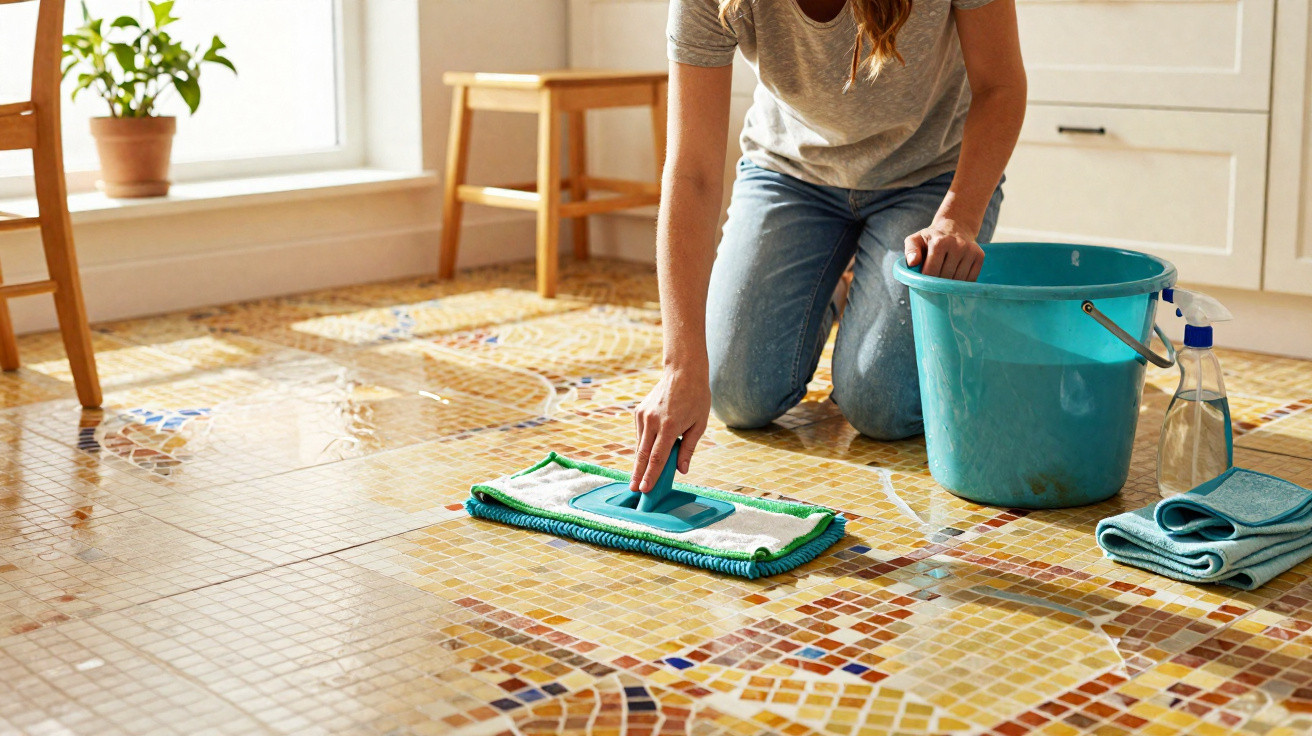
The harder you try to correct it, the worse it can appear. The secret to giving tiled floors a streak-free shine is neither a miracle cleaner nor a panicked second attempt. It is a small adjustment to the water, the movement and the timing that changes the whole outcome. It is a home-cleaning technique that professionals use almost automatically. Once you understand it, your tiles can look glass-like, without the tacky coating or cloudy marks that reveal themselves in every shaft of light.
One sunny Saturday, I watched a neighbour sweep her mop across the kitchen floor as though she were tracing long ribbons over ice. There was no froth in the bucket and no harsh scent in the air. Rather than scrubbing with more force, she worked with better technique. When she finished, she changed buckets, gave the floor a light misting and drew a dry cloth over the tiles with an unhurried smile. The floor did not merely seem clean. It had a stillness to it, like a peaceful pond.
The second bucket was the key.
Why tiled floors streak - what you are actually seeing
Streaks are not grime; they are residue. Fine layers of soap, minerals and oils dry quickly in some areas while remaining longer in others. In sunlight, these microscopic coatings become visible as lines and halos. Adding extra cleaner in an effort to remove them simply creates more residue. What begins as a small cycle soon becomes a larger problem.
I discovered this the difficult way in a hallway with glossy charcoal tiles. A single pass looked acceptable in overcast daylight. Then sunshine moved across the room and revealed a display of drag marks and crescent-shaped mop arcs. I tried three different cleaning liquids that week. Nothing worked until I altered the rinse stage and the pace. From then on, the streaks finally disappeared.
The principle is straightforward. Surfactants attach to grease, hard water deposits calcium, and heat accelerates evaporation. When the water dries before the residue is lifted away, that film becomes fixed in place. A heavily saturated mop merely spreads it into a thinner layer. A lightly damp mop that releases, lifts and removes residue, combined with water that will not leave spots, breaks the cycle. The shine appears because there is nothing remaining to scatter the light.
The streak-free shine method for tiled floors, step by step
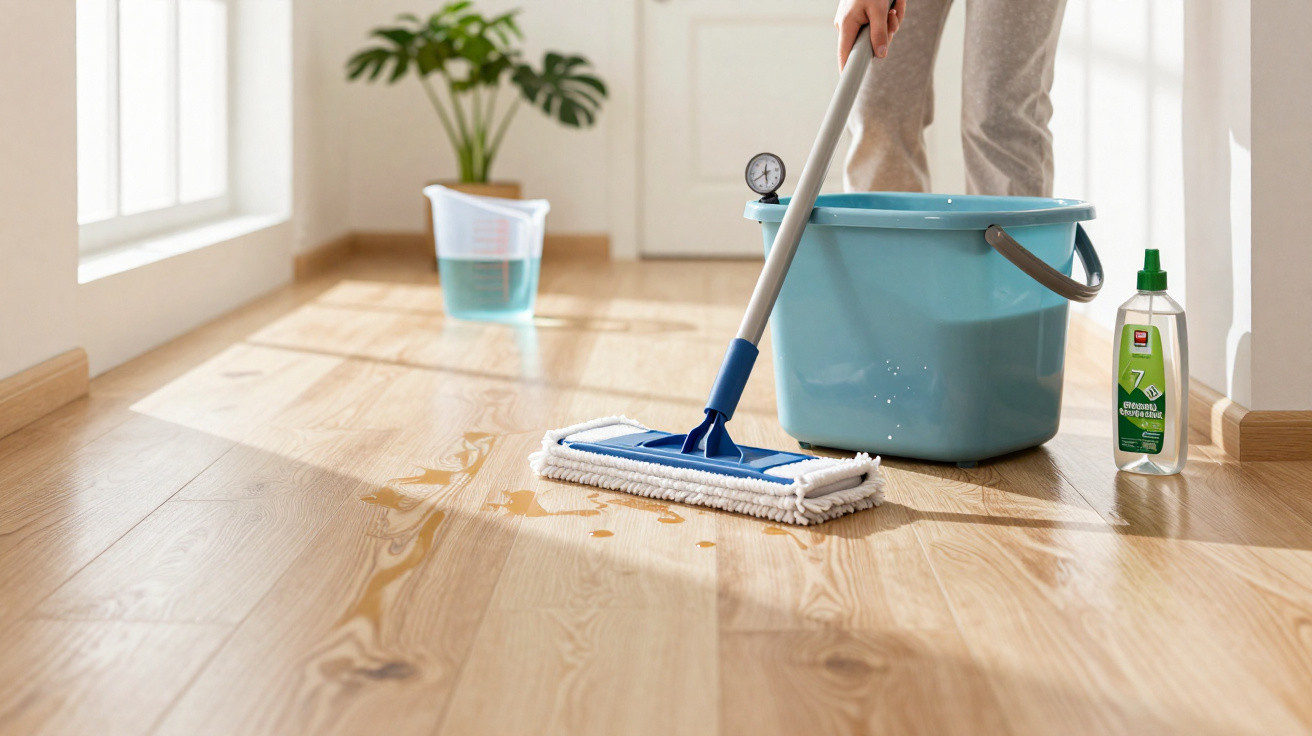
This is the method that changes the result. Put hot water and a small amount of cleaner in one bucket: 2 L, 1 tsp mild washing-up liquid, 1/4 cup white vinegar and 1/4 cup 70% isopropyl alcohol. This mixture removes grease, helps the floor dry more quickly and reduces the chance of streaks. Fill a second bucket with plain distilled water. Use a flat microfibre mop that has been wrung out thoroughly. Starting in the furthest corner and working towards the exit, mop in long S-shaped movements with slight overlaps. Next, use the distilled water and repeat those S-shaped passes. Complete the process by buffing with a dry microfibre cloth in quick, gentle strokes. That is all that is required.
Two points are important. Vinegar works well on ceramic and porcelain, but not on natural stone. For marble, travertine or limestone, choose a pH-neutral tile cleaner and do not use vinegar. Distilled water is not an extravagant choice either; it is inexpensive protection. Without minerals, there are no spots. It makes the final stage a genuine rinse that dries cleanly, even in strong sunlight.
Everyone has experienced the moment when the floor looks worse after we have done our best. The answer is less product and greater control. Wring the mop until it is damp rather than soaked. Glide instead of scrub. Focus on “lifting” rather than “pushing”. When the mop begins to drag, turn it over to a clean pad. The final dry buff is the quiet secret: that light pass restores the shine without depositing anything on the surface.
Common mistakes and simple fixes that protect the shine
The most common error is adding too much soap. A teaspoon per 2 L may seem minimal, but tiles do not need bubbles; they need glide. Using too much creates a thin, sticky layer that holds footprints and streaks. The next trap is rinse water that has become dirty. When the bucket resembles tea, you are effectively mopping the floor with tea. Replacing it promptly brings back a visible clarity.
Water quality also has an understated effect. Hard tap water can leave small rings and pale films, particularly on dark tiles. Distilled water removes that issue. The mopping route matters as well. Brief, uneven strokes leave lap marks, whereas long continuous S-shaped strokes distribute moisture evenly and give it time to release residue. For grout, guide the mop along the lines rather than scouring across them. Realistically, hardly anyone manages that every day.
Another frequently overlooked detail is the cloth itself. Fabric conditioner used on microfibre prevents it from absorbing properly and causes it to spread residue. Wash pads in hot water with a small amount of detergent, then allow them to air dry. Your floor will show the difference after only one pass.
“Shine doesn’t come from shine. It comes from nothing left behind,” said a commercial cleaner who trains new hires with two buckets and a timer.
- Two buckets: one cleaning mix, one distilled water
- Flat microfibre mop, low-pile pads, no fabric conditioner
- Light solution: 1 tsp soap, 1/4 cup vinegar, 1/4 cup alcohol per 2 L
- Rinse pass with distilled water
- Dry buff with a fresh microfibre cloth
Keep tiled floors shining without making cleaning your life
Shine is not about working harder; it is about having a rhythm. Dry-mop or vacuum away grit before wet mopping, then use the two-bucket routine when the floor begins to lose its freshness. Busy kitchens may require this each week, while quiet hallways need it much less often. Everyday life creates marks. The aim is a brief routine that can begin and end within a song. If guests message, “How are your floors always so clean?”, the answer is not a secret brand. It is a sequence that becomes automatic, even on a hectic evening. The light in the room will handle the rest.
| Key point | Detail | Benefit for the reader |
|---|---|---|
| Two-bucket method | One for a light cleaner, one for a distilled-water rinse | Prevents residue from being redeposited |
| Microfibre + dry buff | Low-pile pad for lifting, dry pass for gloss | Creates shine without wax |
| Right recipe | 1 tsp soap, 1/4 cup vinegar, 1/4 cup alcohol per 2 L | Faster evaporation, fewer streaks |
FAQ:
- Can I use vinegar on all tiles? Use it on ceramic and porcelain only. Avoid it on marble, travertine, limestone and cement tiles. Select a pH-neutral cleaner for stone.
- Do I really need distilled water? If you have hard tap water or dark glossy tiles, yes. Distilled water prevents mineral spots and keeps the final pass clear.
- What if I dislike the smell of vinegar? Use a pH-neutral floor cleaner instead and retain the alcohol. Alcohol helps water evaporate evenly, reducing streaks.
- Will a steam mop give me a better shine? Steam can lift dirt quickly from ceramic and porcelain. It can also force moisture into grout and create haze when the pad is dirty. Keep pads clean and do not steam natural stone.
- How do I remove old streak build-up? Reset the floor with hot water and a capful of ammonia or a purpose-made residue remover, scrub lightly using a microfibre pad, then rinse with distilled water. Finish with a dry buff for a fresh start.
The real trick is not a product at all. It comes down to timing, a light touch and water that leaves no residue. If you want a mirror finish, take one further step and run a dry pad over high-traffic routes as the room becomes warmer in the afternoon. This small action restores gloss where shoes travel and sunlight falls. Your tiles do not need a performance; they need a routine.
The floor shows you when the method has worked. The mop moves smoothly, the room has no noticeable smell, and the tiles reflect the window like a lake at dusk. You notice the calm before you notice the shine. Once you have seen it, it is difficult to return to the old way.
When life feels untidy, keep the equipment uncomplicated: a bucket, a bucket, a pad and a song. The shine follows naturally. No streaks, no drama. Simply a clean floor that does not demand attention.
Comments
No comments yet. Be the first to comment!
Leave a Comment