
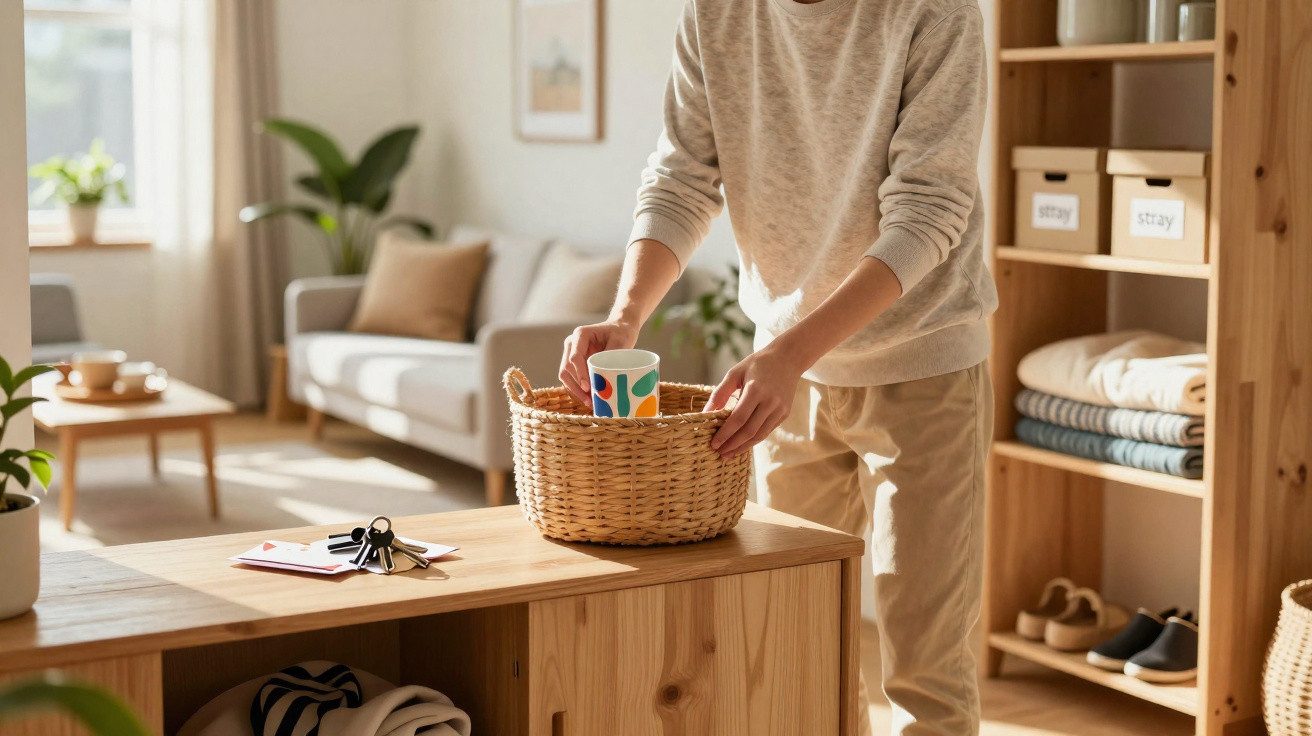
The clutter rarely appears all at once. Instead, it creeps in unnoticed: a mug put down “just for now” on the coffee table, a jacket draped across a chair, a parcel box left in the hallway because you’ll “break down later”. Your home can feel perfectly clear one day, then somehow seem burdened by little, persistent heaps the next.
Before long, you avoid the dining table because it has become part paperwork and part washing. You clean the kitchen worktop, yet look straight past the sticky marks beside the kettle that have been there for… who even knows.
You promise yourself you will sort it out “this weekend”. You made that promise last weekend too.
One understated habit determines which direction this goes.
The unseen shift from “lived-in” to overwhelmed
Step into a home at 7 p.m. on a weekday and the floor almost tells you how the day unfolded. Shoes have been half-removed at the door, a backpack has been dropped a few steps inside, and post has landed on the first flat surface that seemed to say “hello”. This is precisely when clutter takes a side.
It either makes itself at home for the evening and grows.
Or it is quietly stopped before it takes over.
Imagine arriving home worn out, carrying too much, with a completely fried brain. You set your bag on the sofa “for a second”, throw your keys on the table and leave your lunch box on the worktop. Then you immediately start scrolling on your phone because your mind feels like mush.
Two hours on, the bag remains on the sofa. The keys have disappeared beneath a flyer. The lunch box has become a vague shadow of guilt in the kitchen.
Do that for five days and your sitting room is gradually covered by a week’s worth of “for a second”.
What transforms a home is not really the major Saturday clean. Those sessions are dramatic, almost cinematic: music turned up, old joggers on, and a few hours that feel like a productivity montage.
But ordinary life returns on Monday morning, and your energy is needed elsewhere. Clutter does not reappear in one spectacular wave; it returns as crumbs, cables, bottle tops and receipts. The real battleground is the two minutes immediately after you use something.
That is the turning point people rarely mention, perhaps because it does not seem important. It can feel far too small to make a difference.
The no-orphan rule: a tiny habit that prevents silent pile-ups
The decidedly unglamorous habit that stops clutter quietly accumulating has a straightforward name: the “no-orphan rule”. Before moving on, return anything you touch to its “family”.
Cup? Take it back to the kitchen or put it in the dishwasher.
Jacket? Hang it directly on its hook or hanger.
Scissors? Put them back in the same drawer, rather than leaving them “down for a second” on the table.
The principle is simple: do not allow objects to roam around by themselves. Do not let them become orphans on whatever surface happens to be nearby.
Take a single teaspoon in the kitchen. After stirring your tea, you leave it on the worktop. A few hours later, it has been joined by a sandwich knife, a mug and a jar with no lid. That teaspoon made leaving things out seem acceptable.
Now picture rinsing the teaspoon and placing it straight into the draining rack. The worktop stays visually “closed”, as though your mind has marked it with the message: nothing belongs here.
A reader once told me that this habit changed her coffee table before anything else. “I used to treat it like a storage unit,” she laughed. “Now when something lands there, it looks wrong, like a stranger in the wrong movie.”
It works because our minds interpret surfaces as cues. An empty worktop quietly says: “Don’t leave stuff here.” A surface holding a handful of things announces: “Pile accepted.”
The no-orphan rule removes the subtle, ongoing permission we give ourselves to leave items behind “just for now”. One thing left out turns into visual noise, then becomes normal, and eventually fades into the background.
When every item returns to its “home” as soon as it is used, you are not truly cleaning. You are stopping clutter before it begins. That’s the sneaky secret: the best cleaning habit doesn’t feel like cleaning at all.
How to use the no-orphan rule without driving yourself mad
Begin absurdly small. Choose one problem surface: the coffee table, kitchen worktop, desk or the chair that has quietly become a wardrobe. For seven days, use the no-orphan rule there and nowhere else.
Anything placed on that surface either belongs there… or is moved as soon as you get up. Whenever you walk into another room, take something in your hand with you.
Attach the habit to things you already do. Getting up from the sofa? Take one item from the coffee table. Going to the bathroom? Collect that stray glass and leave it in the sink as you pass through the kitchen.
This is where many people falter. They attempt to enforce the rule throughout the entire house from day one, then run out of steam by the second day. Or they blame themselves the first time they forget. That is often the point at which the habit quietly disappears.
The truth is that nobody manages this every day without fail. There will be exhausting days, sluggish evenings, weeks of illness and messy Tuesdays. The aim is not perfection; it is coming back to the habit.
When you spot orphans gathering on the surface again, do not panic. Simply reset that one area. Spend two minutes on it, with no drama and no lectures.
The professional organizers I’ve spoken to all say some version of the same sentence: “Homes don’t get overwhelmed because people are dirty, they get overwhelmed because objects lose their homes.”
- Give everything a simple home: Use a basket for remote controls, a tray for keys, a bowl for coins and a folder for post. Avoid overthinking it; clear landing places are enough.
- Keep homes close to where objects are used: Put the remote control by the sofa, scissors near the desk and reusable bags beside the door. Distance kills habits.
- Use “while you walk” cleaning: Every time you move across a room, carry one orphan back to its home. One item, one journey.
- Protect your hotspot surfaces fiercely: Select two or three “sacred” areas to keep clear. Anything put there without a purpose is moved straight away.
- Accept the 80% rule: Most days, doing this most of the time is enough to change how your home feels. Perfection is a TV fantasy, not real life.
Living in a home that does not silently shout at you
Something slightly surprising happens once you have practised the no-orphan rule for a while. Your home begins to seem noticeably calmer, even if it is not immaculate. There may still be crumbs on the floor and a blanket tossed over the sofa, but the visual disorder eases.
Your brain no longer runs that endless, low-level checklist: “I should move that. I need to sort this. When will I deal with that?” It feels as though there is a little more oxygen in the room.
You start trusting yourself again. When you notice the post on the worktop, you know it will not still be there in three weeks. You know the coffee table will not quietly become a storage depot.
Some readers compare it to lowering background noise they had not realised was there. Others say they feel less embarrassed about opening the door to a friend, because no stray piles are waiting in every corner.
It does not mean your home will resemble a magazine spread. That is not the aim. The aim is for your space to support you, rather than constantly demand something from you.
At the end of the day, you come through the door and most of your belongings are where they should be. The table is ready for dinner instead of confrontation. The worktop is ready for cooking instead of confession.
You may still tackle larger cleaning jobs at weekends, scrub the bathroom and vacuum beneath the bed. Yet those tasks will feel easier, less like trying to save a sinking ship. The no-orphan rule turns daily life into quiet maintenance instead of firefighting.
Perhaps your mood will lift slightly when you wake to a clear kitchen island rather than a cluttered scene. Perhaps you will notice that you spend less time searching for your keys, charger or the one pen that actually works.
And perhaps, one ordinary evening, you will pick up your headphones and carry them back to their place, then realise you have quietly changed the story your home tells about you.
| Key point | Detail | Value for the reader |
|---|---|---|
| No-orphan rule | Every object returns to its “family” spot immediately after use | Stops clutter before it develops into piles and becomes overwhelming |
| Start with one hotspot | Use the habit on only one surface for a week | Makes the change manageable, sustainable and less daunting |
| Use movement as a trigger | Whenever you get up or cross a room, carry one item home | Makes existing routines into easy, automatic tidying |
FAQ:
- Question 1 What if my home is already very cluttered-does the no-orphan rule still help?
- Question 2 How do I get family members or roommates to follow this habit?
- Question 3 What if some objects don’t have a “home” yet?
- Question 4 How long does it usually take before I see a difference?
- Question 5 Can this habit replace deep cleaning?
Comments
No comments yet. Be the first to comment!
Leave a Comment