
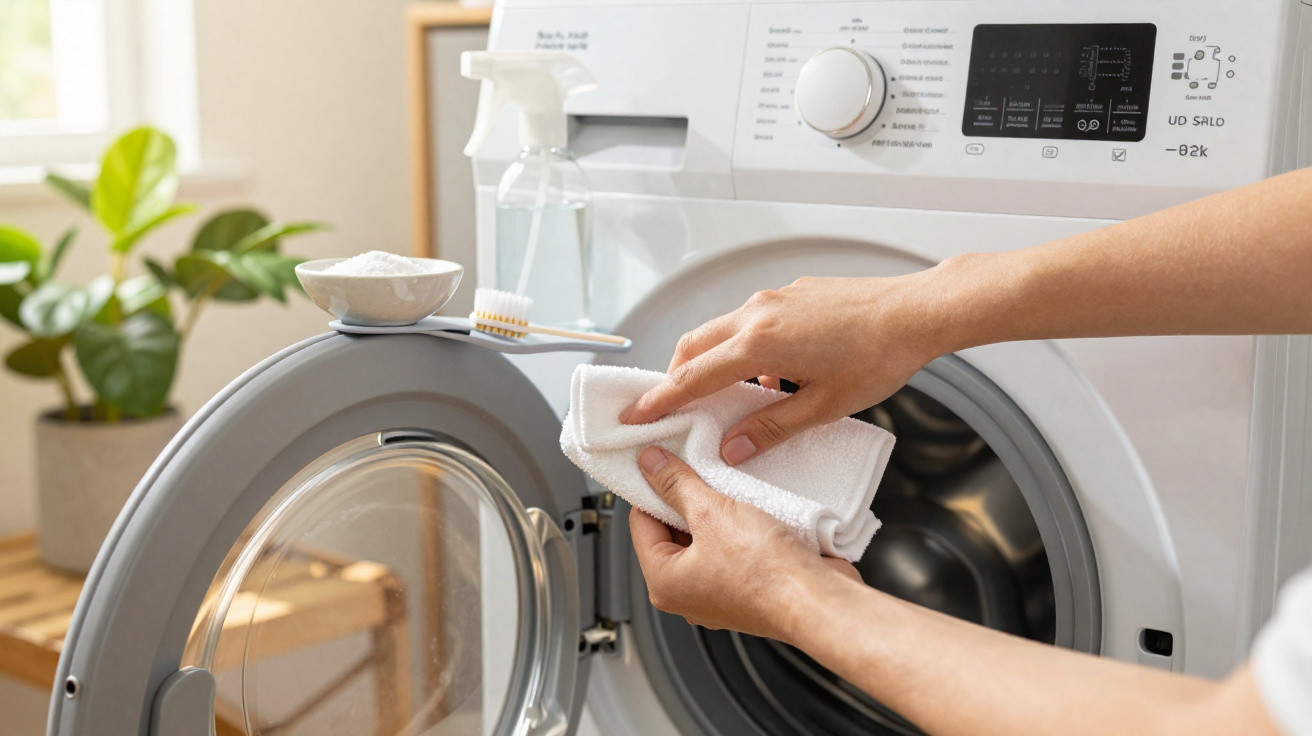
Do you know that sour smell that seems to appear from nowhere when you open the washing machine door?
The scene is nearly always the same: the clothes are clean and soft, yet there is a musty undertone coming from the rubber seal, hidden there and staring back at you. You pull the seal aside with your fingers and spot tiny black marks clinging to it, along with some dark slime tucked into a corner. Then you wonder: “But I only wash clothes here, so how does this happen?” The machine, which ought to represent a well-kept home, suddenly becomes the prime suspect behind an invisible mess. At that point, many people shut the door, pretend they saw nothing and carry on. Others grab any old sponge and start scrubbing in a rush, without really knowing what they are doing. The truth is that this mould conceals an entire routine - and one simple habit that almost nobody adopts.
Why does the washing machine rubber seal become mouldy so quickly?
The washing machine rubber seal, especially on front-loading models, is a small hidden world. It sits there in folds, collecting splashes of detergent, lint, fabric conditioner residue and, of course, standing water. It is the ideal setting for mould to set up camp. At first, most people pay it little attention. We simply want our clothes to come out smelling fresh, full stop. Yet, gradually, that “damp” smell starts taking over the drum. It even begins to appear when the machine is empty, as though it were giving off a secret stored away for months. Everyone notices too late.
In many homes, the same scene unfolds according to an almost identical script. During the first few months, the washing machine is new, spotless and untouched. After a year, it has splash marks, a little dust and hardened detergent in the drawer. The rubber seal then becomes the blind spot: nobody cleans it and nobody checks it. Only when the smell starts reaching down the hallway does the alarm go off. Some people pour in litres of vinegar, while others resort to undiluted bleach. Some become so frustrated that they consider buying another machine, believing that “once it has mould, that’s it”. It is a quiet waste of both money and patience.
Mould does not appear because the machine is somehow at fault. It is essentially the result of three things: constant moisture, limited airflow and organic residue. Contrary to what many people assume, detergent and fabric conditioner also feed fungi when they build up in damp corners. The seal does not fully dry between cycles, particularly when the door remains closed all the time. We treat the machine as though it were a cupboard. In the end, we forget that it is almost a miniature damp environment. And mould, like any occupant of a crevice, loves a place like that.
Simple habits that stop mould forming on the washing machine rubber seal
The first step is so obvious that hardly anyone does it: leave the washing machine door slightly open after every wash. That alone changes everything. Air can circulate, the rubber seal dries more quickly and mould loses its foothold. Another effective habit is to wipe the seal with a dry or slightly damp cloth whenever you finish the final wash of the day. Nothing elaborate is needed. Use a microfibre cloth, spend one minute on it and focus on the folds where water tends to sit. Once a week, it is worth using a mixture of warm water and white vinegar to clean the seal, working calmly all the way around it. It works almost like a quick behind-the-scenes clean.
Common mistakes make matters much worse. Many people use too much washing powder and fabric conditioner, believing that more product means cleaner clothes. In reality, the excess collects on the rubber seal and forms a crust that traps moisture and grime. Others close the door as soon as they have removed the washing, “so it does not get dusty”. Let’s be honest: nobody carries out the ideal machine cleaning routine every day. Still, keeping the door slightly open and cleaning the seal once a week is already a major step forward. It does not need to become a demanding ritual. It is a small habit with a big effect.
As one housewife I interviewed for a report on household appliances put it: “When I understood that the machine needs air too, the smell in the laundry room changed”.
- Cleaning the rubber seal with warm water and vinegar once a week drastically lowers the risk of mould.
- Leaving the door slightly open after use helps the internal parts dry and removes the constant moisture.
- Using the correct amount of detergent and fabric conditioner prevents sticky build-up on the rubber seal.
- Removing visible coins, hair, pet fur and lint from the seal stops them becoming a breeding ground for fungi.
- Running a self-clean cycle or a hot wash once a month helps keep the drum and rubber seal healthier.
What changes at home when the washing machine no longer smells of mould
When the rubber seal is clean, dry and free from dark marks, the washing machine returns to its quiet role as an ally in the daily routine. Clothes come out smelling of detergent rather than carrying that “closed cupboard” undertone. The laundry area stops being the corner of the home you avoid showing visitors. Even people living in a small flat notice a difference in the air. The feeling that the machine is “looked after” also changes how we relate to it. It may sound exaggerated, but it is not: a clean appliance makes less noise, lasts longer and causes fewer headaches. In the middle of a busy routine, that is worth its weight in gold.
There is an interesting point: when someone discovers the right way to prevent mould on the rubber seal, they often become a source of the information for others. They tell their mum, their neighbour, send a video to the family group chat or make a loud reminder: “Everyone, leave the washing machine door open!” Small household habits spread this way, almost like a good rumour. Perhaps you have already heard a home remedy, tried one mixture or another and felt disappointed. Even so, your machine’s rubber seal is still there, waiting for care that is simple, ongoing and achievable. And the next wash cycle could be the ideal time to start changing that story.
| Key point | Detail | Value for the reader |
|---|---|---|
| Ventilation after washing | Leave the door slightly open until the rubber seal has dried completely | Reduces moisture and removes the ideal environment for mould |
| Weekly rubber seal cleaning | Use a cloth with warm water and vinegar on folds and corners | Removes residue before it becomes dark marks and a strong smell |
| Correct use of products | Follow the detergent and fabric conditioner quantities stated by the manufacturer | Prevents sticky crusts that feed fungi and bacteria |
FAQ:
Question 1 Can I use bleach to remove mould from the rubber seal? Yes, it works in many cases, but it must be diluted in water and used carefully, as it can dry out the rubber over time. Apply it with a cloth or soft sponge rather than pouring on a large amount directly.
Question 2 How often should I clean the washing machine rubber seal? For ordinary household use, a quick weekly clean is usually enough. If the home has many occupants or the machine is used heavily, checking it visually every two days helps catch mould at the very beginning.
Question 3 If the mould is already very black, can it still be dealt with? In most cases, yes. Use a stronger mixture of warm water, vinegar and a little bicarbonate of soda, scrubbing patiently. If the rubber seal is cracked or misshapen, it may be time to consider replacing the part.
Question 4 Do top-loading washing machines also get mould on the rubber seal? They do, but it tends to happen less often because the top lid allows more natural ventilation. Even so, the rubber edge and the inside of the lid can retain moisture and need attention.
Question 5 Does using a self-clean cycle solve the problem on its own? It helps a great deal, but it is not a miracle cure. The self-clean cycle looks after the drum and internal parts, but the rubber seal still needs manual care with a cloth and a watchful eye.

Comments
No comments yet. Be the first to comment!
Leave a Comment