
You switch off the light, rest your head on the pillow and… something feels wrong.
The pillowcase is perfectly clean, yet beneath it you can see an old yellow outline, almost like a map of restless nights. It is a little embarrassing, especially when a family member decides to change the bedding and comes across it. Everyone insists they wash things properly, bought a “stain-resistant pillow”, or uses a protective cover. Even so, the white gradually disappears, day after day. Sweat, natural skin oils, forgotten make-up, moisturiser that had not dried. It all remains there, absorbed into the fabric. The truth is that a pillow records how we sleep, breathe, sweat and live. Up close, that story is not always pretty. The question remains simple, and rather persistent.
Why do white pillows turn yellow so quickly?
Anyone who has unzipped a pristine white pillowcase only to find a yellowed pillow underneath knows that quiet shock. It almost instantly feels unclean, even if it was washed not long ago. This is especially common in warm homes, poorly ventilated bedrooms and during long summer nights. The fabric absorbs everything without a word. It only complains when daylight hits it and exposes the damage. From a distance, the pillow may still look passable. Close up, though, there are uneven marks, darker edges and a faded centre. It is the sort of detail many people prefer to hide from guests.
An internal market survey by a major bedding and bath linen retailer found that yellowing is one of the main reasons people replace a pillow, ahead of discomfort or loss of shape. That says a great deal. Some people keep an old pillow for years, but discard the poor thing as soon as its stains move from “acceptable” to “embarrassing”. A housewife from Campinas summed it up simply in an interview: “If my mother-in-law is going to sleep here, I buy a new pillow”. This everyday situation, partly funny and partly tense, shows how much the appearance of a bed affects our sense of care.
In reality, yellowing is not simply “lazy dirt”; it is everyday chemistry. Sweat contains mineral salts, urea and oils. Skin sheds dead cells, while hair and facial hair release oils, and cosmetics leave behind residue. All of this works its way into the fibres, particularly synthetic ones. Over time, the mixture oxidises, changes colour and becomes set in. A pillow acts like a silent sponge, taking in what the sheet fails to hold back. Infrequent washing speeds up staining. Washing too often, or incorrectly, can cause it to lose its shape. Finding the balance means understanding the material, choosing the right cleaning frequency and paying attention to one detail that many people overlook: layered protection.
A smart routine to keep white pillows brighter for longer
The single habit that makes the greatest difference is straightforward: place two barriers between yourself and the pillow filling. Use a zipped protective cover, then put the pillowcase over it. The cover catches heavier sweat, skin oils and even splashes of night cream. The pillowcase, which is what everyone sees, is then easier to wash. Ideally, choose a cotton or jersey cover that feels cool, as plastic-lined covers trap heat and can disrupt sleep. Washing this cover at least once a month greatly reduces yellowing on the pillow itself. It is like fitting a filter to a camera lens.
When life is busy, many people keep just one set of pillowcases in use and another “for visitors”. This means the gap between washes grows longer, particularly during cold or rainy weeks. Let us be honest: nobody changes all their bedding every day. Yet the pillow is the item that suffers most from the delay. For someone who sweats very little, changing the pillowcase every 7 days is a good routine. Anyone who sweats more, or uses make-up, gel, hair oil or rich cream, benefits greatly from changing it every 3 or 4 nights. It is not fussiness; it is quiet prevention against that dreaded yellowing.
“A white pillow is not kept clean with a thousand miracle products; it is kept clean through consistent habits,” said a hotel housekeeper who washes dozens of them each week.
She describes a routine that can be adapted at home with only a few changes:
- Change the pillowcase regularly instead of waiting until it “looks dirty”.
- Use a washable protective cover, preferably one with a full zip.
- Machine-wash the pillow only if the care label allows it, always using a gentle cycle.
- Dry it thoroughly in the sun or in a tumble dryer, without rushing, to prevent internal mould.
- Leave the pillow spread out on an unmade bed during the day so it can air, rather than keeping it trapped beneath blankets.
Homemade solutions and tricks that genuinely work for white pillows
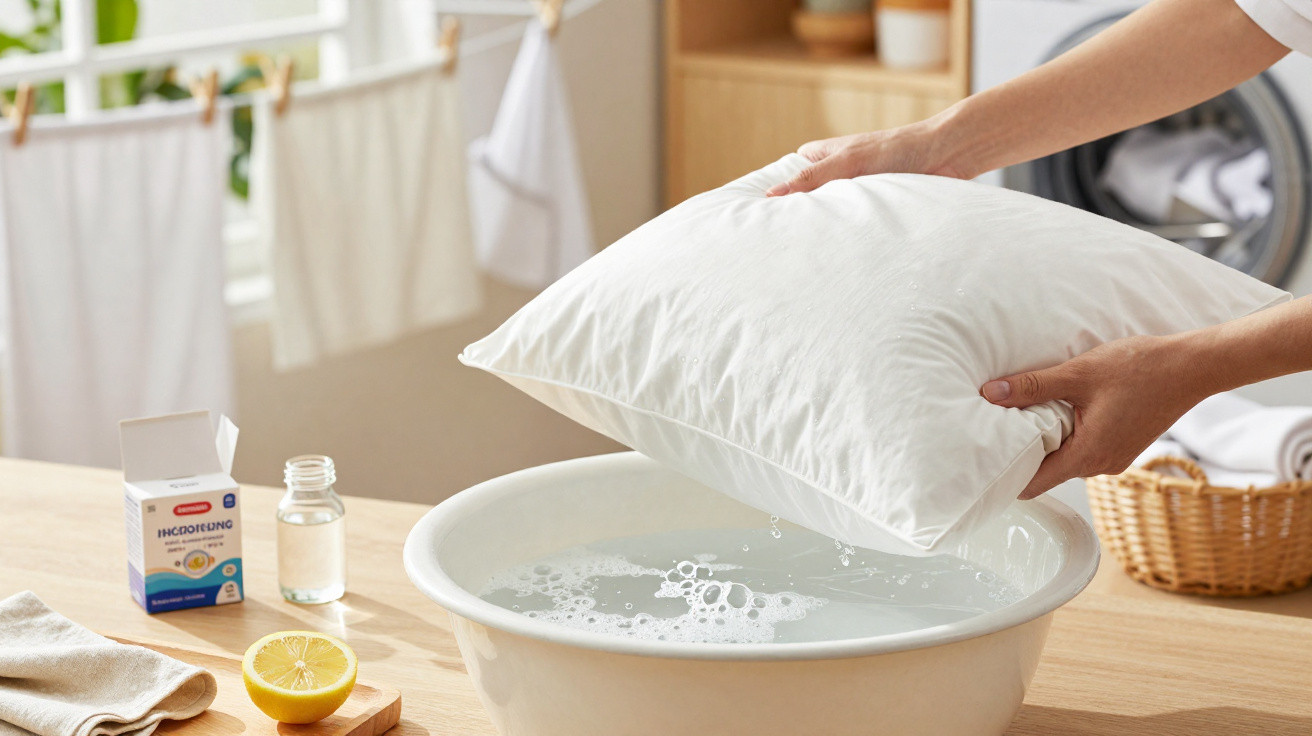
One approach that many people underestimate is a “smart pre-soak”. Before putting the pillow in the washing machine, leave it in a bucket for 30 to 60 minutes with warm water, one tablespoon of bicarbonate of soda and a little mild liquid soap. This mixture helps loosen the embedded oils responsible for yellowing. Where the care label permits chlorine, you can add a small amount of bleach designed for white laundry. For more delicate pillows, use a chlorine-free bleach based on active oxygen. It is not instant magic, but with repeated treatment, the white can begin to look fresh again.
People who have tried to remove all the yellowing in one go with excessive amounts of harsh product often have disaster stories: a torn cover, clumped filling, or a pillow that comes out of the machine looking like a deflated loaf of bread. Rushing is the enemy of whiteness. It is better to tackle stains gradually, over several gentle washes, than to try to undo years of neglect in one attempt. There is an emotional side to it too: nobody wants an impossible laundry routine that they cannot maintain. Keeping pillows white needs to be realistic, something that fits into an ordinary week of work, children and tiredness. Otherwise, it becomes another perfect plan that never gets put into practice.
A dermatologist interviewed for a report on night-time allergies put it plainly: “A clean pillow is not only a matter of appearance; it is a matter of respiratory and skin health”. According to her, combining good habits delivers far more than relying on last-minute chemical miracles.
- Use warm water, rather than boiling water, to avoid damaging sensitive fibres and fillings.
- Do not soak the pillow in fabric softener

Comments
No comments yet. Be the first to comment!
Leave a Comment