
You notice it before it comes into view: that faint crunch beneath your sock as you walk through the kitchen, the small betrayal of a crumb left behind after last night’s “quick tidy”. The worktop appears clean and so does the table, but the floor says otherwise. There is a toast crust here, cereal scattered there, and a light coating of pastry by the skirting boards, as though somebody has attempted to garnish the house with breadcrumbs.
Then comes the sigh and the familiar calculation: brush, vacuum, or “I’ll deal with it later”?
There is an easy way to prevent that entire scene before it begins.
Hardly anyone does it.
The quiet reason your home is always just a bit crumb-covered
Watch somebody eat toast above a keyboard, or hand a child a biscuit on the sofa, and you can almost see each crumb plotting its route out. They travel down sleeves, tumble from plates and ricochet off cushions. Once the final mouthful has gone, the table, floor and clothes have all quietly become part of the clean-up area.
Oddly, we simply accept this as normal. “That’s just crumbs, they happen,” we say to ourselves while already imagining reaching for the dustpan.
Consider breakfast, perhaps the day’s biggest producer of crumbs. There is sourdough, a croissant, or a bowl of cereal that always seems to miss the spoon. Now multiply that by everyone in the household, every morning of the week. One UK cleaning company estimated that families spend up to 20 minutes a day dealing solely with table and floor mess after meals.
It may not seem like much, until you work out that it amounts to more than two entire days each year spent pursuing crumbs you never wanted in the first place.
Crumbs are particularly elusive because they do not land in a single obvious heap. Instead, they spread through micro-zones: beneath the toaster, between chair legs and along the cutting board’s edge. Eventually your brain overlooks them, but your feet, socks and vacuum filter continue to keep track.
The real problem is not the crumbs themselves. It is that we respond only once they have already spread everywhere. We remain in a constant state of dealing with the aftermath, rather than quietly changing the routine so that the mess scarcely develops at all.
The forgotten trick: create a crumb zone before you take the first bite
The solution is almost comically straightforward: provide every crumb with somewhere to land. Before anything starts, make one contained area beneath the activity.
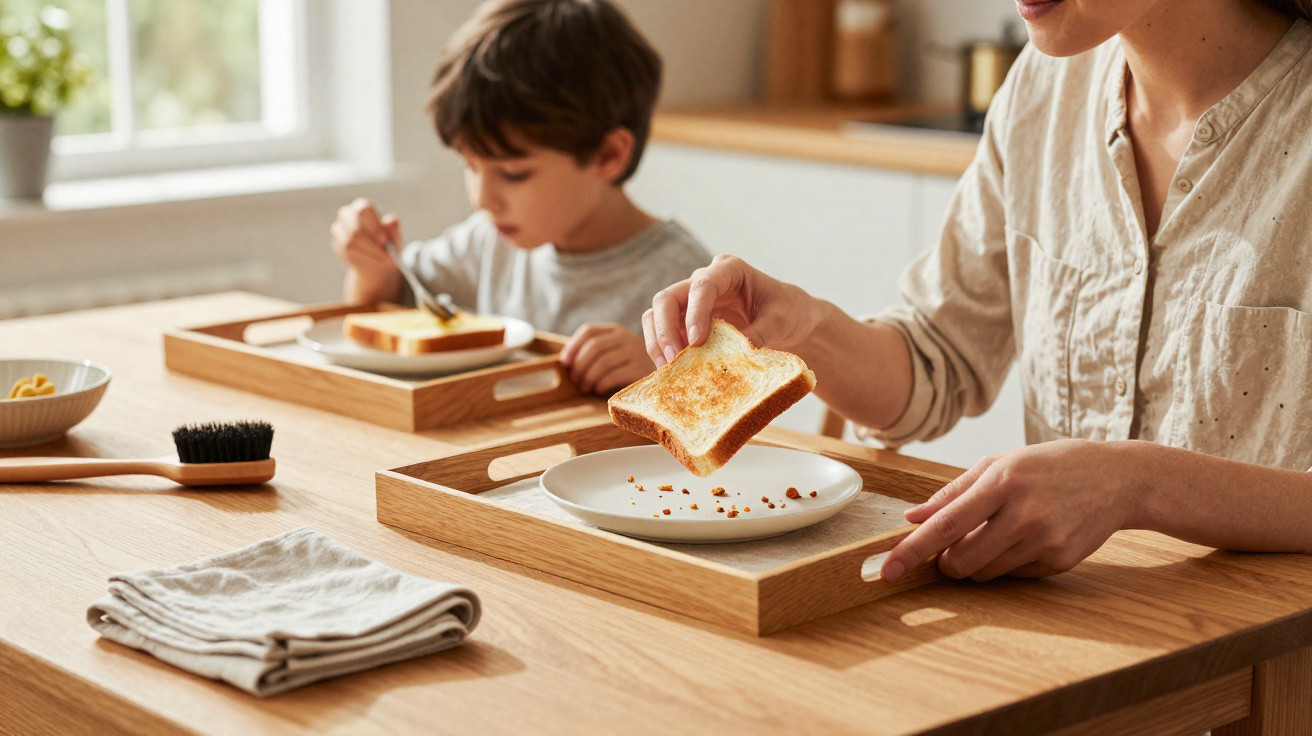
Use a tray, a rigid placemat or even a baking sheet as a designated “crumb zone”. All crumb-producing activities take place on that surface: cutting bread, buttering toast, eating pastries and making snacks. No exceptions, and no “just this once on the sofa”.
Rather than having 360 degrees of freedom, crumbs suddenly meet a boundary.
Most people see placemats as decorative items, or something reserved for visitors. This approach is different. It means using a surface with raised edges, or at least clear limits, as a small stage on which all the mess is permitted to happen.
Imagine a child eating a biscuit over a tray on the coffee table rather than directly above the fabric sofa. Or picture your morning toast on a cutting board that stays firmly on the worktop, rather than hovering awkwardly between the sink and the floor. The crumbs do not vanish by magic; they simply end up landing together.
This is the understated brilliance of the method: tidying changes from “hunt and gather” to “lift and dump”.
There is no need to circle the table with a sponge or kneel down to sweep the strip of toast dust beneath a chair. Pick up the tray, tip its contents into the bin, and the task takes seconds. Of course, nobody will do this every day with military precision. But even using the trick for half of your meals can immediately reduce daily cleaning time and that ongoing thought of, “How is there always something under my feet?”
You’re not cleaning more, you’re just cleaning smarter and earlier.
How to set up your crumb zone so it actually works in real life
Begin with whatever you already own: a baking tray, wooden board, sturdy plastic tray or even the solid lid from a storage box. What matters is a defined edge or visible boundary-something your mind recognises as the place where mess belongs.
Put it where the crumbs begin: beside the toaster, underneath the bread knife or on the coffee table where snacks seem to multiply without explanation. Whenever you serve something crisp or flaky, place it on the tray first, rather than directly onto an unprotected table or sofa arm.
The biggest error is viewing the crumb zone as something for special occasions rather than a regular habit. You use it twice, feel pleased with yourself, then forget it as soon as you are hungry or rushing. We have all had that moment when you think, “I’ll grab a plate in a second”, only to find yourself halfway through a croissant over the laptop.
Go easy on yourself. This is not about getting it right every time; it is about gently adjusting your routine. Leave the tray on display rather than tucked away in a cupboard. Keep it where your hand naturally reaches in the morning. If it is simple to grab, you are ten times more likely to use it.
“Once we introduced a ‘crumb tray’ at home, the difference was ridiculous,” laughs Emma, a mother of three who works from her kitchen table. “The kids joke that snacks aren’t allowed to cross the tray border. I spend less time sweeping and more time actually sitting down.”
- Use one tray per “crumb hotspot”
Give the kitchen worktop, coffee table and children’s snack area their own zone. - Choose a surface that wipes clean in seconds
Avoid fabric and tiny grooves that hold crumbs forever. - Make it visible, not pretty-but-hidden
The most effective system is the one you can see and pick up without having to think. - Pair it with a tiny brush or cloth nearby
That makes clearing up a 10-second reflex instead of a larger chore. - Turn it into a family rule, lightly
“Crumb food on the crumb tray” is straightforward enough for children to understand.
From crumbs to calm: a tiny habit that changes the feel of your home
There is something surprisingly soothing about walking into a kitchen that is not quietly telling you, “you’ll have to clean me later”. No stray flakes under bare feet and no cereal lodged in corners of the skirting boards, silently taunting you. Instead, there is simply the sense that mess has a place-and that place is not everywhere.
This habit will not make your home look like a showroom. Everyday life still takes place. Children will keep dropping things, friends will still laugh while holding a biscuit, and your own late-night snack may escape the rules on some evenings. Even so, introducing a crumb zone subtly changes the pattern of ordinary household mess.
After a week or two, you may realise that you vacuum less frequently, wipe the table more quickly and put more energy into cooking, talking and enjoying meals rather than carrying out cleaning operations. It is a tiny, almost unnoticed choice: plate or tray, sofa or crumb zone. Repeated a hundred times, it reshapes the map of your home.
Some people make cutting boards into permanent breakfast stations. Others place a shallow tray under the toaster and never return to the old way. A few keep a rigid placemat beside the laptop and keep snacks away from the bare keyboard area. The versions vary, but the idea stays the same.
You may create your own approach. It could be an attractive wooden board kept on the coffee table, a metal tray for outdoor snacks or a child-approved, sticker-covered “crumb island” that gives them a sense of control. The item itself is not the point; the boundary is. It is the moment your brain quietly decides: crumbs land here, not there.
Once you see how much calmer the room feels, you might start introducing other small “zones” around your home. A bowl for keys by the door, a tray for post instead of random stacks of paper, or a line for shoes rather than hallway chaos. They are all related forms of the same principle: give mess a gentle place to land before it spreads into everything.
| Key point | Detail | Value for the reader |
|---|---|---|
| Define a crumb zone | Use a tray, board, or rigid placemat under all crumb-heavy foods | Reduces scattered crumbs on tables, floors, and sofas |
| Keep it visible and easy | Store the crumb tray where you eat or prep, not in a cupboard | Makes the habit natural instead of one more “rule” to remember |
| Shift from reaction to prevention | Clean the tray in seconds instead of chasing crumbs around the house | Saves time, energy, and keeps the home feeling tidier with less effort |
FAQ:
- Question 1 Do I really need a special tray, or can I just use a plate?
- Question 2 How do I get my kids to actually use the crumb zone?
- Question 3 What if I have a very small kitchen?
- Question 4 Won’t a tray permanently on the table look messy?
- Question 5 Does this trick work for pets’ food areas too?
Comments
No comments yet. Be the first to comment!
Leave a Comment