
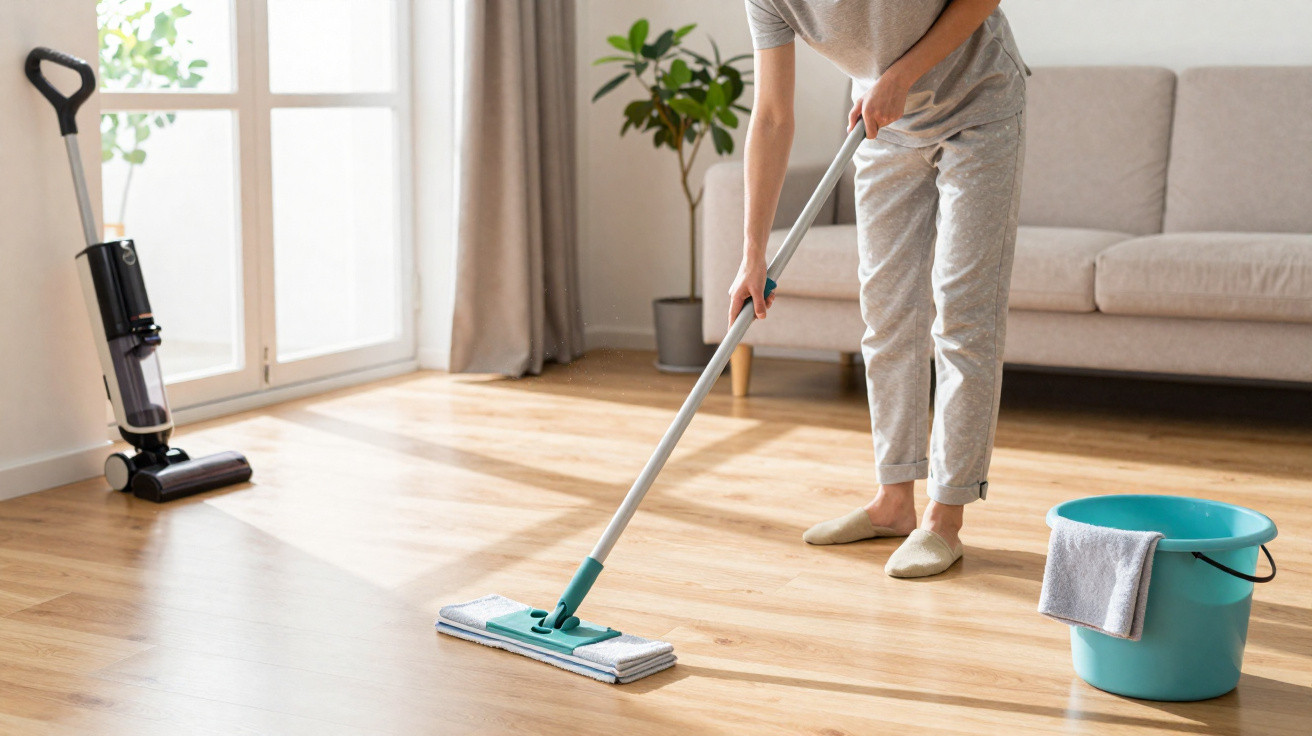
You mop on Sunday, admire the spotless tiles and promise yourself they will stay that way. By Monday evening, though, the light catches the floor from an unflattering angle and there it is once more: a grey film, a few uninvited crumbs and dust that appears to have doubled overnight.
You blame the children, the cat, shoes or polluted city air. You reach for a cloth, give the floor a hurried wipe, and find yourself facing exactly the same problem the following day. There is another coating, another small loss in the endless battle with dust.
Then, one day, a neighbour says quietly, “You’re probably cleaning in the wrong order.”
That one remark can change everything.
The invisible choreography of dust in your home
Walking through a room does more than carry you from one place to another. It drives an unseen current of air ahead of you, lifting dust, pet hair, skin flakes and minute fibres from clothing. Everything that eventually reaches the floor has not simply dropped straight down. It has travelled first.
This is why even a professionally mopped floor can have a dusty coating by the next morning. Although you cleaned the surface, the air still contained particles. After you left the room, gravity took over and the dust settled again on your freshly cleaned floor.
The real problem, then, is not only the floor itself but the path dust follows before it gets there.
A cleaning specialist once demonstrated this with a straightforward test in a small flat. We shut the windows, waited for an hour, and then aimed a torch sideways across the living room. Its beam revealed a thick cloud of particles floating in the air. Nothing in the room had been disturbed, yet the air seemed filled with snow.
Next, we vacuumed the carpet but left the shelves and furniture untouched. An hour later, the torch showed virtually the same cloud. By the following day, the floor felt gritty under bare feet again. The dust had not returned; it had never properly gone away.
When we changed the sequence, cleaning surfaces before the floor, the difference the next morning was remarkable. There was still a little dust, naturally, but nothing close to that grey veil.
Dust is rather like an idle traveller. It remains airborne for as long as possible, relying on air movement and your own activity to carry it along. Eventually, it lands on the first available horizontal surface: bookcases, television units, window sills and, finally, the floor.
When your cleaning routine begins with the floor, you are tackling the final destination before addressing the earlier stops. Dusting a shelf after mopping releases another layer of fine particles into the air. They do not disappear; they drift down gradually, often hours later, once the mop has dried and you are sitting back on the sofa.
To clean floors so they remain cleaner for longer, you need to work with this choreography and reverse its order.
The right order for clean floors: top to bottom, dry to wet
The approach is surprisingly straightforward: begin at the top and finish at the bottom; start dry and end wet. Picture the room in vertical sections. Deal with the ceiling and upper shelves first, followed by furniture at middle height, then skirting boards, and only after that the floor.
For furniture and other surfaces, use a dry or barely damp microfibre cloth, drawing dust towards yourself rather than flicking it into the air. For floors, progress from dry equipment to wet tools: vacuum or use an effective dust mop first, then mop lightly with as little water as your particular floor permits.
This is more than a routine; it is an order that reflects the way dust truly travels.
On busy days, most of us do precisely the reverse. We take whatever is closest, often an ordinary broom or an overly wet mop, rush around the floor and feel that we have at least “done something”. Afterwards, we spot a mark and dust the television unit or coffee table.
You are then left with clean tiles beneath a cloud of microscopic debris drifting down from the furniture you have just wiped. Before bedtime, that invisible shower has settled. By the following morning, the floor exposes the truth about yesterday’s shortcuts.
Realistically, nobody follows this process every single day. That makes using the correct order on the days you do clean even more important.
“Once I started cleaning my living room top to bottom, I cut my floor mopping in half,” admits Léa, a busy nurse who used to mop three times a week. “The dust still comes, of course, but not like that depressing gray film after just one night.”
- Dust and wipe upper surfaces first, including shelves, frames and the tops of cupboards.
- Move on to middle-level areas, such as tables, television units, desks and chair backs.
- Deal with the lower sections last: skirting boards, furniture sides and floor edges.
- Vacuum or use an electrostatic or dust mop before applying any wet product to the floor.
- Finish with a lightly damp mop, rinsing it frequently and working from the furthest corner towards the exit.
Small habits that keep floors clean beyond tomorrow
Once you have mastered the order, the habits surrounding it are almost as important. Ventilating the room before you clean, for instance, helps remove some of the dust suspended in the air rather than merely moving it around. Ten minutes of proper airflow can make more difference than you might expect.
Another helpful change is replacing worn cotton cloths with good microfibre ones. Their fibres catch particles instead of simply shifting them elsewhere. The same principle applies to floors: a vacuum cleaner with an effective filter captures dust rather than expelling it from the back. Even a basic model that is well maintained is more effective than frantic sweeping, which sends particles back into the air.
These may be minor habits, but together they can prolong that freshly cleaned-floor feeling by several days.
| Key point | Detail | Value for the reader |
|---|---|---|
| Clean from top to bottom | Begin with high surfaces and end with the floor | Less dust settles again after mopping |
| Work from dry to wet | Vacuum or dust mop first, then use a damp mop | Dust is captured rather than spread around |
| Choose suitable tools | Microfibre cloths, a decent vacuum and a lightly damp mop | A longer-lasting clean with less effort |
FAQ:
- How often should I really clean my floors? For most households, vacuuming or dry mopping properly once or twice weekly is sufficient, followed by damp mopping every one to two weeks. Busy spaces, including kitchens and hallways, may require attention more often.
- Is sweeping worse than vacuuming for dust? Using a stiff broom generally throws fine dust into the air. A vacuum with a clean filter, or a high-quality dust mop, captures considerably more dust and prevents it from resettling as quickly.
- Do I need different products for each type of floor? Yes, although there is no need to overcomplicate things. Wood and laminate need very little water and mild cleaners, whereas tiles can tolerate slightly stronger products. Always follow the manufacturer’s guidance for your specific flooring.
- Why does my floor feel sticky after mopping? This usually happens because too much product has been used or the mop has not been rinsed enough. Apply only a small amount of cleaner, rinse the mop frequently and replace the water as soon as it becomes cloudy.
- Can I skip dusting furniture if I only care about the floor? You can, but dust from those surfaces will still settle on the floor within hours. Dusting upper surfaces first is one of the simplest ways to keep floors cleaner for longer.

Comments
No comments yet. Be the first to comment!
Leave a Comment