
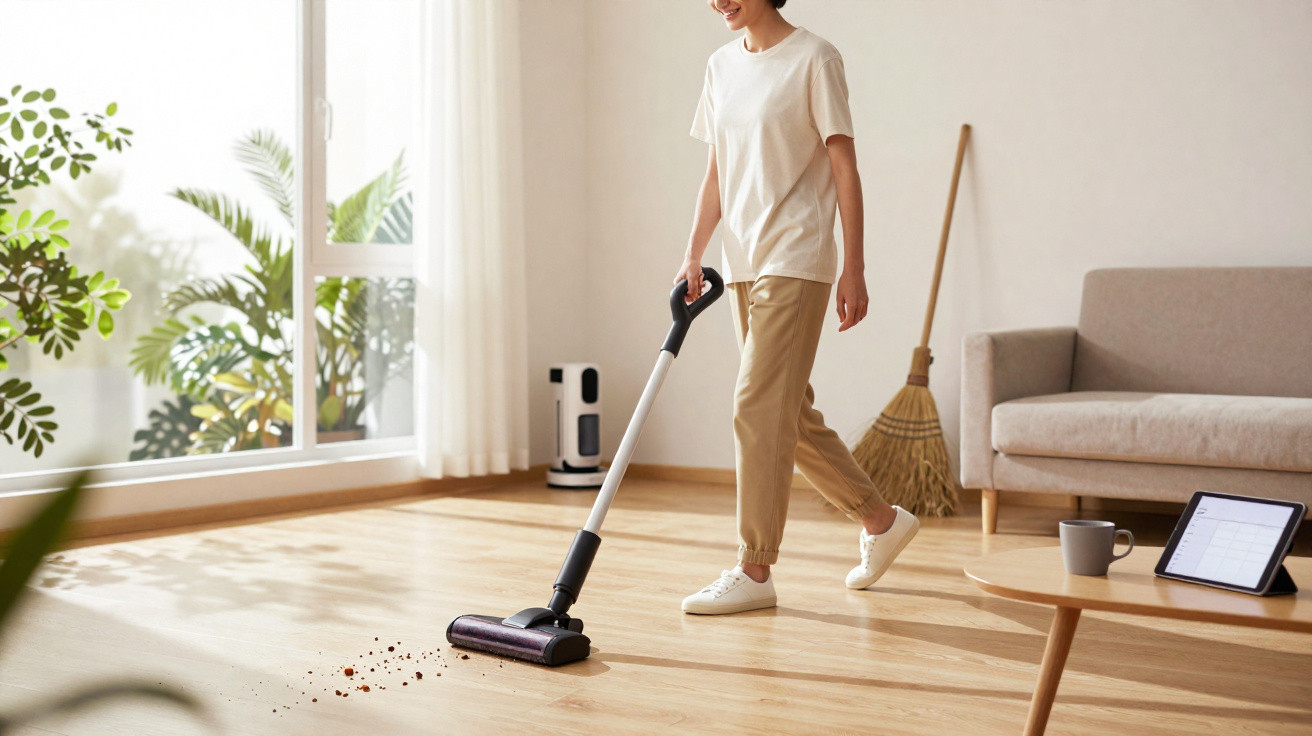
For generations, the broom has been a staple in Brazilian homes. Yet, over the past few years, something has quietly shifted in everyday cleaning. The cordless vacuum cleaner-lightweight, portable and battery-powered-has taken off so quickly that it has become the go-to for people in flats, households with pets, or anyone who no longer wants to lose an entire weekend afternoon to cleaning.
The problem the broom never truly solved
Traditional brooms have a built-in drawback that anyone with rhinitis or allergies knows all too well: they do not remove dust; they spread it around. Bristles push debris back and forth and kick up fine particles that can hang in the air for minutes before settling elsewhere. On top of that, you still need a dustpan-which rarely collects everything-and it often leaves you having to follow up with a damp cloth to pick up what remains.
Add in the constant postural strain that comes with sweeping: a bent spine, pressure through the arms, and cumulative wear for anyone doing it day after day. A broom gets the job done, but it is not as efficient compared with what is now available at increasingly accessible prices in the Brazilian market.
- Genuinely faster cleaning: dirt is sucked up immediately-no dustpan, no extra wipe afterwards-cutting down the number of steps in the clean
- Less dust left airborne: vacuuming instead of sweeping stirs up far fewer particles, which matters a great deal for people with rhinitis or asthma
- Pet hair without the battle: interchangeable motorised brushes are designed specifically to lift dog and cat hair from rugs, sofas and awkward corners
- Freedom without a cable: 30 to 60 minutes per charge is already enough for daily cleans in flats and medium-sized homes, without relying on sockets
- Works across surfaces: one device can handle hard floors, rugs, sofas, mattresses, cars, high shelves and tight spaces by simply switching the nozzle
The habit change that comes with the device
One of the most interesting changes driven by a cordless vacuum cleaner is not technological-it is behavioural. Rather than cramming the entire clean into one overloaded day, many users shift to what specialists call micro-cleaning: quick 5–10 minute bursts across the week that keep the home under control without concentrated effort.
This is particularly effective in compact flats, which dominate the Brazilian property market in major cities. Because it is so easy to pick up, use and put away a vacuum without uncoiling cables or hunting down a dustpan, the psychological resistance to daily cleaning drops. The end result is a cleaner home with less total effort, even without doing a traditional deep clean every weekend.
What to assess before choosing the right model for your home
The Brazilian market already offers a wide range of cordless vacuum cleaners, with meaningful differences in performance, run time and price. Before buying, it is worth mapping what you genuinely need day to day: the size of your home, whether you have rugs and pets, and how often you plan to use it will determine which type offers the best value.
Checklist for choosing the right cordless vacuum cleaner
Six criteria determine whether the device will fit your routine.
Battery run time: for small flats, 25 to 30 minutes is usually enough. Larger houses may need 45 to 60 minutes at medium power.
Suction power: crucial for rugs and pet hair.
Weight: heavier models can tire your arm during longer cleans.
Bin capacity: the smaller it is, the more often you will have to stop and empty it.
Filter quality: models with a HEPA filter capture finer particles, which matters for people with allergies.
Also check that the included accessories suit the surfaces in your home: a narrow crevice tool for corners and skirting boards, a motorised brush for rugs and hair, and an upholstery tool for sofas and mattresses. 2-in-1 models that convert into a handheld vacuum are particularly useful for cars and furniture.
One important detail that adverts do not always highlight: manufacturers’ run-time claims are typically measured at reduced power. In real life, if you use maximum power for rugs or pet hair, the time drops significantly. Be wary of “60-minute” promises if your everyday use is demanding, and try to test one-or at least check reviews from real users-before deciding.
The broom will not disappear, but it will lose its starring role
The trend is not that the broom will vanish entirely. It still has a place in gardens, open balconies, areas with soil, and situations where the debris is too coarse for a vacuum. However, inside the home-especially on hard floors, rugs and in homes with pets-a cordless vacuum cleaner already does the job more efficiently, more hygienically and with less effort.
What became firmly established in 2026 is a rebalancing of roles: the cordless vacuum cleaner handles quick, everyday cleaning, while the broom-when it is used at all-becomes an occasional back-up for specific situations. Once people make that switch, few choose to go back.
If you know someone who still spends more time than they would like sweeping every weekend, pass this on.
Comments
No comments yet. Be the first to comment!
Leave a Comment