
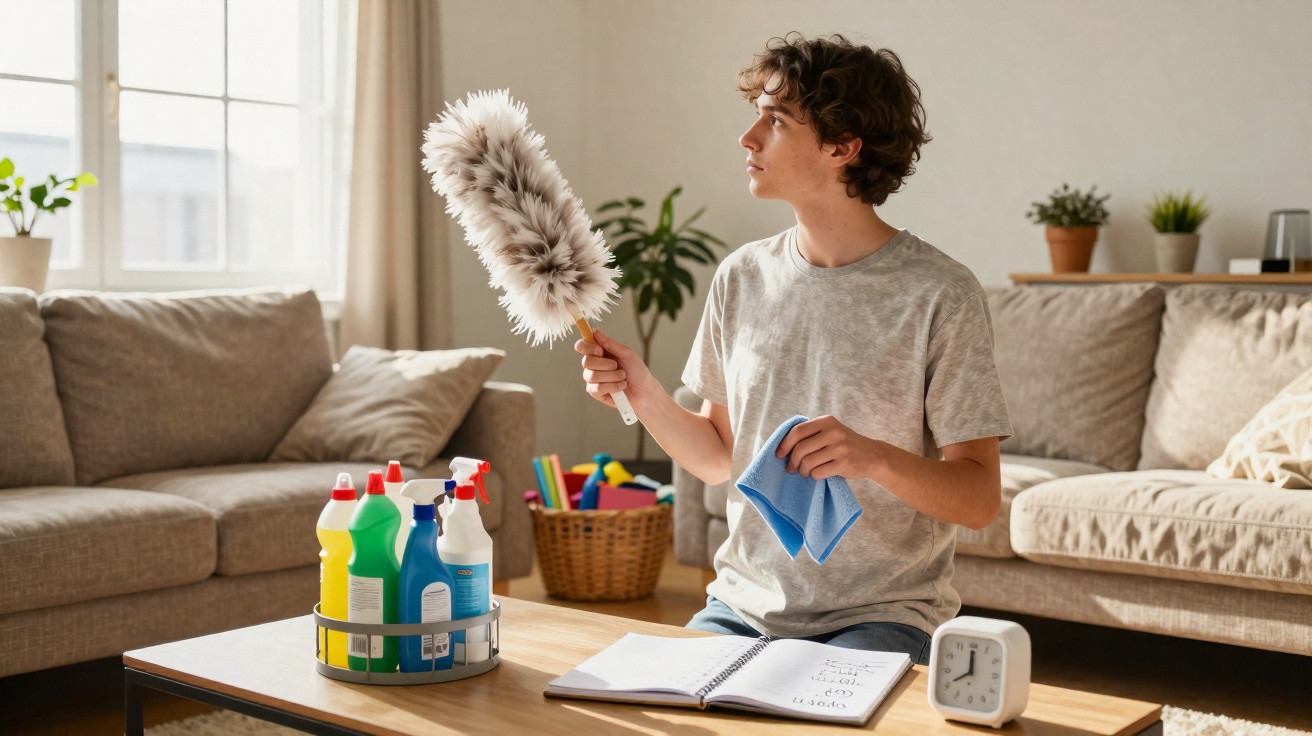
The realisation came to me on a Tuesday morning as I knelt down to scrub the skirting boards behind the sofa. My coffee had gone cold, emails were accumulating, and I had not even begun the day’s to-do list. Still, I was putting serious effort into cleaning a narrow strip of wood that no one ever notices.
I leaned back on my heels and asked myself why I was doing it. It was not a poetic question; it was a practical one, asked with growing irritation.
The room was not becoming more “clean”. It was simply becoming more managed, more controlled, more like a display of cleanliness than a space for living.
Then an uneasy little thought appeared.
What if some of my cleaning tasks were just stealing time without improving anything?
When “clean” turns into a full-time hobby
Some cleaning happens because something genuinely needs cleaning. Other tasks happen because we are anxious, bored, or pursuing an indistinct fantasy of a perfectly spotless home.
Once you pay attention, the distinction becomes obvious. Doing the washing-up makes a difference to the kitchen. Wiping already-clean plates before placing them in a shut cupboard is something else entirely.
I started recognising whole routines that made me feel industrious and responsible while changing nothing meaningful about my home. They were simply taking over my mornings, evenings and weekends.
The most embarrassing part was that I felt proud of them, as if I had reached an expert level of adulthood.
One afternoon, I timed the process from picking up the vacuum cleaner to dropping exhausted onto the sofa. It took fifty-eight minutes.
Afterwards, I looked around my flat with new eyes: not as the person who had just cleaned it, but as someone arriving for the first time. The sink was empty and the floor looked fine. Yet the fifteen minutes I had spent dusting the top of the wardrobe, standing on a chair balanced on a stool, had made no visible difference.
No one would notice it. I would not notice it either.
Most of us know that feeling: spending half an hour polishing something that has absolutely no effect on everyday life. It seems productive, while a quiet part of your mind keeps wondering why.
That day, I began placing chores into two mental groups: “life-changing” and “ego-soothing”. The life-changing jobs were easy to identify: laundry, washing-up, and putting out the rubbish before it begins to smell like a minor crime scene.
The ego-soothing jobs were less obvious. They tended to be painstaking, fussy and repetitive: cleaning inside drawers that are barely used, folding already-folded clothes again so the piles look “perfect”, or arranging books by height as though I lived in a boutique hotel.
The principle was straightforward. Some jobs noticeably improve hygiene, comfort or safety. Others mostly improve the reassuring story we tell ourselves about being “on top of everything”. The first category deserves daily or weekly energy; the second can move quietly into the “sometimes, when it honestly matters” category.
How to identify time-wasting cleaning at home
I eventually used a simple approach: for a week, I noted every cleaning job I did and roughly how long it took. It was not a formal system, just brief entries in my phone.
Alongside every task, I asked one additional question: “Can I feel or see a real difference tomorrow if I skip this?” When the truthful answer was no, that chore joined my “shrink or drop” list.
Wiping kitchen worktops stayed. Deep-cleaning the oven each Sunday changed to once a month, unless something had exploded inside it. Washing bedding stayed. Ironing pillowcases went directly into the “why did I even start doing that” category.
By the end of seven days, the pattern was frustratingly clear.
Some routines had plainly been inherited. My mum washed the floors twice a week, so a part of me believed grown-ups “should” do the same. But I live in a small city flat with neither children nor a dog. Weekly is more than enough.
Other habits had come directly from social media: those 20-step “night reset” routines in which someone polishes the sink until it reflects their soul. I realised that I had copied parts of them. The difference is that I do not film it; I simply lose the time.
Honestly, nobody does this every day. Nobody completes the whole performative routine without sacrificing something more worthwhile along the way.
The emotional pull is easy to miss. Cleaning can feel like control. When life is disorderly, your inbox is overflowing and your mind is noisy, folding tea towels into neat little rectangles can be strangely calming.
Yet it comes at a price. Time spent on low-impact cleaning does not appear from some supply of “extra hours”. It is taken from sleep, rest, reading, conversation, thought, time with your children, staring at the ceiling, or doing nothing at all.
Eventually, I had to ask myself whether I was polishing skirting boards because they mattered or because it was easier than facing the unfinished project on my desk.
Giving yourself an honest answer to that question stings a bit.
Designing a home that remains “good enough” with less effort
Once you recognise the pattern, there is a more useful response than scrubbing without end: arrange your home so that it can remain “good enough” with less effort.
One helpful change is to think in terms of zones rather than separate little spots. Kitchen worktops, the floor, the bathroom sink, the bed and the sofa area became my priority zones. They deserved regular attention because they are the places where I actually spend my time.
Everything beyond those zones went onto a flexible timetable: high shelves, storage boxes, beneath the bed, and that mysterious drawer full of cables. They were not neglected; they just stopped being allowed to consume my weekday evenings.
This zoned approach made cleaning feel calmer: less panicked and more deliberate. The home did not become dirtier. It simply became more honest.
Tools matter too. Certain jobs feel never-ending because we are tackling them in the most difficult way. I replaced my vacuum cleaner, which constantly tangled, with a cordless model, and a 20-minute ordeal suddenly became a 7-minute sweep.
I also kept a small spray bottle and cloth in the bathroom. That turned a “big cleaning session” into a 30-second daily wipe while I waited for the shower to heat up. It required little effort but made a noticeable difference.
Many of us make the same mistake by trying to defeat chaos through willpower alone. We give ourselves lectures about discipline, when what may actually help is a better basket, a hook by the door, or permission to have one junk drawer without apologising for it.
At one point, I wrote my own small set of rules. There was no attractive print-out and no pastel planner, only a few lines on a sticky note above my desk.
“Clean for function, not for performance.
If nobody can feel it, it can probably wait.
Your home is allowed to look lived-in.”
Beside it, I made a small boxed list of the jobs that truly protected my sanity.
- Clear sink and counters once a day
- Quick floor sweep where we walk the most
- Fresh sheets every 1–2 weeks
- Bathroom surfaces wiped regularly
- One small declutter spot per week, no more
Everything else became optional seasoning: pleasant to have, but not compulsory. The relief was tangible.
When abandoning perfection creates space for better things
The oddest result of giving up time-wasting cleaning was not a messier home. It was a more peaceful mind. All at once, there was room between tasks and a little breathing space in the day.
I began reading in the evenings again rather than “just quickly” reorganising the spice rack for the third time. Instead of scrubbing inside the washing machine with a toothbrush, I phoned a friend. The flat remained completely acceptable, but my life felt a little more like my own.
There is a quiet kind of courage in deliberately choosing “good enough”, particularly if you were raised to believe that a worthwhile person keeps everything immaculate at all times. That story is burdensome. It leaves us kneeling with a sponge when we could be sitting on the balcony with a cup of tea.
Perhaps the real change is to treat cleaning as support for your life rather than the main event: background maintenance, not a personality. When you no longer pour energy into invisible, low-impact chores, you do not become lazy. You become available: for people, ideas, rest, and the kind of mess that actually leads somewhere.
| Key point | Detail | Value for the reader |
|---|---|---|
| Identify “ego-soothing” tasks | Keep track of cleaning for a week and mark jobs that make no difference when skipped once | Immediate clarity about what can be reduced or abandoned without guilt |
| Clean in priority zones | Prioritise areas used every day: kitchen, bathroom, bed and main floor | Less time spent while the home still feels properly clean and comfortable |
| Shift from performance to function | Judge chores by their effect on comfort, hygiene or safety rather than appearance alone | More mental space, less pressure and a routine that supports real life |
FAQ:
- How do I know if a cleaning task is really unnecessary? Ask yourself: “If I skip this today, will anyone notice tomorrow, including me?” If the answer is no and it is unrelated to hygiene or safety, move it from “always” to “sometimes”.
- Won’t my home slowly get dirtier if I do less? Not if you prioritise high-impact jobs such as washing-up, floors, bathroom surfaces and laundry. These control the dirt that truly matters, even if you let go of decorative perfectionism.
- What if I actually enjoy detailed cleaning? Keep doing it, then, but regard it as a hobby rather than an obligation. Choose it when you have the time and energy, rather than taking it from sleep, relationships or genuine rest.
- How do I deal with guilt when I don’t clean “enough”? Guilt often grows from old rules or comparison. Create a realistic standard for your present life, rather than following your parents’ routines or social-media tours of immaculate homes.
- Is there a quick routine that covers the essentials? Keep it simple: washing-up and worktops, a quick sweep where you walk most, a check of the bathroom sink and toilet, and a 5-minute tidy of surfaces. Everything else is a bonus rather than a requirement.



Comments
No comments yet. Be the first to comment!
Leave a Comment