
Standfirst: Many flats lack room for drying laundry – a new tower clothes airer from the discount retailer aims to solve the problem affordably.
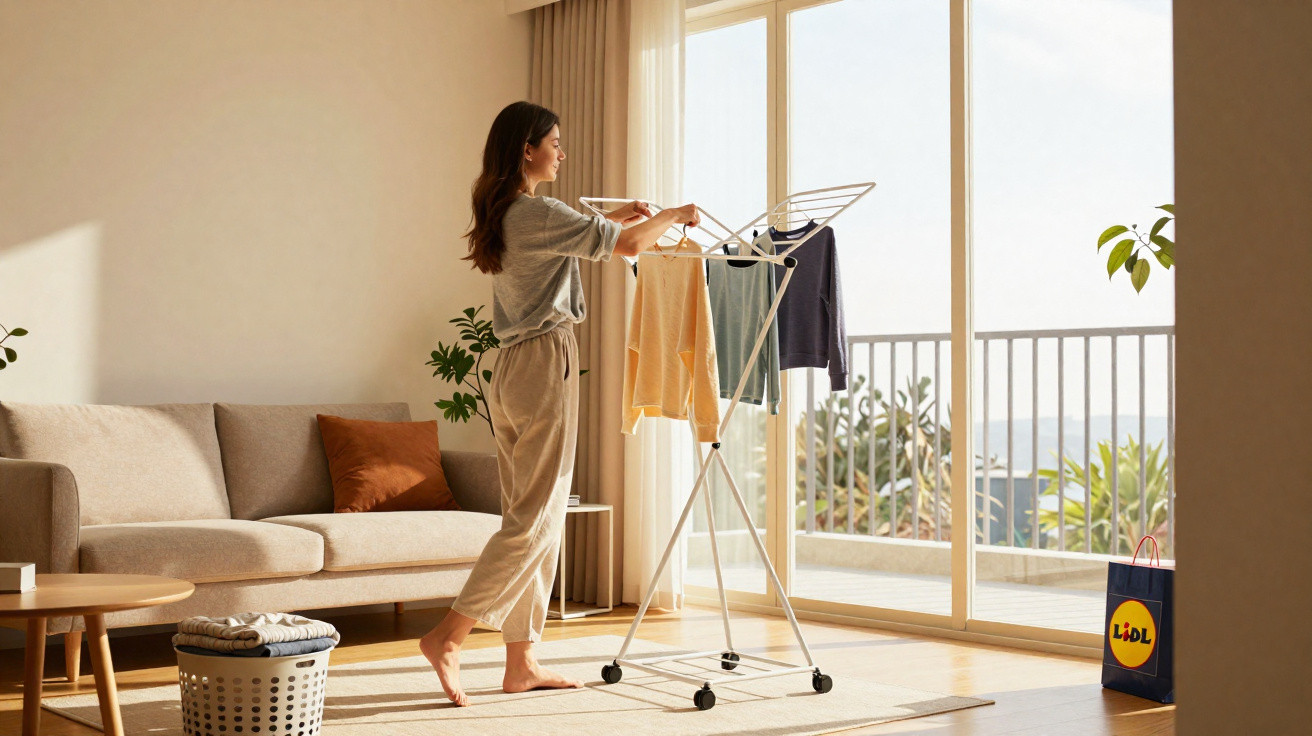
Anyone without a balcony or drying room, and with only a few spare square metres, will recognise the issue: damp laundry ends up everywhere, while conventional winged clothes airers take over half the living room. Lidl is now bringing a compact tower clothes airer to its stores, aiming to impress with a low price, substantial load capacity and a clever design.
A vertical clothes airer instead of space-hungry wings
Lidl’s new clothes airer prioritises height over width. Rather than extending across the room like a winged frame, it builds upwards. This means it can fit into alcoves, beside a wardrobe, in a narrow hallway or directly next to the washing machine.
Its dimensions are approximately 74 cm wide, 59.5 cm deep and 155 cm high. It therefore takes up barely more floor space than an ordinary kitchen chair, while providing considerably more room for hanging laundry.
Despite its very small footprint, the tower clothes airer provides around 16 metres of total drying space.
The rails are arranged across three levels, each of which can be folded down at the sides. This creates a tiered layout, allowing shirts, jumpers, towels and bed linen to dry on several layers above one another. It is more than sufficient for single people and couples, while families can use it as an additional option alongside a basement washing line or tumble dryer.
Under €20 – what does the Lidl offer include?
Lidl has priced the tower clothes airer at €19.99. That puts the model well below many branded airers with a comparable design, which can quickly cost €30 or more in DIY shops or online.
Despite its low price, the discount retailer promises a respectable load capacity. According to the product details, the frame can hold up to 12 kg of laundry. That is enough for a full drum of towels, bed linen or jeans – precisely the items that often overwhelm basic low-cost airers.
The base is formed by a steel frame. This provides stability and reduces the risk of the airer leaning to one side when laundry is unevenly distributed. This matters particularly with tall models, as a knock against the tiers could otherwise make the entire unit unsteady.
Thicker rails for quicker drying
Lidl states that it uses slightly thicker drying rails than many basic frames. This may seem unremarkable at first, but it has several benefits:
- Laundry does not hang as though it were on wire cables, but rests over a slightly wider surface.
- More air remains between layers of fabric, allowing moisture to escape more effectively.
- Fine pressure marks in the fabric are less noticeable, helping to reduce creasing.
The tower also has two fold-out holders that can accommodate up to twelve clothes hangers. These are suitable for shirts, blouses or jackets that come straight from the washing machine and need to dry while retaining their shape. Those with a small home office could, for example, wheel the airer into the study and dry business shirts there without blocking most of the room.
Flexible use in compact flats and small households
The tiers can be folded not only up or down, but also used on one side only. Anyone wanting to position the airer against a wall, for instance, can simply unfold the rails on one side. The other side stays folded away, saving space and preventing constant knocks as people pass.
Folding out one side allows the tower to be pushed directly against a wall or into a corner – ideal for micro-flats.
This is useful in a range of living situations:
- Studio flats, where the bed shares the same room as the clothes airer
- Narrow storage cupboards or utility alcoves
- Bathrooms with a free corner beside the shower or bath
- Shared laundry rooms where several people want to dry clothes at the same time
The vertical arrangement also makes it easier to sort laundry when hanging it up: delicate garments at the top, T-shirts and underwear in the middle, and towels or bed linen at the bottom. Families can reserve an entire level for children’s clothes – these items are lighter and dry more quickly.
Easy to move on castors – dry laundry where it works best
A key everyday feature is the four castors at the base of the frame. They make it possible to move the clothes airer carefully even when loaded. Its position can therefore be adjusted as needed:
- Place it beside the washing machine straight after a wash to catch the dripping stage.
- Then move it in front of an open window to take advantage of the airflow.
- In the evening, wheel it closer to the radiator as the room air becomes warmer.
Anyone using a portable dehumidifier at home can place the tower directly in front of it. Combining drier air with a high density of laundry pays off: clothes dry sooner, musty odours are reduced and humidity levels in the flat do not rise as much.
Typical issues when drying laundry indoors
Moisture can build up quickly, particularly in smaller rooms with poor ventilation. This can result in damp patches on walls, mould or persistently humid indoor air. A tower clothes airer cannot solve the issue by itself, but it can be positioned more purposefully:
- near an open window
- in front of a radiator, without covering it completely
- in a room that can be ventilated well, such as the kitchen
Its wheeled construction makes one thing clear: this airer is not merely a static frame, but part of a flexible drying strategy for small flats.
Who is the Lidl tower clothes airer worth buying for?
The €19.99 price is clearly aimed at households with limited space and a restricted budget. Typical buyers include students in halls, commuters living in one-room flats, and couples in urban areas where every square metre matters.
For families doing a large amount of laundry each week, the tower is primarily suitable as an extra drying option:
- for delicate garments that should not go in the tumble dryer
- for sportswear that needs to dry quickly between uses
- for bed linen or blankets when the tumble dryer is already running
Anyone who already owns a winged clothes airer can use the tower as an additional unit for hanging particular items higher up. This leaves more space on the floor, for example for a laundry basket or a shoe-drying rack.
Helpful tips for laundry that dries faster
The clothes airer alone will not dry laundry. However, a few simple measures can noticeably improve drying time and odour:
- Run the washing machine on a high spin setting to reduce residual moisture.
- Do not fold large textiles such as bed linen over a rail twice; spread them out more widely instead.
- Shake laundry out thoroughly before hanging it up to minimise creasing.
- Leave some space between items rather than packing everything too closely together.
Delicate fabrics such as wool or viscose can be placed on the upper levels. Air circulation is generally better there, and the items can hang freely without rubbing against heavy jeans.
What to consider when buying clothes airers generally
The Lidl tower demonstrates how much functionality can be fitted into a small footprint. In general, the following criteria can help when comparing clothes airers:
| Feature | Question to ask when buying |
|---|---|
| Total drying length | Is the total number of metres enough for a full washing-machine load? |
| Load capacity | Can the airer support heavy towels or blankets as well? |
| Dimensions | Will the frame fit in its intended location, such as the bathroom? |
| Material | Does the frame appear sturdy, or rather unstable? |
| Mobility | Does it have castors or other features to make transport easier? |
With energy prices rising, many households are once again using clothes airers more often instead of tumble dryers. A model with a well-designed layout and high load capacity makes this much more practical for everyday use – especially in flats where space is already limited.


Comments
No comments yet. Be the first to comment!
Leave a Comment