
The smell arrives first: faint, almost polite.
A slight trace of dampness when you open the wardrobe quickly, take out a T-shirt and shut it again, pretending you noticed nothing. Then one day, you decide to deal with it: you open every door, pull out the drawers and move the hangers aside. Stale, heavy air, like that of a seaside home left closed for months, hits you in the face. Your clean clothes do not smell clean. They smell of an old wardrobe, of mould you cannot see but know is there, clinging to every fabric.
You take a deep breath, look around the house and realise you have no dehumidifier, no expensive product and no time for a major cleaning session. All you have is a kitchen, a few spare hours and a strong desire for your wardrobe to smell of freshly washed laundry again. The good news is that, to make a start, one overlooked cupboard ingredient can solve half the problem. The culprit has a smell. So does the solution.
The smell that ruins even clean clothes
Everyone has experienced it: on a rushed morning, you pick up your favourite top, hold it to your nose and catch a mouldy undertone that can spoil your mood instantly. The garment is clean and has been washed with care, yet it comes out of the wardrobe smelling as though it has been shut away. It is as if the wardrobe has swallowed the scent of detergent and returned the smell of an old house. Nobody wants to leave home with a “drawer smell” clinging to them.
This odour does not appear all at once. It develops gradually, usually during damp weather, in bedrooms that get very little sunlight, or in small flats where air does not circulate well. At first, you notice it in a towel stored at the bottom of the stack, then in a coat you only wear in winter. Before you know it, mould has quietly spread through the darkest corners of the wardrobe, even if there is no visible mark. The odour comes before the stain.
In an informal survey shared among householders in family WhatsApp groups, one complaint keeps returning: “I can’t bear washing everything only for the strange smell to come back within a week.” The same pattern is seen in flats near the coast, ground-floor houses in damp neighbourhoods and bedrooms with walls adjoining outdoor areas. It feels like an endless battle: you clean, add fragrance and buy scented sachets, yet one cold snap is enough to turn the wardrobe into a small, stuffy cave.
There is also the familiar saying from grandparents that “clothes left stored for too long take on a wardrobe smell”. Today, science explains this through fungi, spores, relative humidity and poor ventilation. In everyday life, though, what matters is the result: clothes that seem dirty even though they were washed yesterday. This is when many people reach for scented sprays and costly fragrances, although the issue is still the environment rather than the scent.
Setting aside the drama, the principle is straightforward: mould thrives in enclosed, damp, dark and stagnant places. Your wardrobe is practically an invitation. Wood or MDF absorbs moisture from the air, outside-facing walls become cooler, and temperature differences create condensation. In fact, the strong smell is simply the “trail” left by fungal activity. Getting rid of this odour is not just about comfort; it is also a way to protect the respiratory health of those living there. Strong chemical products can seem daunting, but the answer may begin with something you probably use in cooking every day.
Bicarbonate of soda: the ingredient already on your side
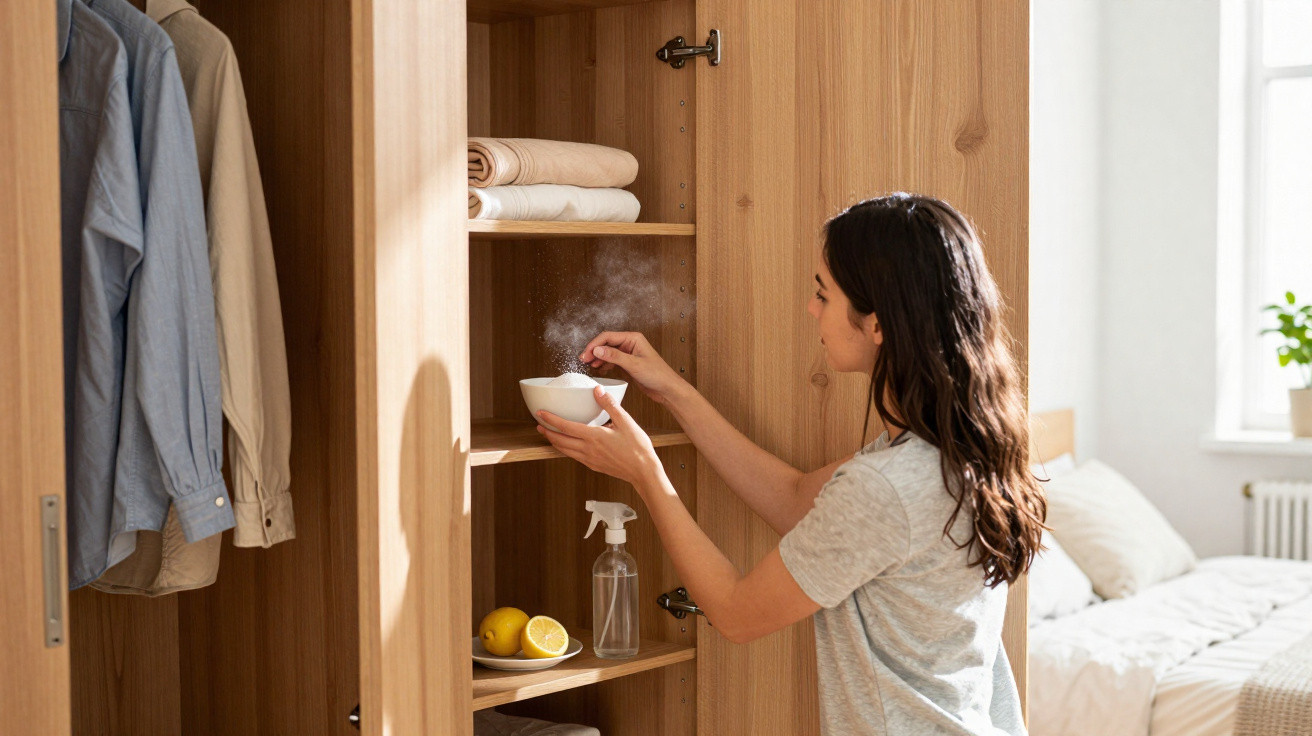
Let us get straight to it: the single, inexpensive and quietly effective ingredient for drawing the smell of mould out of a wardrobe is bicarbonate of soda. There is no mystery and no magical internet formula involved. That little tub forgotten beside the baking powder or salt is highly effective at absorbing odours and helping to neutralise moisture in the space. It does not disguise the smell; it draws the problem towards itself.
The method is simple. Take a small uncovered container, a saucer or even halves of a clean egg box. Add a few tablespoons of bicarbonate of soda, keeping it dry and without adding water. Place these small containers around the shelves, especially in more concealed areas, such as at the back of drawers or in the corner where you store bedding. If you have lots of hanging clothes, you can make small bags from fine fabric, fill them with bicarbonate of soda and hang them discreetly between garments. The powder will sit there quietly, working while you get on with life.
Let us be realistic: nobody empties an entire wardrobe every week. Most people only act when the smell becomes too strong to ignore. That is where two classic mistakes appear. The first is spraying fragrances and air fresheners over the issue, creating a floral-mould perfume that fools nobody’s nose. The second is using too much water when cleaning, wiping everything with a soaking cloth and leaving the inside of the wardrobe even damper, which feeds fungi instead of driving them away.
Using bicarbonate of soda is almost the opposite approach: it is a quiet maintenance strategy. The key is to replace the contents of the containers every 30 to 40 days, or sooner if the space seems especially damp. Both the cost and effort are low. If the wardrobe is badly affected, it may need a deeper clean with a slightly damp cloth followed by a dry one, then leave the doors open for a few hours. Bicarbonate of soda acts as a bodyguard, helping the space remain drier and the smell more neutral for longer.
A home organisation specialist summed it up in a recent interview that went viral on social media: “Brazilian wardrobes were not made for our humid climate, which is why we need to create a microclimate inside them.” Bicarbonate of soda is one of those small, affordable tools for creating that microclimate.
- Put uncovered containers of bicarbonate of soda on the wardrobe shelves.
- Replace the powder regularly, before it becomes saturated and stops absorbing odours.
- Leave the doors open on dry days so air can circulate and strengthen the effect.
- Avoid putting away clothes that are still damp or warm from ironing.
- Use fewer artificial fragrances and focus instead on reducing humidity in the space.
When the smell disappears, something else emerges
After a few days with the little containers discreetly placed around the wardrobe, something curious happens. Opening it stops feeling like an act of self-defence and becomes natural, almost automatic. The mouldy smell fades, the sense of an enclosed space eases, and even your perfumes seem to make more sense on your clothes. Rather than competing odours, you have a neutral, clean space where the scent of freshly washed laundry can genuinely come through.
This sort of simple measure has an interesting side effect: it changes your relationship with your home. Rather than fighting mould with anger and frustration, you begin to see the environment as something living, responding to humidity, ventilation and the way you store things. It is a small, almost invisible step, but it makes room for other gentler choices: getting rid of excess clothes, stacking fewer items, opening the window more often and noticing damp corners without fear.
Sometimes, what bothers us is not only the smell itself, but the feeling that the house is slipping through our fingers. When you discover that an ordinary kitchen ingredient can restore a little of that control, everyday life takes on a different texture. It is not a miracle, of course. Bicarbonate of soda cannot fix serious damp penetration, replace building work or make sunlight appear at a window that never receives it. However, it offers a practical, tangible bit of relief on the scale of an ordinary weekend.
Then an almost unavoidable question arises: if such a small change can improve the experience of opening a simple wardrobe so much, what else could gradually be adjusted in the rest of the home? Perhaps the next step is not buying another product, but sharing the tip with someone, swapping stories and hearing how others manage everyday mould. Homes with fewer secrets and hidden tricks tend to feel lighter inside too.
| Key point | Detail | Value to the reader |
|---|---|---|
| Use of bicarbonate of soda | Place containers of dry bicarbonate of soda inside the wardrobe | Removes the smell of mould with an inexpensive, accessible ingredient |
| Maintenance routine | Replace the powder every 30–40 days and air the wardrobe when possible | Ensures a lasting effect without daily effort |
| Avoiding common mistakes | Do not use excessive water when cleaning or merely disguise the problem with strong fragrances | Reduces the risk of mould returning quickly and protects clothes |
FAQ:
- Question 1 Does bicarbonate of soda remove only the smell, or the mould itself too? It works mainly on odour and helps control humidity. For visible mould, the surface needs to be cleaned with a cloth, a suitable product and good ventilation.
- Question 2 Can I sprinkle bicarbonate of soda directly onto clothes in the wardrobe? This is not ideal. Use uncovered containers or fabric bags instead. In direct contact, the powder may mark dark or delicate fabrics.
- Question 3 How much bicarbonate of soda should I use in a medium-sized wardrobe? Generally, 3 to 5 small containers holding 2 to 3 tablespoons each can already make a difference in a standard double wardrobe.
- Question 4 How long does it take for the mould smell to start fading? Many people notice an improvement within a few days, particularly if the wardrobe is aired at some point. In more severe cases, the process is gradual.
- Question 5 Can I combine bicarbonate of soda with other household methods? Yes. You can use bicarbonate of soda alongside containers of coarse salt or charcoal in separate areas, always prioritising ventilation and avoiding excess moisture during cleaning.




Comments
No comments yet. Be the first to comment!
Leave a Comment