

Saturday morning, 9.17 am: my living room resembled the “before” image from an advert. There were crumbs across the rug, dishes glaring at me from the coffee table, and a heap of clean yet creased clothes drooping over the chair where all hopes of organisation seemed to expire. My phone lit up with a new cleaning reel: a woman turning towels into flawless spa-style rolls in a kitchen that gleamed like a magazine shoot. I watched it repeatedly, somehow motivated and discouraged at once.
I had saved her routine, along with five more. There was also an entire Pinterest board of colour-coded schedules that I had never managed to keep up for longer than two days.
That morning, looking between the mess and my screen, I had one quiet but determined thought.
What if their routines simply were not designed for my life?
Why other people’s cleaning routines quietly fail in real homes
Trying to copy somebody’s “perfect” routine while your own home remains untidy brings a particular kind of guilt. In the time-lapse, they clean, organise and label, and within 30 seconds the whole place is glowing. You attempt every stage yourself, only for real life to interrupt somewhere between “deep clean the fridge” and “vacuum baseboards”.
The dog is sick. A child spills juice. Your boss sends an email.
At the end of the day, your home looks nothing like the reel. Then you begin repeating a quiet, harmful idea to yourself: perhaps I am simply not a “clean” person. That belief tends to linger far longer than any cleaning routine.
One week, I resolved to become “that” person by following a viral 30-day cleaning calendar. Day 1 was surfaces. Day 2 covered floors. Day 3 focused on appliances. Written down, it all felt almost calming. But by Day 4, my timetable had fallen apart. I finished work late, had toast for dinner and looked at “clean all windows” on the list as both the daylight and my energy disappeared.
I missed one day, then two. By the weekend, the calendar was stuck to the fridge like a passive-aggressive flatmate. My guilt increased, as did the dust bunnies. That calendar had not been made for a person with a full-time job, a commute and sole parenting responsibilities for half the week. It suited an imagined existence, not mine.
Most borrowed routines fall apart for a straightforward reason: they are shaped by somebody else’s priorities, home layout, mental load and natural energy pattern. A stay-at-home parent in a single-storey home will not clean in the same way as a nurse working night shifts in a small flat. Online, though, all of those circumstances are reduced to “my 5 a.m. cleaning routine you HAVE to try”.
We overlook the purpose behind these routines: they are often tailored for presentation, aesthetics or content, rather than for something sustainable. A routine you can keep half-heartedly for a year is worth more than a routine you crush for four days. When I realised that my “failure” was largely a poor fit rather than a personal defect, everything felt less harsh. My home was not transformed overnight, but my expectations were.
How I built a cleaning routine that fits my actual, messy life
The change began in a surprisingly practical way: I walked around my home with a notebook, like a consultant on a very small budget. In every room, I noted only the things that irritated me each day. Not the things Instagram told me ought to bother me. Not the jobs I “should” have been deep cleaning. Only the details that caught my eye and made me sigh.
The tacky kitchen worktop. Shoes scattered all over the hallway. The bathroom sink gathering toothpaste like a piece of modern art.
That became my starting list. There was no concern for aesthetics, only for the points of friction.
After that, I stopped organising tasks by “days of the week” and began planning around “energy levels”. On evenings when I had plenty of energy, I could manage a 20-minute kitchen reset and a quick sweep. On low-energy evenings, clearing the sink and putting rubbish in the bin was all I could do. I therefore created two versions of every job: a “full” version and a “bare-minimum” version.
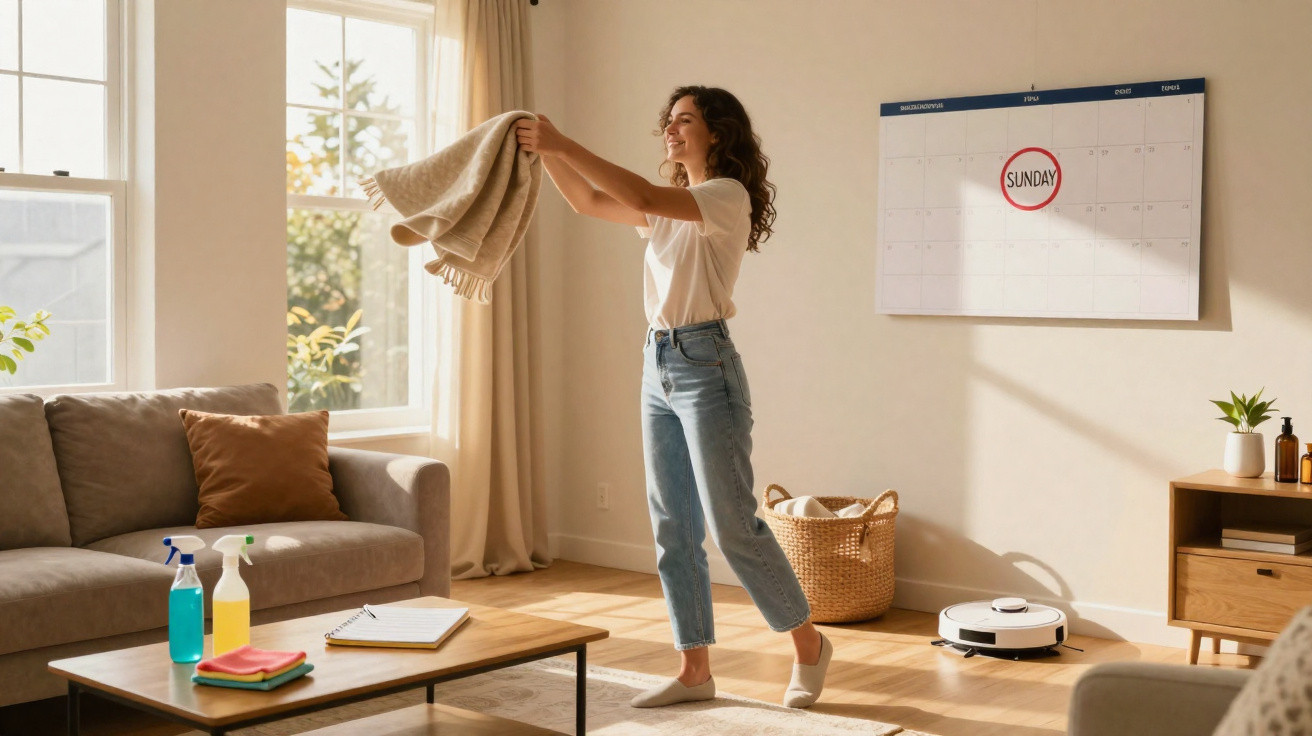
I also reviewed my week with a pen rather than a fantasy mindset. Mondays were hectic, so I scheduled no major cleaning. Wednesdays were easier, which made them my bathroom day. Laundry was already taking over Sundays, so I called it “Laundry Day” and stopped feeling as though I had fallen behind when I completed three loads at once. Matching cleaning to my real week made it feel less like a punishment and more like a background habit I could grow into.
Honestly, nobody truly does all of this every day. The polished charts online rarely allow for migraines, unexpected visitors, PMS, work crises or days when you only want to lie on the floor and scroll.
For that reason, I deliberately included “mess days” in my routine. One midweek evening, and usually Saturday morning, became times when no cleaning progress was expected. The only aim was not to create additional mess. That small allowance altered everything.
I told a friend about my new system and she laughed, then said, “Wait, so you’ve basically given your house a personality and negotiated with it?”
“Yes,” I said. “And it’s surprisingly less toxic than my old routines.”
- Daily bare-minimum – Get the dishes to zero, take out the rubbish if it is full, and clear one surface I actually use.
- High-energy tasks (2–3 times a week) – Vacuum high-traffic areas, wipe down the bathroom and quickly tidy the entrance hall.
- Weekly anchors
- Monthly “quiet wins” – One drawer, one shelf, one odd corner.
The quiet benefits nobody tells you about creating your own system
Once my routine began to mirror my actual life, an unexpected change followed: the way I spoke to myself shifted. Instead of saying “I’m so messy”, I started saying “I haven’t done my bare-minimum yet.” It may seem minor, but it changed cleaning from a moral verdict into an ordinary task, much like brushing my teeth.
My home did not suddenly become immaculate. It became reliable. Even on difficult days, I knew the dishes would not remain there for three nights. If the living room became a disaster zone, I knew the next day already included a 10-minute reset. That small amount of certainty settled my mind more than any aesthetic video had done.
I also recognised that some supposed online “cleaning truths” were simply not true for me. I do not fold fitted sheets into neat rectangles. I do not arrange spices alphabetically. I will never steam-clean curtains on a Tuesday. Once I released those borrowed standards, my own essentials became more obvious: a clean sink, a reasonably fresh-smelling bathroom and floors that are not sticky.
That understanding extended into other parts of life. I began using the same question for wellness routines, work practices and even my social life. Whose plan am I using? Does it fit my capacity and values, or is it only responding to my FOMO? A custom cleaning routine became a small act of resistance against the pressure to live someone else’s life.
The amusing thing is that my home still would not pass the white-glove test of certain influencers. Dust sits on the highest shelves, and there is a mysterious mark on one hallway wall that I continue to pretend I am investigating. Yet friends visit and say, “Your place feels easy.” It is not spotless or staged; it simply feels lived-in and looked after.
That was what I had wanted from the beginning, and it was not something I could find in another person’s timetable. When we build routines around our bodies, schedules and moods, a home stops being a performance and starts becoming a conversation. The space reflects us, and we respond to it, imperfectly but consistently, day after day.
The next time you save a cleaning reel, try viewing it differently. Which part genuinely supports my life, and which part belongs to the person on the screen? Your own routine begins with the answer to that quiet question.
| Key point | Detail | Value for the reader |
|---|---|---|
| Start from reality, not aesthetics | Identify what genuinely bothers you in every room and deal with those things first | Reduces overwhelm and focuses energy where it improves daily life most quickly |
| Build around energy levels | Make “bare-minimum” and “full” versions of each task | Keeps the routine sustainable on good days and bad ones alike |
| Give yourself permission to be imperfect | Plan mess days and let go of impossible expectations | Reduces guilt, improves consistency and makes cleaning feel easier |
FAQ:
How do I start if my home feels completely out of control?
Start with one surface and one habit. For a week, clear only the kitchen sink or coffee table each day. When that becomes normal, add another small area.What if my partner or kids don’t follow the routine?
Make the system straightforward and visible. Give each person one or two clearly defined jobs instead of expecting them to “help more.” Small, regular responsibilities are more effective than vague requests.How much time should a daily routine take?
For most busy people, 15–30 minutes spread throughout the day is achievable. Anything more is a bonus rather than an obligation.Do I need fancy tools or products?
No. A good all-purpose cleaner, a microfibre cloth and a vacuum or broom will meet most needs. New tools are optional extras, not a requirement for being “good” at cleaning.What if I keep falling off the routine?
Think of it as a playlist, not a contract. If you fall behind, begin again with today’s tasks instead of trying to “catch up.” The aim is a rhythm, not perfection.
Comments
No comments yet. Be the first to comment!
Leave a Comment