
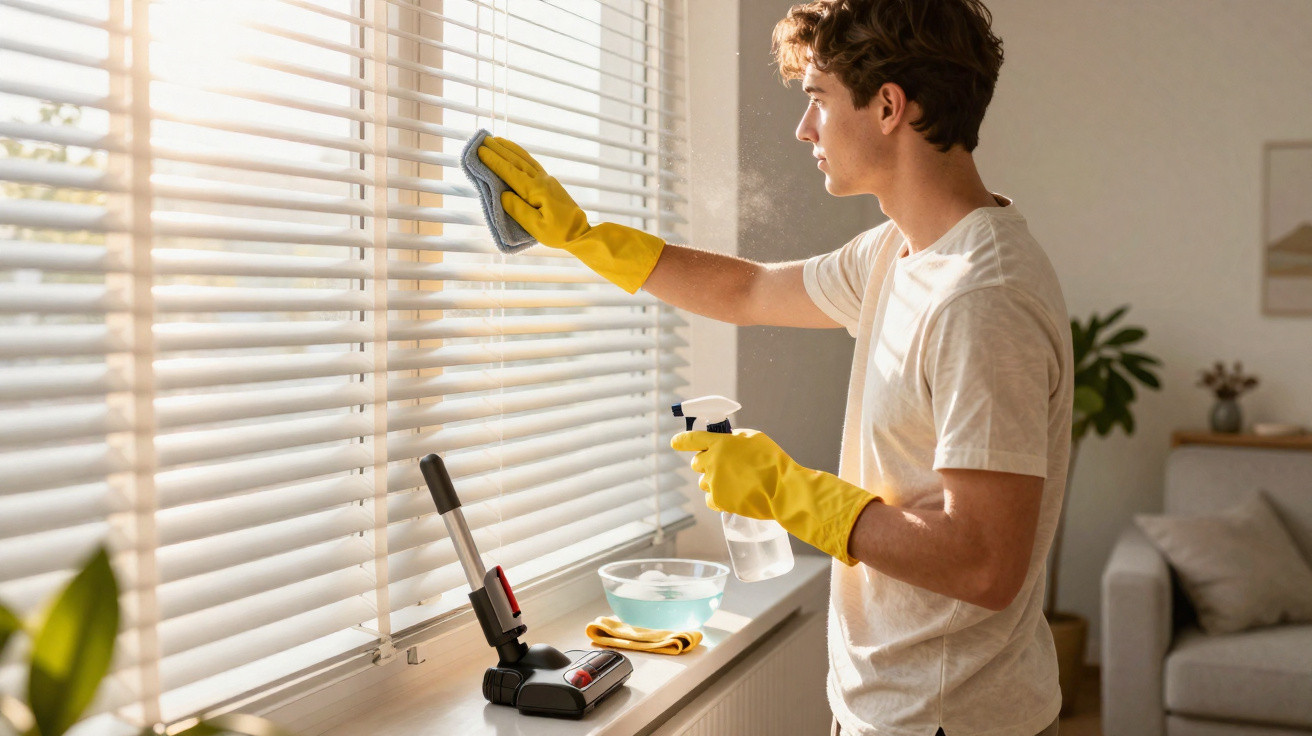
Saturday morning: light slanting through the window, coffee going cold by the sink.
You quickly wipe the table, wash two mugs, turn around… and there they are: the blinds, grey with dust and sticky with grease, as though they have absorbed the tiredness of the entire week. You feel like yanking them down, pulling them from the fittings and pretending they never existed. But you know what happens: if you take them apart, they will not go back up the same way. Or worse, they will sit in a corner for weeks while you promise, “one day I’ll wash them”. Everyone has made that pact and never kept it. You take a deep breath, grab any old cloth and try to clean each slat individually. Ten minutes later, your arm aches and the result is mediocre. That feeling of domestic defeat is real. Yet there is a less dramatic way to deal with it. The change starts with one very simple action.
Why does cleaning blinds feel like an impossible mission?
Anyone who has tackled dirty blinds knows it is not merely dirt; it is stubbornness. Dust settles in the gaps, mixes with grease and becomes that almost invisible film from afar, but an embarrassing one up close. Open the slats and they seem clean. Close them and that dreary grey appears. The same scene plays out in small flats, large houses and air-conditioned offices. Blinds are the sort of thing that stay in your line of sight all day yet are forgotten for months as part of the routine. Until the late-afternoon light hits at just the right angle and exposes everything. It is always on a day when you are tired.
A quick look through home and décor groups reveals a curious pattern: plenty of people admit they have considered replacing their blinds, not because they were damaged, but because they were “impossible to clean”. Others confess that they only deal with them before an important visitor arrives or when moving house. Some use a hairdryer, others wipe every slat with a wet wipe, and some try a vacuum cleaner with a brush attachment. These methods work to a degree, but nearly every account ends the same way: exhaustion and the feeling that time has been wasted. Among all this, there are those before-and-after photos featuring miracle tricks, but hardly anyone shows the real process, complete with aching arms, airborne dust and a dirty floor.
The truth is that many people make this more complicated than it needs to be. Blinds were not designed to require a two-hour cleaning ritual. They are meant to stay there, enduring sunshine, dust and hands opening and closing them in a hurry. The mistake begins when we treat them like fragile crystal, taking everything apart, soaking it in soapy water and waiting days for it to dry. Let’s be honest: nobody does that every day. Your mind already links the job with exhaustion and pushes it back to “when I get round to it”. Which almost never happens. The smarter answer is not to work harder, but to change the method. And that method follows a very simple logic.
The quick way to clean blinds without taking them down
The turning point starts with a minimal kit: a pair of old cotton socks, a spray bottle containing a mild mixture of water and washing-up liquid (or white vinegar for those who prefer a more natural option), and a dry microfibre cloth. No bucket and no taking down the rail. The aim is to turn cleaning into a continuous, almost automatic gesture. Put one sock on each hand as makeshift gloves. Rotate the blind slats until they are completely horizontal and fully open. Lightly spray the cleaning solution onto the socks, not the blinds. Then start to “hug” each slat with both hands, sliding from right to left.
This two-handed grip makes a difference. Rather than wiping one side and then the other, you clean both surfaces at once, with greater firmness and control. The cotton lifts dust without spreading it around, while the damp mixture breaks down the light everyday grease. If the blinds are particularly dirty, repeat the movement, always refreshing the socks with a few sprays rather than spraying the material directly, so that it does not become soaked. Once you have finished a whole row of slats, run the dry microfibre cloth over them in one general top-to-bottom motion, simply to remove excess moisture and add a little polish. It is straightforward, not glamorous, but it works quickly.
“Cleaning blinds should not be a domestic saga, but a quick habit fitted in between one coffee and the next,” said a professional organiser I interviewed for this piece.
- Use cotton socks that fit snugly over your hands, as they hold onto dust without scratching the slats.
- Make the solution using 500 ml of water and one teaspoon of washing-up liquid or vinegar; nothing stronger is needed.
- Always begin at the top and work downwards, so any falling dust is removed on the next pass.
- For wooden blinds, spray only a small amount onto the sock and finish with an almost dry cloth.
- Schedule this routine every 15 days: the more often you do it, the quicker the cleaning becomes, taking less than 10 minutes.
Mistakes that undermine your efforts and how to avoid them
The first major mistake is soaking everything. In a rush, many people grab a bucket, drench a cloth and wipe the blind as if it were bathroom tile. Too much water gets into the mechanisms, oxidises metal parts, warps wooden slats and leaves marks on PVC. The dirt may come away, but the damage appears later, gradually. Another error is using products that are too harsh: concentrated degreaser, multipurpose cleaner with strong solvents and even bleach have appeared in people’s accounts. The immediate effect is the impression of an intense clean, but over time you get stains, fading and a rough texture.
There is also the psychological exhaustion factor. If you turn cleaning the blinds into a huge event, with newspaper on the floor, gloves, a ladder, a bucket and a two-hour playlist, your brain records it as a difficult chore. Next time, just thinking about it will put you off. Then the dirt builds up again, thicker and harder to remove. It becomes a vicious circle. When you reduce the process to a simple task that fits into an ordinary day, it feels lighter. Nobody needs to become a character in a cleaning-product advert. You just need a method that fits real life, including laziness, time pressure and children running around the house.
Another point that hardly anyone mentions is height. Many blinds are beyond arm’s reach, so people overstretch, climb onto unstable chairs and perform balancing acts. Quick cleaning should include safety too. Keeping a sturdy small stool or step ladder at home changes everything. You can reach more easily, make more accurate movements and avoid straining your shoulder or back. There is another subtle benefit: when the process feels safe, the fear of “interfering too much” fades. You then feel more comfortable repeating it regularly. The difference between grimy blinds and ones that look new is often simply this quiet consistency, unnoticed by others but very present in your everyday routine.
Small routines, big effects throughout the home
There is something curious about cleaning blinds: they are a detail that runs through every room without making any noise. When they are dirty, nobody points it out, but you feel it. The bedroom seems heavier, the living room more neglected and the office less welcoming. When you find a quick, no-drama method, that feeling shifts. The blinds stop being “that thing I pretend not to see” and become simply another part of the home that you can look after without exhausting yourself. It may sound exaggerated, but a 10-minute clean done calmly can even change the way we view our own household routine.
Many people carry a quiet guilt about their home: the untidy cupboard, the floor that has not seen a mop for days, the window that has not been opened for weeks. Blinds belong in that collection. Once you realise you do not need to take everything down or spend an entire Saturday on the task, the guilt loses its hold. A kind of confidence emerges: if I can sort out this part of the house with two old socks and a spray bottle, perhaps the rest is less daunting than it seems too. A clean home is not a magazine photograph; it is an imperfect process, completed in stages with whatever is possible.
Perhaps you are reading this while glancing sideways at your own blinds, already imagining the soft sound of slats tapping as cotton-covered hands slide from one side to the other. It is a simple, almost ordinary scene. That is precisely why it has strength. Small routines like this, repeated without drama, create a real sense of care for the space where life happens. Next time the light falls sideways and reveals that persistent dust, perhaps instead of sighing deeply, you will simply pick up the spray bottle, put on the socks and deal with it in a few minutes. No saga, no fuss. Just you, the window and a method that finally makes sense.
| Key point | Detail | Value for the reader |
|---|---|---|
| Sock and spray-bottle method | Cleans both sides of the slat at the same time, without taking anything down | Saves time and reduces physical effort in the routine |
| Avoiding excess water and strong products | Uses a mild solution of water and washing-up liquid or vinegar | Protects the blinds, prevents marks and extends their lifespan |
| Making it a quick, regular routine | 10-minute cleans every 15 days, working from top to bottom | A visually lighter home, without exhausting large-scale cleaning sessions |
FAQ:
- Question 1: Can I use this method on every type of blind? It works well on PVC, aluminium and some wooden blinds, provided the wood is not extremely porous. With wooden blinds, use less moisture and always finish with a very dry cloth.
- Question 2: How often should I clean them? For people living in a large city or on a busy road, every 15 days already makes a difference. In less dusty settings, once a month is usually enough.
- Question 3: Does vinegar leave a strong smell in the room? The smell is noticeable at first, but it evaporates quickly. If that bothers you, use a small amount of colourless neutral washing-up liquid, which leaves virtually no smell.
- Question 4: Can I use a vacuum cleaner instead of the socks? A vacuum cleaner with a brush attachment helps remove heavier dust, but it does not remove light grease or marks. The combination of vacuum cleaner + sock method is usually the most effective.
- Question 5: What should I do when the slats are very greasy, as in a kitchen? In those cases, it is worth strengthening the solution with a little more washing-up liquid and repeating the passes with the sock. If the situation is severe, do an initial clean with a more concentrated damp cloth, always avoiding soaking the blinds, then move into a lighter maintenance routine.



Comments
No comments yet. Be the first to comment!
Leave a Comment