
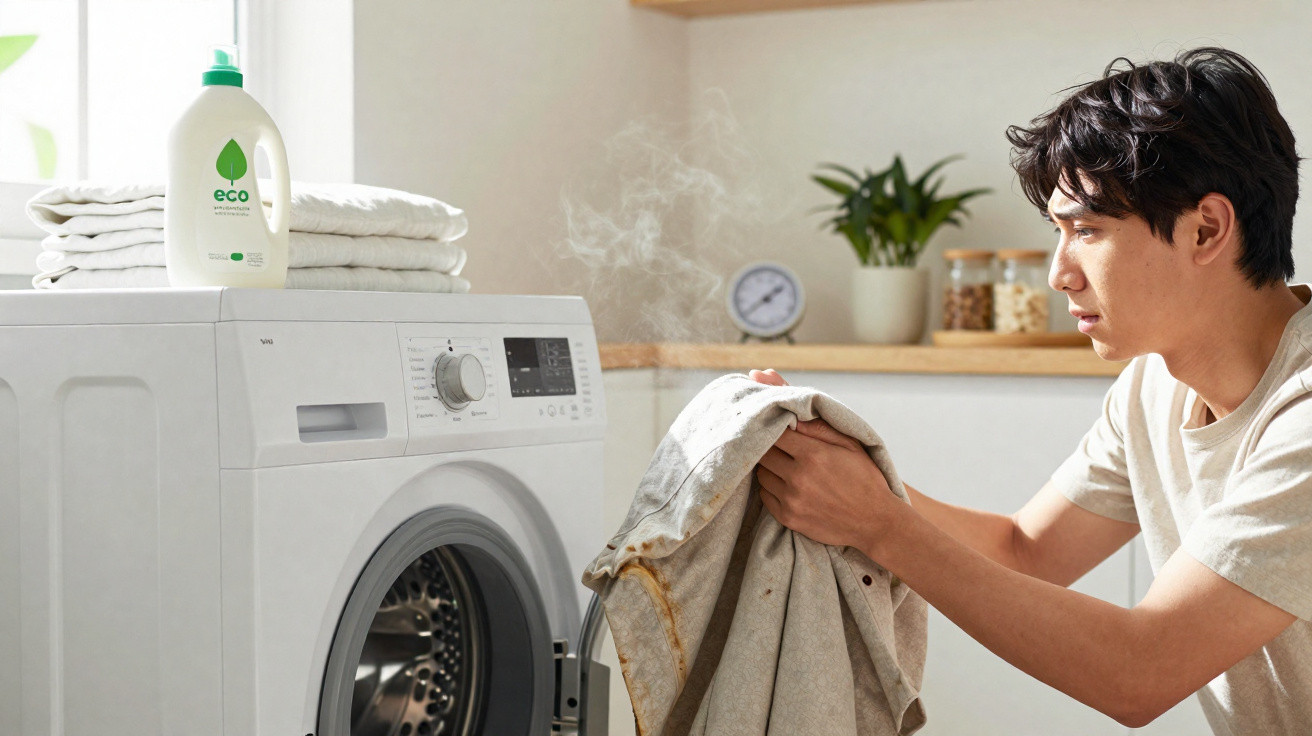
Yet that everyday routine may be quietly damaging your washing machine.
Across Europe, appliance repair engineers are seeing the same trend in 2026: washing machines smelling like stagnant ponds, strange grey marks on pale linen sheets, and annoyed owners insisting they “only use the Eco mode to be eco-friendly”. The issue is not their intention, but the automatic way many of us now do the laundry.
Eco mode: lower bills, poorer hygiene
Most current washing machines have an Eco programme that runs at roughly 40–50°C, uses less water and takes longer to complete. In theory, it cuts energy consumption and lowers your electricity costs. However, when it is used as the standard setting for nearly every load, the appliance can become a lukewarm breeding ground for microbes.
Microbiologists note that many ordinary bacteria, yeasts and moulds can readily survive at 40°C, with numbers only beginning to fall substantially above 60°C. At low and moderate temperatures, detergent may lift visible grime, but some microorganisms and detergent deposits remain in the machine.
With a steady diet of lukewarm Eco cycles, the drum, door seal and pipes can become lined with a sticky biofilm in just a few months.
This biofilm is a fine gel-like coating made up of bacteria, fungi, skin cells, detergent deposits and textile fibres. Studies of household washing machines have found as many as a million colony-forming units per square centimetre on the door seal alone. This greyish sludge creates odours resembling rotten eggs, a damp cellar or stagnant water.
Over time, small pieces of the coating break away during a wash. They circulate around the drum and attach themselves to fabrics, creating unexplained grey lines or flecks that are particularly obvious on light-coloured items.
Why linen sheets are commonly affected first
Linen bedding has become hugely popular because it is breathable, fashionable and often available in pale shades. Sadly, the natural qualities of linen also make it especially vulnerable when the machine is dirty.
- Highly absorbent fibres: linen readily takes in moisture and residues.
- Textured weave: small uneven areas catch particles and fragments of biofilm.
- Often pale or pastel colours: stains and greyish shadows are more visible than they are on dark cotton.
If the drum is covered in biofilm, light linen sheets can work almost like cleaning cloths, collecting the grime the appliance has built up. The outcome is disappointing: costly bedding that ought to look fresh emerges smelling slightly musty, with unusual marks that were not there before.
Washing linen repeatedly in these circumstances can also fade its colours and make the fabric feel softer for the wrong reasons. Residues accumulate in the fibres while detergent is not rinsed away effectively.
Overfilled drums and the heavy bedding-load trap
Alongside the reliance on Eco mode, many homes wash all their bedding in one enormous load. A duvet cover, fitted sheet and multiple pillowcases are pushed into the drum in the hope that one cycle will deal with everything. Once wet, that bundle may weigh two or three times as much as it did dry.
This creates several problems inside the washing machine:
| Habit | What really happens |
|---|---|
| Filling the drum to the brim with bedding | The load is excessively heavy and uneven, putting strain on the bearings and suspension. |
| Eco cycle with limited water | Sheets form a dense, heavy ball that prevents water and detergent from moving around properly. |
| One big wash instead of two smaller ones | Inadequate rinsing, detergent streaks, persistent odours and quicker wear on the machine. |
When sheets become tangled in a low-water Eco cycle, certain sections may receive hardly any detergent, while others are rubbed continuously and can be damaged. Typical results include:
- pale streaks caused by detergent that has not dissolved or rinsed out correctly
- damp areas with a musty smell only hours after the wash
- more regular error warnings or severe vibrations during spin cycles
The combo of Eco-only washing and overstuffed bedding loads is a quiet machine killer that also ruins the feel and look of your linen.
Using Eco mode without damaging your washing machine
The answer is not to stop using Eco mode altogether. Instead, repair engineers recommend “rebalancing” the laundry routine: give the appliance an occasional hot clean while allowing bedding enough room to move freely.
The 70–80% drum rule
Many specialists advise filling the drum to no more than around three-quarters of its total capacity. A straightforward check is the “hand rule”: once the bedding is loaded, try placing your flat hand on top of the laundry inside the drum. If there is not enough room for your hand, the drum is too full.
Before starting the programme, open out each sheet and duvet cover to stop them twisting into a rope-like bundle. Do not put large, heavy terry towels in with bedding, as they add weight and can trap sheets inside them.
Regular hot cycles for a deep clean
To reduce odours and limit biofilm, professionals often recommend three practical measures:
- Wash bedding at 60°C at least once every three Eco cycles, particularly where somebody in the household sweats heavily or has allergies.
- Run an empty 90°C wash once a month, adding about one litre of white vinegar directly to the drum, to help break down deposits and limescale.
- Leave the door and detergent drawer slightly open after every wash, allowing the inside to dry rather than remain humid.
These hot, empty programmes work as a reset for the washing machine. They do not have to replace Eco mode, but should accompany it as part of routine care.
Selecting suitable products for linen and the washing machine
The detergent you choose affects both bedding and the likelihood of biofilm. Highly foaming, strongly fragranced liquid detergents are more likely to leave deposits, especially in cooler washes. Those deposits feed microorganisms and remain inside the fibres.
For linen sheets, many fabric-care specialists suggest:
- using a moderate detergent dose, preferably powder for whites or a mild liquid detergent for coloured linen
- avoiding fabric conditioner, as it can coat fibres and reduce their breathability
- using an extra-rinse option where someone has sensitive skin or allergies
Vinegar in a maintenance wash can assist with removing mineral deposits. However, adding it to every wash in place of fabric conditioner may eventually harm rubber components. Infrequent use is safer than using it systematically.
What biofilm means inside a household washing machine
Biofilm may sound like a technical term. In practical terms, it is the same sort of slime that develops inside a vase left with water in it for too long, or on the surfaces of a shower that has not been cleaned properly.
In washers, biofilm gives microbes a protected shelter: a sticky city of cells glued together, anchored to plastic and rubber.
Inside this layer, bacteria and fungi share nutrients and withstand detergent and heat more effectively than they do when floating freely in water. This is why the occasional empty, hot wash achieves more than simply using extra detergent in a lukewarm Eco programme.
When laundry routines go wrong in real life
Imagine a small flat without a garden and with little room for drying clothes. Trying to save energy, the owner uses Eco at 40°C for every load, including socks, underwear and bedding. As the utility cupboard is cramped, they close the washing machine door as soon as the laundry has been taken out.
A slight musty odour develops after several months. Pillowcases that once felt crisp feel faintly sticky when dry. Pale linen sheets develop grey shadows in areas that should not be dirty. A repair engineer later discovers a thick band of slime behind the door seal, along with limescale covered in detergent around the heating element.
Now consider the same home with a few adjustments: bedding washed at 60°C every few weeks, one 90°C maintenance programme each month, the drum left slightly open between washes, and bedding divided into two loads rather than one. Electricity costs rise a little, but the appliance lasts longer and the sheets come out cleaner and fresher.
Extra precautions for allergy sufferers and young children
For anyone with dust-mite allergies, asthma or skin complaints, depending almost entirely on low-temperature Eco cycles may be a risk. Dust mites and many microorganisms cope fairly well with washing at 40°C. Bedding that appears clean can still retain allergens capable of provoking symptoms.
Specialist clinics frequently recommend regular 60°C washes for bedding, baby clothes and towels. Together with appropriate drying, this temperature reduces mite and bacteria levels far more effectively than Eco cycles can. For families balancing energy savings against health needs, alternating Eco loads with targeted hot washes provides a practical middle ground.


Comments
No comments yet. Be the first to comment!
Leave a Comment