
The evening I realised just how grimy my kitchen had become, it was neither the sink nor the oven that gave it away. It was the wall behind the hob. In the gentle yellow light, the tiles were not gleaming; they had a sticky, faintly orange lustre that my routine pass with a sponge had courteously overlooked for months. I drew a finger over a tile, expecting dust. It came away shiny and nearly oily, carrying the subtle scent of old cooking. It is the sort of smell you notice only when the extractor hood is switched off and the house is quiet.
That evening, a friend made an offhand comment that transformed the way I clean.
The hidden grease trap right under our noses
Once greasy tiles catch your eye, they are impossible to ignore. Every day, tiny droplets of oil and steam settle quietly on the walls above the hob, around the hood and beside the kettle. They make no sound and are not immediately visible, yet they gradually weave a varnish-like coating across the kitchen. At first, the tiles simply seem less bright. Then dust and cooking vapours cling to the unseen layer. Eventually, your white splashback starts to look slightly beige, leaving you to wonder whether it always looked that way.
Grease does not make itself known. It simply settles.
A reader from Lyon shared an experience that felt remarkably familiar. After moving into a rented flat, she assumed the kitchen tiles were merely “old”. On one wet Sunday, feeling bored and a little frustrated, she chose to scrub a small section behind the hob. She started with washing-up liquid and hot water. The sponge slipped and smeared the grime, without properly removing it. In desperation, she added a splash of white vinegar to a bowl of warm water and returned to the same patch.
Within seconds, a light yellow trail began to run down the tile. Beneath it, the original white emerged, noticeably brighter than the surrounding wall. She then spent the next hour working silently from tile to tile in disbelief.
There is a practical reason this modest mixture performs so well. Grease consists largely of fat molecules that cling firmly to surfaces, particularly when heat has helped them polymerise into a thin coating. Ordinary washing-up liquid can assist, but on vertical tiles the layer can act almost like clear adhesive. The acetic acid in vinegar gently breaks down alkaline residues and cuts through the greasy coating, while warm water softens and lifts it away. Rather than merely moving dirt around, the mixture weakens the connection between the grease and the tile.
That is why it can be difficult to return to other methods after trying vinegar water.
The simple vinegar-water routine that actually works
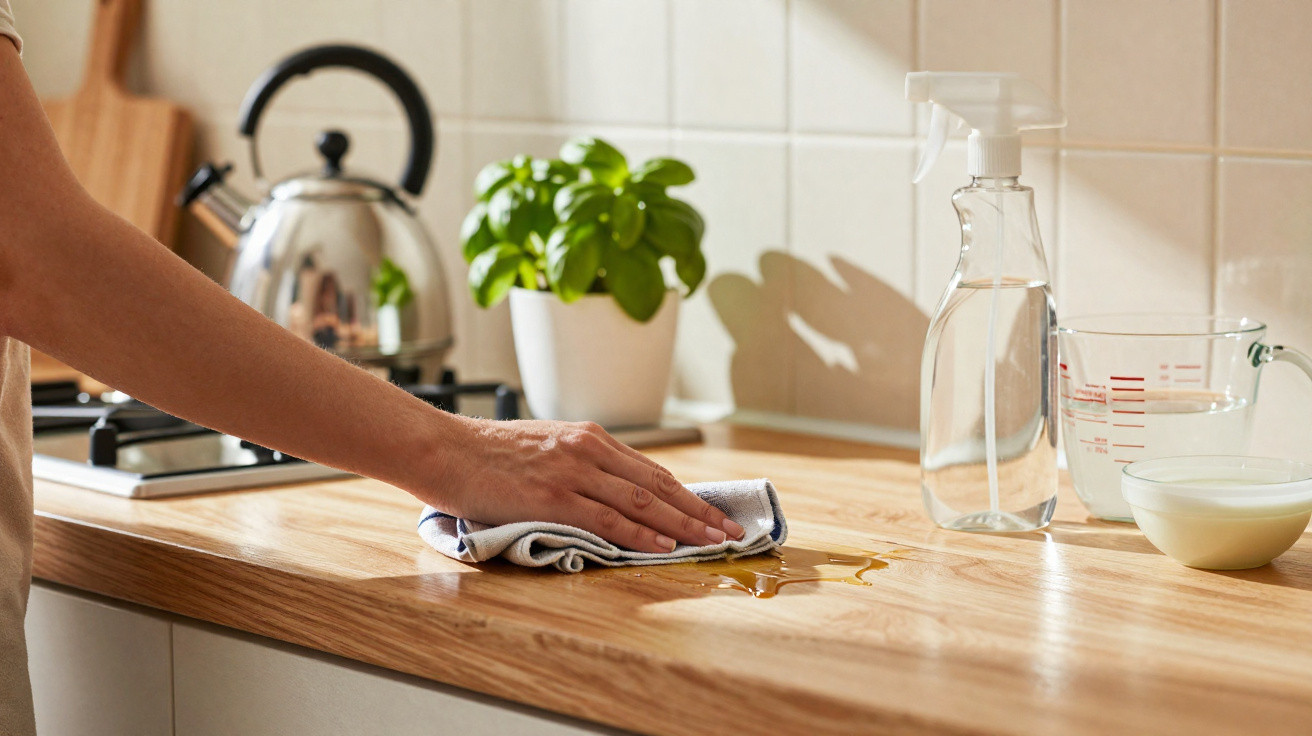
The core technique is almost surprisingly straightforward. Put warm water into a bucket or large bowl - not boiling water, but water warm enough to dip your hand into comfortably. Add a generous splash of white vinegar: use approximately one part vinegar to four parts water for particularly greasy tiles, or slightly less for regular upkeep. Stir it gently. Your cleaning mixture is ready.
Soak a clean microfibre cloth or sponge in the solution, wring it out so that it is not dripping, and begin with a test patch behind the hob. Wipe slowly using light pressure. Leave that first application for a minute, then wipe the area again with the same mixture. Complete the job with a quick rinse of clean water, followed by a dry cloth. The resulting shine can look almost unreal.
This is the point at which most people get it wrong: we either scrub with too much force or give the cleaner too little time. Particularly greasy tiles seldom come clean with a single wipe. The grease may have been building up for months or even years. Treat it as you would a dirty pan left to soak. Allow the vinegar water a moment to “work” on the surface before pressing on. Several gentle passes work better than aggressive scrubbing, which exhausts your arm and can scratch the grout lines.
In truth, hardly anyone follows this routine every day. Cleaning the area around the hob once a week and the rest of the splashback once a month is already heroic in everyday life.
A professional cleaner I spoke to put it in a single sentence:
“The trick isn’t the product, it’s giving the product time to do its job.”
A handful of small habits can have a major effect:
- Clean tiles while they remain slightly warm after cooking, as the grease will be softer.
- Always use a dry cloth at the end to prevent streaks and water marks.
- For grout and corners, use a soft toothbrush dipped in vinegar water.
- Air the kitchen for a few minutes so the vinegar smell disappears more quickly.
- Keep a small spray bottle of diluted vinegar on the worktop for quick touch-ups.
Once you have established this routine, the major clean becomes infrequent and almost unnecessary.
When a small habit quietly changes your kitchen
The day you notice that your tiles remain bright with very little effort, something changes. The kitchen seems lighter, fresher and easier to breathe in. You no longer wince when sunlight reaches the splashback at 3 p.m. and reveals every mark left by old frying oil. Instead, there is a small and unexpected pleasure in watching a vinegar-water-soaked cloth move across the wall and restore its crisp, clean sheen. It is a modest household triumph, unnoticed by visitors but oddly soothing.
We all know the feeling of a house seeming “heavy” without being sure why; sometimes, it is simply the quiet accumulation of everyday life on the walls.
This vinegar method is not a solution to everything. It will not repair cracked grout or a faulty extractor hood. However, it creates a basic standard of cleanliness that alters the way you view your kitchen. A cleaner surface can encourage you to cook more, open the window and take a breath. Behind this very simple action lies a gentle reminder: you do not need ten miracle products or an entire free afternoon. You only need warm water, a splash of vinegar and five unhurried minutes after dinner. Not perfection - simply an improvement on yesterday.
| Key point | Detail | Value for the reader |
|---|---|---|
| Vinegar-water ratio | Around 1 part white vinegar to 4 parts warm water for greasy tiles | Provides a clear starting formula without any guesswork |
| Cleaning method | Gentle repeated wiping, a brief resting period, then rinsing and drying | Delivers better results while preventing damage and wasted effort |
| Maintenance rhythm | Weekly around the hob, monthly for the rest of the splashback | Keeps the routine achievable and sustainable in daily life |
FAQ:
- Can vinegar damage my tiles? Diluted white vinegar is usually safe for standard ceramic or glazed tiles. Do not use it on natural stone, such as marble or limestone, because acid can dull the finish.
- Do I need hot water or is cold water enough? Warm water helps to soften grease, making the mixture more effective. Cold water can manage light dirt but is less effective on older, sticky residue.
- What if I hate the smell of vinegar? The scent disappears quickly as the surface dries. Adding a few drops of lemon essential oil or cleaning with the windows open can make the process more pleasant.
- Can I use this on painted kitchen walls too? Use a more diluted mixture and test it first on a small concealed area. Wipe lightly without soaking the paint, to avoid marks or peeling.
- Is vinegar enough for very old, thick grease? For severe build-up, begin with a little washing-up liquid in warm water, then use vinegar water to remove the remaining film and bring back the shine.




Comments
No comments yet. Be the first to comment!
Leave a Comment