
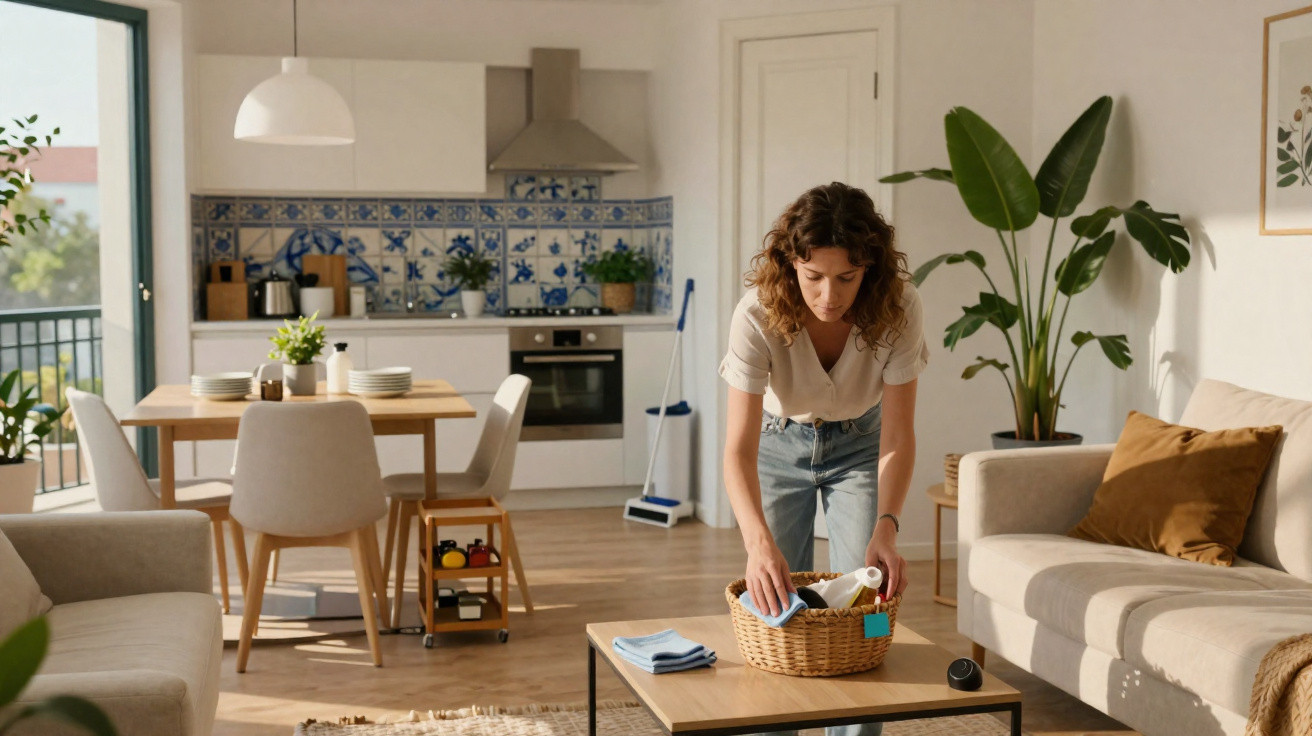
One Tuesday evening, which already felt as though it had lasted three days, I stood in the hallway holding a damp cloth in one hand and a basket of Lego in the other. The kitchen light remained on, the washing machine droned away, and every room in the flat appeared to be calling for me. Bedroom: wreckage. Living room: blast zone. Bathroom: a crime scene. As usual, I sighed, pushed up my sleeves and opened the first door.
Within ten minutes, irritation had set in. I had tidied the bedroom only the previous night, yet yesterday’s neatness had disappeared beneath a light covering of clothes, cables and partly read books. It felt like replaying a video-game level that never records your progress.
That night, I made one small change that transformed the experience. Rather than cleaning a room, I cleaned the place I genuinely use.
Why cleaning “rooms” quietly keeps you stuck
Most of us have learned to view our homes as rectangles: bedroom, living room, office. We enter, scan the space and decide that it is the area we need to “do” that day. Yet a room is not a unit of life; it is simply four walls. Daily life runs across it in unseen routes: the place where you leave your bag, charge your phone, or sit with a laptop and a bowl of cereal you promised yourself you would eat at the table.
This is why tidying an entire room can feel as though you are working in somebody else’s home. You restore every surface, only for clutter to return along the same invisible routes you use every day.
One day, entirely out of frustration, I stopped telling myself, “I have to clean the living room.” I asked instead, “Where does life actually happen in this space?” Four distinct usage zones stood out: the sofa corner where I scroll and snack, the coffee table where everything gets dropped, the TV unit that swallows cables, and the children’s play rug, which resembles an exploded toy shop.
I chose the coffee-table zone and nothing else. I emptied it, wiped it down, set out a simple tray for remotes and chargers, and placed a small bowl there for keys. It took five minutes. When I sat down again, the room was still untidy, but the spot we touched 20 times a day felt unexpectedly peaceful.
That sense of calm remained. The effort did not vanish overnight.
The realisation that day was almost painfully straightforward: rooms are for architects, while zones are for people. Your brain does not care that your flat contains seven neatly divided spaces. It knows that you always throw your bag on one particular chair, make coffee on one exact section of worktop, and keep your laptop on the same side of the sofa. Cleaning by room means going broad but superficial; cleaning by usage zone means working in a focused, thorough way.
The order lasts because it follows how your body really moves through the home. Cleaning begins to feel less like a penalty and more like bringing your surroundings into line with everyday life.
How to identify and clean your usage zones
Begin by doing absolutely nothing. Stand in the centre of an untidy room and observe it for a minute. Do not pick up a thing. Ask yourself: if a camera recorded me for a day, where would it capture the most activity? That is your first usage zone. It could be the section of kitchen worktop where you put groceries down, the chair where you work from home, or the area by the front door where shoes, bags and random post gather for a party.
Picture that zone as a small island within the larger room. You are not trying to rescue the entire continent, only that island.
Choose one zone, and only one. This is where many people stumble: they become overambitious, then find themselves “just quickly” dusting shelves, vacuuming behind the sofa and rearranging books. That is how you run out of energy by 9 pm and end up doomscrolling amid resentful clutter. Treat the zone as one small but important project.
Empty it fully, even if that requires putting everything into a laundry basket to sort later. Wipe or sweep the mini-area, then return only the items that genuinely support the activity taking place there: working, eating, relaxing or leaving the house. Anything else should be discarded, given a new home, or left in the basket until later.
“Once I started cleaning zones instead of rooms, the mess stopped feeling personal. It became a logistics problem, not a character flaw.”
Next, give every important zone a small support system. It need not be elaborate, only useful and easy to repeat, such as:
- A shallow tray by the front door for keys, cards and headphones
- A small upright file or magazine holder for incoming post and documents
- A box or basket beneath the coffee table for remote controls, chargers and game controllers
- A lidded container beside the children’s play rug for their “today toys” only
- A transparent pot or cup beside the bathroom mirror for toothbrushes and everyday skincare
These simple, low-tech aids work like magnetic fields. Belongings suddenly have an obvious landing place, giving order a genuine chance to hold.
What changes when you live by usage zones, not doors
Once you begin to see your home as a network of usage zones rather than a collection of separate rooms, something unusual happens: the guilt level drops. Instead of looking at the entire bedroom and thinking, “I’m a mess,” you look at the bedside-table zone, spend five concentrated minutes on it, and see how one peaceful area changes the feeling of the whole space. The disorder seems smaller, more manageable, almost like a set of minor customer-service problems rather than a judgement on your life.
Your priorities change too. The zones you interact with every day rise to the top of the list, while the guest room you enter twice a month can wait without taking up mental space.
There is also an unexpected effect on time. When you clean by room, you often postpone it until you “have time”: a spare hour, a quiet Sunday, or that imaginary weekend when you will “catch up on everything”. Honestly, hardly anyone does that every day. With usage zones, however, five minutes suddenly seem worthwhile. You can reset the coffee station while the kettle boils and the tea steeps.
You can sort the sofa corner while a video loads. These tiny resets are too small to provoke resistance, yet their benefit is considerable because they address the places you encounter throughout the day.
After a week or two, the home begins to feel noticeably lighter without any dramatic before-and-after photograph. Clutter still happens, and life still spills from bags and pockets, but the key zones recover more quickly. You stop pursuing the fantasy of a permanently perfect living room and accept a more realistic cycle: things are used, things become messy, things return home. The drama drains out of everyday clutter when every high-traffic zone has a clear, straightforward “home system.”
By that point, you are unlikely to speak about “cleaning the house” at all. Instead, you look after usage zones as you would paths in a garden that you genuinely walk along.
Perhaps your home already contains a few natural zones that function well without conscious effort, while others are battlegrounds. What might happen if, this week, you stopped trying to conquer the entire home and chose only three usage zones that matter most to your daily peace of mind? The bathroom sink you face first thing each morning. The kitchen strip where every meal is prepared. The corner where you drop your bag and the day you have had.
Try giving those three zones one simple rule: return them to “reset” once a day, however imperfectly and however quickly.
In time, the rest of the home begins to revolve around these anchors. Friends will not notice dust on top of the wardrobe; they will notice that the entrance zone is not a clutter trap. You will notice that leaving the house no longer requires a frantic hunt for keys buried under yesterday’s post. The outer edges of the room may remain imperfect: practical, lived-in and a little wild.
Inside your usage zones, however, a quiet agreement forms between you and your everyday self. It is a promise that your actual life, rather than only the floor plan, deserves room.
Perhaps that is the quiet revolution: not another “method” or another colour-coded miracle, but a new way of looking. You are not failing at housekeeping; your previous categories were simply wrong. When you clean usage zones instead of rooms, the home you occupy starts to match the life you are truly living.
That is often the difference between always feeling behind and suddenly feeling that your home is finally on your side.
| Key point | Detail | Value for the reader |
|---|---|---|
| Focus on usage zones | Identify the precise places where everyday activities gather: coffee corner, sofa area, entrance drop zone | Provides a realistic focus for quick improvements and lasting order |
| One zone at a time | Clear, clean and reset one “life island” rather than an entire room | Lessens overwhelm and makes five-minute tidying sessions worthwhile |
| Simple support systems | Use trays, baskets and small containers to direct where belongings land | Builds automatic habits and slows the return of clutter |
FAQ:
- How do I find my usage zones? Observe yourself for a day and note where belongings collect or where you repeat particular actions: making coffee, working, getting dressed or arriving home. Those busy spots are your zones.
- What if my whole house feels like one big mess? Begin with the zone you use most in the morning or evening, such as the bathroom sink or bedside table. One calm zone in the day’s “opening scene” can create a significant ripple effect.
- How long should I spend on a single zone? Five to fifteen minutes is generally sufficient for a basic reset: clear it, wipe it and return only what belongs there. If it takes an hour, you have selected a room rather than a zone.
- Can this work with kids, roommates, or a partner? Yes, particularly when each shared zone has a visible home: a toy container, key tray or post box. If the system is clear, people are more likely to join in.
- Do I ever need to do a full-room clean again? Deep cleaning still matters for jobs such as windows, skirting boards or seasonal decluttering. However, day-to-day calm comes far more from reliable usage zones than occasional marathon cleaning days.
Comments
No comments yet. Be the first to comment!
Leave a Comment