
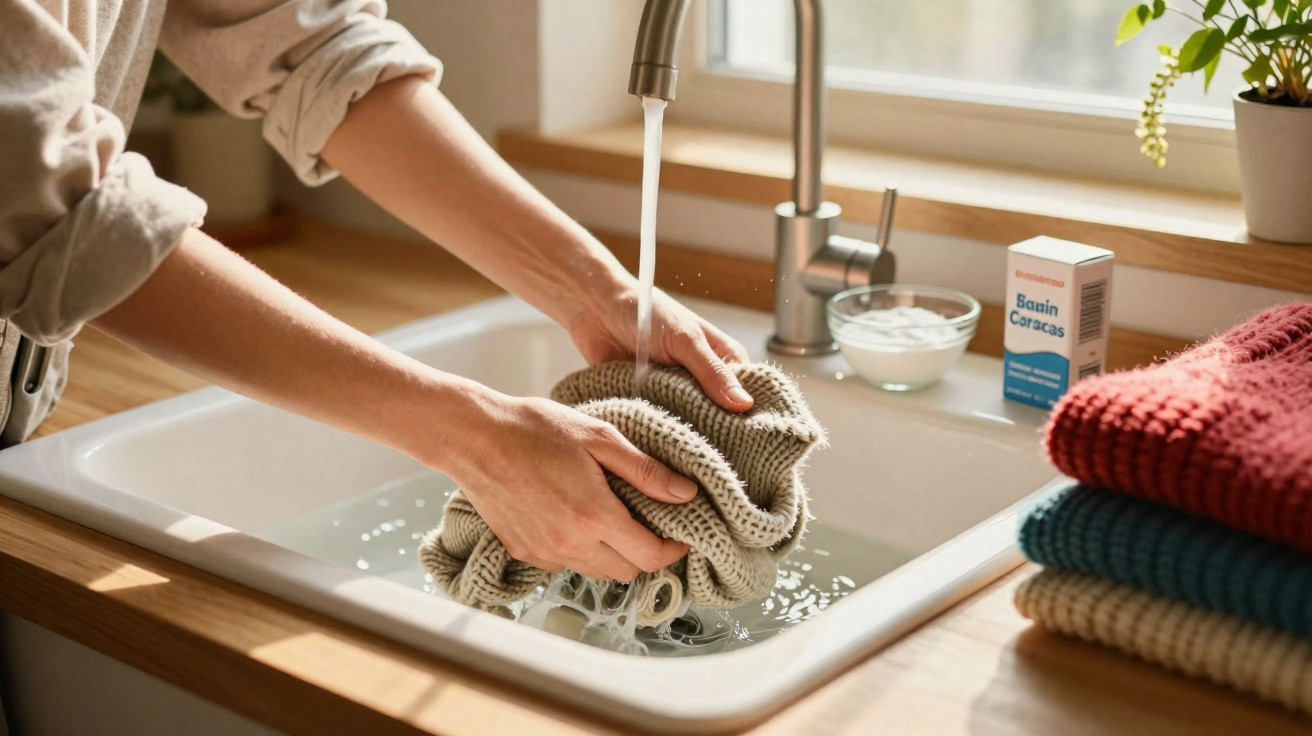
It had simply grown tired. Fibres stiffen, detergent residue hangs on, and the softness that once felt cloud-like turns into a restrained scratchiness. There is no need for dry cleaning or fabric softener: all you need is a sink, a handful of cupboard staples and ten peaceful minutes.
On a damp Saturday, I took a navy crew-neck jumper from a box of winter clothes. It was the sort of day made for tea and warm socks. The knit felt rigid, as though it had developed views of its own. It still carried a slight stale-soap scent, while the cuffs felt harsher than I recalled. As the kettle boiled, I looked at the jumper as if it were a minor puzzle. Perhaps it had always felt this way and memory had been misleading. Or perhaps the fibres had merely lost the ability to loosen up. I remembered my gran saying that wool responds well to acidity and patience. Leaving the tea aside, I filled the sink. Everything needed to revive it was already in the kitchen.
Why old knits become rough without you noticing
Softness comes down partly to chemistry and partly to recollection. Wool, cashmere and alpaca consist of protein fibres covered in tiny scales; when those fibres are in good condition, the scales lie flat and the material feels soft and full. Minerals from hard water and alkaline detergents gradually build up, making the scales rougher. Drying on a washing line lets gravity pull at the fibres, helping to set that stiff, board-like texture. Add wear-related friction and pilling, and a jumper can slowly change from cloud-soft to scrub-pad rough.
Last winter, a friend came across a £12 cashmere jumper in a charity shop that looked dreadful: flattened, covered in pills and slightly crunchy. We gave it a sink soak followed by a careful brush. The following week, she wore it to brunch, where a stranger asked whether it was new. She laughed so much she almost spilled her coffee. The change is that subtle: softness disappears in small stages, then can return just as quietly with a little targeted care.
There is sound reasoning behind what seems like magic. Alkaline residue raises the fibre cuticles, whereas acidity helps them lie back down. Hard-water minerals accumulate like unseen dust and can make yarn squeak. A brief acidic soak breaks down that build-up, while humectants, such as glycerin, draw in a trace of moisture to make the knit feel fuller again. Lowering friction is equally important: less movement, less twisting and less heat. This is not about spoiling a jumper; it is about restoring its chemistry and shape memory.
Kitchen-sink rescue for soft knits without fabric softener
Fill a clean sink or tub with cool to lukewarm water. Mix in 2 tablespoons of white vinegar and 1 teaspoon of vegetable glycerin, or 1 teaspoon of mild hair conditioner if that is what you have available. Swish the water, immerse the jumper and press it beneath the surface until it is thoroughly wet. Leave it for 15–20 minutes, giving it one or two gentle nudges. Give it a short rinse in cool water, then support it from underneath as you lift it out, as though handling a cake. Use cool-to-lukewarm water-never hot. Place it flat on a towel, roll the towel to press out moisture, and reshape the garment on a dry surface.
A few careful adjustments have a noticeable effect. Avoid scrubbing and twisting. Do not wring; press and roll instead. If pills remain once the jumper is dry, lightly pass a jumper comb or fabric shaver over it in one direction. Use a soft clothes brush afterwards to lift the nap. Realistically, this is not something anyone does daily. Think of it as a reset ritual rather than another household task: it is for the jumpers worthy of a second first wear.
Most of us have owned a favourite knit that began to feel like sandpaper and seemed destined for the back of the drawer. That is the time to try this soak. Once dry, brush it slowly ten times with a soft brush, working from cuffs towards the collar. A teaspoon of glycerin is the quiet hero of softness. It draws in just enough moisture to fill out the yarn without making it oily. If you are concerned, test colourfastness on a seam first, then rely on your hands: the fabric will show you when it has relaxed.
“Clothes age, but fibers can forgive. All they want is the right water, the right touch, and a little time.”
- A basin of cool-to-lukewarm water or a clean sink
- 2 tbsp white vinegar
- 1 tsp vegetable glycerin or mild hair conditioner
- An absorbent towel for rolling
- A flat drying rack, or a dry towel spread on a table
- A jumper comb or fabric shaver, plus a soft clothes brush
Help soft knits stay soft for longer
Softness benefits from a calm approach. Keep knits folded rather than hanging them up. Air them between wears instead of washing them too often. Spot-clean with a damp cloth and a drop of gentle soap, then leave them to rest for a day. When washing is needed, use the same cool soak, a shorter rinse and unhurried drying. Rotate your jumpers as you would shoes; fibres recover more effectively when they have time off. The benefit is more than a cleaner garment: the fabric has a smoother, quieter feel, almost like new skin.
| Key point | Detail | Benefit for the reader |
|---|---|---|
| Acidic reset | 2 tbsp white vinegar in cool water removes residue and relaxes wool scales | Restores softness without commercial fabric softeners |
| Humectant boost | 1 tsp glycerin (or mild conditioner) provides light moisture to plump fibres | That “new sweater” hand returns in one soak |
| Gentle finish | Roll in a towel, dry flat, remove pills, then brush in one direction | Looks fresher, feels smoother and lasts longer |
FAQ:
- Can I use hair conditioner on wool and cashmere? Yes-add one teaspoon for each sink of water. Pick a simple formula with little silicone. Rinse gently so only a trace remains rather than a coating.
- Is vinegar suitable for delicate fibres? Yes, when used sparingly. Its mild acidity helps flatten raised cuticles. Use roughly 2 tablespoons per sink, and do not leave the garment soaking for hours.
- Will this help cotton or acrylic jumpers? It can improve residue and the feel of the fabric, particularly for cotton blends. Acrylic will not “plump” in the same manner, but rinsing and brushing can still make it softer.
- Should I include baking soda? Avoid it with wool and cashmere. Alkalinity makes protein fibres rougher. If smell is the concern, the vinegar soak already tackles it gently.
- How often should I use the softening soak? Use it only when a knit feels rough or dull, anywhere from every few wears to every few months. Between treatments, air it out, brush lightly and spot-clean it.




Comments
No comments yet. Be the first to comment!
Leave a Comment