
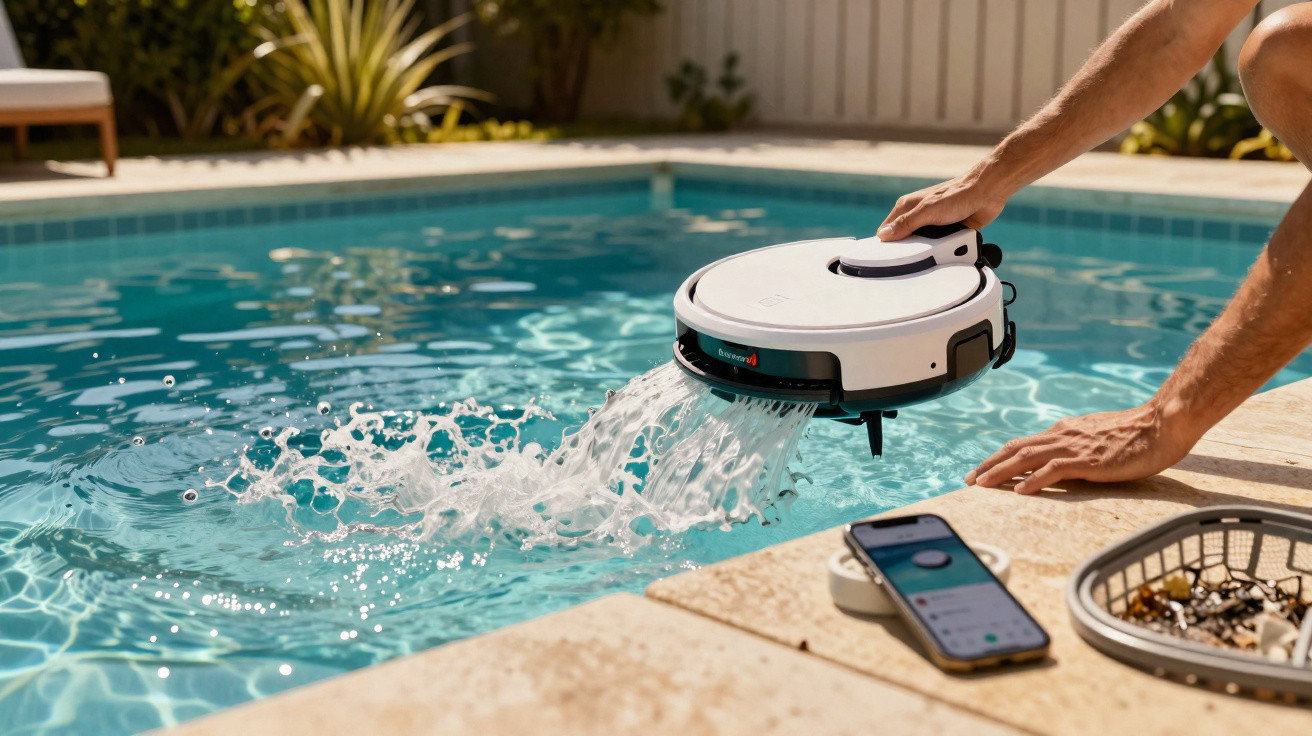
The Beatbot Sora 70 claims to offer 4-in-1 cleaning. It promises to clean your entire pool, from the floor and walls to the waterline and even the water’s surface. We tested this still-uncommon versatility for a month to find out whether it could deliver.
Summer after summer, pool robots are gradually becoming less niche. That is welcome news, as France is a sizeable market: the country has nearly 3.7 million domestic pools, including 90,600 installed in 2025 alone. This makes it Europe’s largest pool market and the world’s third largest, behind the United States and Brazil.
The sector was long dominated by specialists such as Maytronics and Zodiac, but it is now attracting a new generation of manufacturers. Aiper quickly established itself as an early pioneer of cordless models, while Dreame, Mova and Ecovacs have more recently moved into pools after gaining experience with floor-cleaning robots and robotic lawn mowers.
Beatbot has taken a different route. The Shenzhen brand comes neither from vacuum cleaners nor robotic mowers. Since arriving in Europe in 2024, it has focused exclusively on pool robots, specialising in putting ever more jobs into a single machine.
The AquaSense Pro was the most spectacular example. Introduced at €2,499, it featured nine motors to clean the floor, walls, waterline and surface, while also dispensing a clarifying agent into the pool. That extensive feature set came at a substantial price.
At €1,499, the Sora 70 retains the core of that formula for €1,000 less. It keeps the 4-in-1 principle-floor, walls, waterline and surface-along with two jets that direct floating debris towards its suction inlet. We put this rare level of completeness at this price through a month of testing in a 40 m² pool, to see whether trying to do everything caused the Sora 70 to fall short anywhere.
A substantial robot that is easy to get in the water
With the appearance of a miniature tank, the Beatbot Sora 70 takes a markedly different approach from several rivals. There are no pastel accents or two-tone bodywork to brighten it up. Black dominates, spanning the chassis’s matt plastics and a broad glossy lid. The result is restrained, yet suitably purposeful.
Its plastics are thick and its joins are tightly fitted, which is reassuring for a device that spends its entire working life underwater. Despite its solid build, its 10.4 kg weight remains well below the 15.8 kg of the Mova Rover X10. Underneath, two tracks sit alongside four rollers fitted with rubber fins.
Setup takes only a few minutes, which is worth bearing in mind for anyone still hesitant about buying a pool robot. The Beatbot app identifies the Sora 70 via Bluetooth before Wi-Fi takes over. A few moments later, it is ready for its first lap of the pool.
Wi-Fi is not essential for every competing model: the Ecovacs Ultramarine P1, for instance, does without it altogether. Underwater, it makes little difference anyway. Once submerged, the Sora 70 disappears from the network, as every pool robot does.
Wi-Fi becomes useful when it returns to the surface. The app then automatically receives the end-of-cycle status, battery level, cleaning history and water temperature. However, this connectivity does not extend to mapping. Beatbot’s flagship AquaSense 2 Ultra displays its routes in the app, so this is one of the first refinements sacrificed to lower the price.
How does the Beatbot Sora 70 find its way underwater?
Underwater, dolphins rely on sonar while sharks follow their sense of smell. Each has its own method, and pool robots work much the same way. Aiper, for example, opted for a camera paired with a rangefinder on its Scuba V3.
Beatbot instead uses 18 sensors, including two ultrasonic sensors to detect obstacles, slopes and changes in level. The manufacturer says nothing about the other sixteen. They are likely responsible for monitoring water temperature, the robot’s balance and the basket’s level of blockage.
It is difficult to crown any technology the winner on paper, however. Cameras, ultrasonic sensors and rangefinders are simply different tools chosen by different manufacturers. As with robot vacuum cleaners, the real distinction lies in the quality of the algorithms and how they use the data collected.
A few exploratory swims, then remarkably precise navigation
Called SonicSense, the Sora 70’s ultrasonic sensors are designed to keep it away from steps and obstacles. Its first runs in our 40 m² pool were nevertheless somewhat erratic, as though the machine needed time to warm up. The S-shaped routes promised by the brand only appeared after several cleaning sessions, once it had apparently learnt the pool.
After that, its precision was striking. The Sora 70 climbs walls without hesitation, reaches the waterline, then descends cleanly. Our four corner steps were no obstacle either.
It detects them, settles onto them and cleans them one by one without falling back to the floor, including the final step, which was only partly submerged. That deserves praise, as steps remain a major challenge for the category. If your pool has a large staircase or a shallow beach area, the Sora 70 should move around it without difficulty.
Its dives were not entirely free from mishaps, though. On roughly one cycle in four, we found a corner or small section that the robot had clearly missed. This was never serious: the area rarely exceeded 1 m², and a second pass was enough to solve the problem.
Six cleaning modes, but some settings are missing
As its main promise suggests, the Sora 70 offers 4-in-1 cleaning. In other words, it handles the floor, walls, waterline and surface. The waterline is the band at water level where sun cream, pollen and greasy deposits collect. Over time, especially in a pool used by both adults and children, this can form an unsightly ring.
Six modes divide up these tasks. “Pro” combines all four in a single cycle, while “Standard” cleans everything except the surface. Three dedicated programmes focus solely on the floor, surface, or walls and waterline. An Eco mode completes the selection. The app also shows the condition of consumables and sends a notification when a cycle ends. These alerts only arrive once the Sora 70 has resurfaced, however, because it cannot be contacted while working on the bottom.
Over the weeks, we found it a little sparse compared with competitors. There is no weekly scheduler for setting cleaning days and times. It is also impossible to adjust suction power, whereas the Ecovacs Ultramarine P1 offers three levels, or change travel speed as Mammotion allows on the Spino E1.
Finally, while the six modes cover the essentials, they never allow you to build a custom programme. If you want to clean the floor and surface without doing the walls, for example, you must run two cycles.
Strong suction, but no ultra-fine filter
The Sora 70 uses eight motors for propulsion, brushing and suction. Two independent pairs of rollers, at the front and rear, loosen dirt from the lining while the pump draws it in through a 17 cm-wide inlet. Its claimed flow rate reaches 25.7 m³/h. It is not the fastest in the sector-the Mova Rover X10, for example, reaches 38 m³/h-but that is a more expensive pool robot. At its price point, the Sora 70 therefore sits towards the top of the range.
Nothing escaped the basket on the first pass, from fallen leaves and small stones to sand. The 6-litre basket is also a welcome capacity. By comparison, the Aiper Scuba V3 makes do with 3.5 litres. It lifts out from the top: press the lid, then rinse it with a hose to empty it within seconds.
The mesh reaches its limits with fine particles, however. Its 150-micron rating is roughly equivalent to the diameter of a fine grain of sand. Anything smaller-from pollen and microscopic algae to mineral dust responsible for milky water-passes through the basket and immediately returns to the pool.
For finer filtration, Beatbot sells an ultra-fine kit capable of reaching 3 microns for €60. Firstly, that is very expensive for this type of accessory. Secondly, it is surprising that it is not included at the Sora 70’s price. To make the paradox even more pronounced, the brand regularly includes it free with the robot during promotional periods. Frankly, it should simply be supplied from the outset.
JetPulse, the Beatbot Sora 70’s defining feature
Cleaning the water’s surface usually means spending more than €2,000 or adding a separately sold skimmer. Beatbot does neither, instead tackling the issue with its JetPulse system.
Two side jets propel water towards the front of the robot, producing a converging current that pulls floating debris towards the suction inlet rather than pushing it ahead. In this mode, the robot does not dive. It floats across the surface, with its two jets constantly drawing water in front of it.
That distinction matters. A robot that merely moves forward pushes drifting matter away: a flower petal or a dead bee can be sent swirling to the other end of the pool by the turbulence from its body. Here, the current draws them back towards the suction entrance.
During our surface-mode sessions, results were convincing. Everything floating on the water gradually disappeared as it passed. The robot did not need to cover the same spot three times, either. The waterline benefits from the same treatment.
To put it to the test, we spent an entire afternoon applying far more sun cream than was reasonable. The following morning, after leaving the robot to work for 2 hours, almost no trace remained. The Beatbot Sora 70 had hugged the surface and removed virtually everything in its path.
Battery life depends more on the pool than the battery
On paper, the 10,000 mAh battery is impressive. It needs to be put into context, though, as it must power eight motors, two pairs of rollers and a 25.7 m³/h pump. That is why the quoted runtime is limited to 5 hours on the floor and 7 hours at the surface.
Each mode has its own duration options, calibrated to the scale of the job. Pro mode begins at four hours, Standard and Surface start at two, while Wall mode goes down to just one hour. A MAX setting lets the robot run until its battery is exhausted. Yet these figures do not tell the whole story. A pool robot does not drain its battery predictably: it depends on the selected mode, the pool’s size and, above all, its condition. The essential thing is to know your own pool well.
In our 40 m² pool, runtimes varied considerably. After a turbulent night, the Beatbot Sora 70 spent 2 hours skimming the surface before deciding it had done enough. On another day, with cleaner water, it finished in under an hour. In every case, its endurance never let us down.
It then takes four and a half hours to recharge, thanks to 65 W fast charging. That is a welcome time given its endurance. One minor disappointment remains: there is no charging station, despite cheaper robots offering one.
Beatbot Sora 70 price and competitors
Launched at €1,499, the Sora 70 is a mid-range robot. Above it, the AquaSense Pro cost €2,499 at launch and brought a fifth capability: water clarification. The Mova Rover X10 is priced the same and also cleans the surface with 38 m³/h suction.
Below it, direct competitors give up that all-important surface cleaning. Released at €1,299, the Dreame Z1 Pro relies on its 30 m³/h flow rate and a plan viewable in its app. The Aiper Scuba V3, launched at €1,099, includes a camera and artificial intelligence intended to refine its behaviour over the weeks.
Our view on the Beatbot Sora 70 pool robot
After a month watching it dive, the conclusion is clear: Beatbot has made the right compromises. Its suction is effective on everyday debris, and it is untroubled by walls. On steps, it even performs better than many competitors, which still often struggle with this task.
Surface cleaning makes a genuine difference compared with models limited to the floor, walls and waterline. JetPulse truly lets it skim the pool and collect floating debris, rather than merely floating around for show.
The savings versus Beatbot’s premium models are apparent elsewhere. There is no mapping, the app offers limited customisation, small areas are occasionally missed, and filtration stops at 150 microns. It is difficult to understand why the 3-micron filter, billed at €60, is not included in the box, along with a charging station.
None of this matters much in pools that become dirty quickly. A pool surrounded by trees and regularly covered with leaves, pollen or insects will give it plenty to do at the surface. The same applies to a family pool, where children, sun cream and sand multiply dirt at every level. Its 6-litre basket and excellent endurance also allow it to handle large pools without repeated trips to the mains. In this kind of setup, it is hard not to recommend it wholeheartedly.
Beatbot Sora 70
€1,499
8.9
| Category | Score |
|---|---|
| Installation and build quality | 9.0/10 |
| Navigation and obstacle handling | 9.5/10 |
| App and features | 7.5/10 |
| Cleaning performance | 9.5/10 |
| Battery life and charging | 9.0/10 |
What we like
- “4-in-1” cleaning, including the surface
- 6-litre basket and precise navigation
- Excellent cleaning performance
- Convincing battery life and fast charging
- Automatic parking at the surface
What we like less
- Optional 3-micron filter
- No charging station
- App lacks a weekly scheduler and suction adjustment
- No pool mapping



Comments
No comments yet. Be the first to comment!
Leave a Comment