
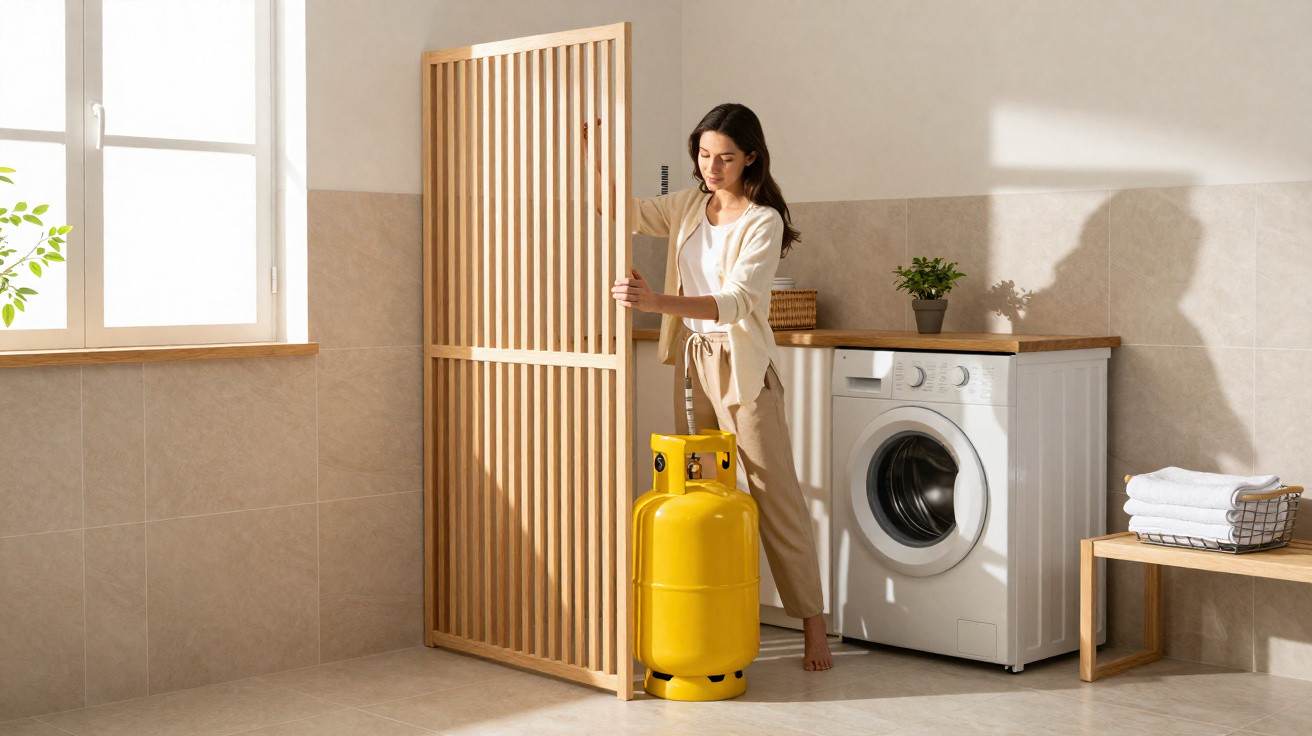
Keeping an LPG cylinder out of sight in the utility room can make the laundry area look tidier, but appearance must never take priority over safety. The key is to choose no-build solutions that retain ventilation, easy access and distance from heat sources.
Why does a visible gas cylinder look so disruptive in the utility room?
In many Brazilian homes, the gas cylinder is left on display in the utility area, beside cleaning supplies, buckets and a clothes airer. Visually, it interrupts the sense of order and makes it harder to achieve a more modern, clean design.
Liquefied petroleum gas, or LPG, is supplied as fuel in cylinders, particularly for household use. Any decorative solution must therefore allow for ventilation, access to the valve and safety in storage.
Before concealing the cylinder, take the following into account:
- Ventilation: the enclosure must never be completely sealed.
- Access: the valve must be easy to reach in an emergency.
- Slatted screen: this disguises the cylinder without stopping airflow.
- Distance: keep it away from the cooker, sockets, heat and sparks.
- Sealing: an ordinary closed cupboard is a hazard, not a solution.
What is the safest way to hide an LPG cylinder?
The safest choice is a purpose-made LPG cylinder cabinet, fitted with ventilation openings at both the bottom and top, an easily opened door and enough room to keep the cylinder upright. It creates a more discreet look without making a stuffy enclosure.
This cabinet must not become storage for cloths, flammable products, brooms or cleaning items. The cylinder should remain unobstructed, accessible and free from anything pressing on the hose, valve or regulator, as operation and inspection are the priority.
Is a slatted screen better than a closed cabinet?
For anyone seeking a no-build option, a screen made from slatted wood, perforated metal or a ventilated panel is often a practical alternative. It partly conceals the cylinder, improves the appearance and maintains airflow, provided that it does not touch the valve or hose.
Attractive, but ventilated
An LPG cylinder must never be sealed in.
Use perforated doors, spaced slats, metal mesh or alcoves with a permanent opening.
If you smell gas, close the valve, ventilate the area and do not operate any switches.
A screen also has the benefit of being movable, making it easier to clean the floor and carry out a quick inspection. To work properly, it should simply disguise the cylinder rather than confining it in an unventilated box or making cylinder replacement difficult.
Good no-build options include:
- A purpose-made LPG cylinder cabinet with perforated doors.
- A floor-standing slatted screen that does not seal the sides.
- A cane-panel, metal-mesh or open-wood panel.
- An open alcove with permanent ventilation at the bottom and top.
- A decorative stand that keeps the valve and hose accessible.
Which safety rules must not be ignored?
The cylinder must always stand upright in a ventilated location, away from the cooker, oven, sockets, drains, heat sources and sparks. The hose should also not be routed behind tightly fitted furniture, makeshift walls or anywhere it could bend or deteriorate.
It is also essential to check the expiry date of the hose and regulator, and to use certified components. If the installation requires relocating the connection point, using a long hose run or making a structural alteration, the right course of action is to call a qualified professional.
Avoid these common mistakes:
- Enclosing the cylinder in a standard cupboard without ventilation.
- Storing flammable products in the same enclosure.
- Positioning the cylinder directly against the cooker or oven.
- Hiding the valve behind items that are difficult to move.
- Using a hose that is expired, deteriorated, bent or overly stretched.
How can you create a modern utility room without taking risks?
Just as clever ways of hiding cables in the living room require thoughtful organisation, concealing an LPG cylinder means keeping things orderly without blocking access to what matters. The finish may be attractive, but it must preserve ventilation and safety.
Choose an open cabinet, keep the area clean, leave the valve visible and do not turn the enclosure into a storage space. With these precautions, the utility room can gain a more modern appearance without building work, dangerous makeshift solutions or compromising the proper use of LPG gas.
Comments
No comments yet. Be the first to comment!
Leave a Comment