
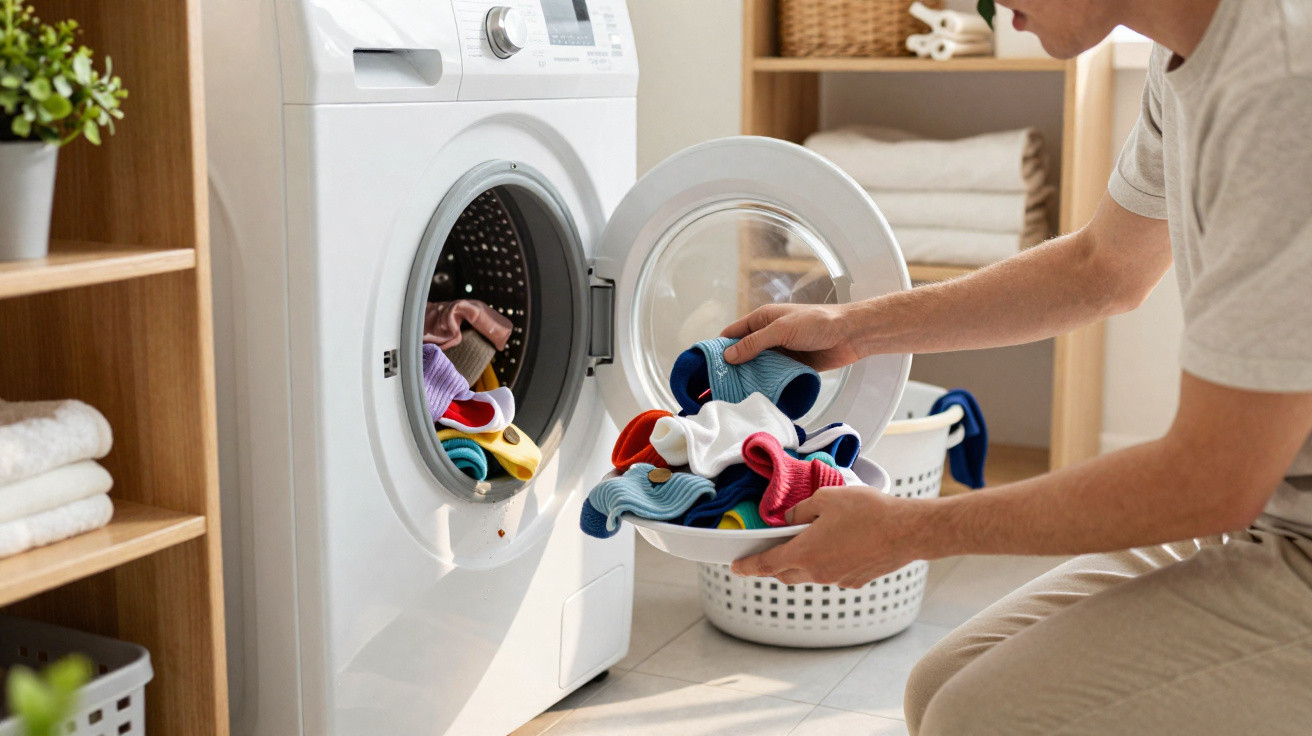
You open the door, lift out the damp heap of clothes… and one sock has disappeared. Again. Holding its partner, you stare into the empty drum as though it might be concealing a clue. You shift the washing around, inspect the rubber seal and even look behind the machine, half convinced there is a hidden gateway to a parallel world of unmatched socks. It may seem trivial, but this small household problem can be genuinely frustrating. You bought the socks as a pair and put them in the wash as a pair, so where has the other one gone?
The hidden route your socks really follow
When you start examining a washing machine with the suspicion usually reserved for a dubious neighbour, its many folds and narrow openings become obvious. The harmless-looking grey rubber door seal is both flexible and surprisingly deep. There is also far more space beneath the drum than most people realise. Water rushes through the machine at speed while fabrics tumble, twist and pull against one another. Behind the glass, it is essentially a miniature storm, with socks acting as the leaves.
Modern machines also tend to spin more quickly and forcefully than older models. That is ideal for freshly washed towels, but less helpful for thin, stretchy garments. Lightweight socks can work their way between the drum and the seal, particularly when caught up with larger clothes. Once they pass that rim, they are no longer in the main washing area: they have entered the inner workings of the machine.
A Samsung UK survey once suggested that Britons lose an average of 1.3 socks each month, adding up to more than 1,200 over a lifetime. The claim became the subject of memes and jokes, yet it reflects a real experience in households nationwide. One repair engineer in London described opening a front-loading machine to discover a whole layer of black trainer socks gathered around the heating element, like seabed sediment. The owner believed they were “vanishing in the wash”. In fact, they had been slowly travelling through the inside of the appliance.
Technicians also share another repair tale: a family believed their teenage son was secretly getting rid of his socks. When the engineer took off the front panel, he removed a handful of grey and white cotton, partly scorched from touching hot metal. It was a dusty, miserable mass of socks that had been “missing” for years. Nothing was wrong with the drum; the socks had simply crossed its edge and worked their way down towards the pump.
After a sock gets beyond the drum, water flow and gravity take control. The material falls into the space between the spinning drum and the stationary outer tub. It may then snag near the heater, become caught in the sump hose or be pulled all the way towards the drain pump. This is when the true culprit comes into play: the filter. This small and neglected component is made to collect coins, hairpins and lint - as well as wayward socks. Gradually, the trapped material forms a soft, damp blockage. The machine still attempts to force water through it, rather like trying to send a river through a stack of wet towels.
The washing machine filter quietly collecting your socks
Every washing machine has some form of filter, often known as the drain pump filter. In most front-loading models, it sits behind a small square flap low down on the front of the machine. Open the flap and there will be a round cap. Behind it is the place where your lost belongings accumulate. This is what engineers mean when they refer to “sock graveyards”.
The usual sequence is simple. A small sock slips over the drum’s edge, is carried downwards by the water and reaches the sump hose. Pieces of fabric can either stick there or travel onwards to the pump filter. When small enough, they wind around the filter and catch hair and lint along the way. Water drains more slowly, the machine has to work harder, and a wash may take longer or stop with an unhelpful error code. What appears to be a faulty washing machine is often just a filter crammed with fabric and coins.
During a call-out in Manchester, a technician opened a filter while the owner looked on. He removed two baby socks, a bra wire, three 20p coins and a Lego arm. The owner initially laughed, before realising that the socks had been “missing” for months. Variations of the same situation occur across the country. Small fabrics do not disappear; they travel. They simply end up in a damp, smelly compartment at the bottom of the machine, somewhere few people consider checking until it becomes blocked.
Mechanically, the route is clear. Water exits the drum through small holes, enters the outer tub and then runs down into the sump. The pump forces it through a narrow passage before it leaves via the drain hose. With so much movement and suction, any item that is small and flexible may be drawn along. Socks are especially suited to this journey: they are not large enough to cause an immediate jam, yet not tiny enough to pass straight through. They flex, fold and snag, eventually behaving like a plug. This is why a single missing sock can quietly disrupt an entire wash cycle, and why the filter exists to catch them before they harm the pump.
How to prevent lost socks - and deal with the filter
The most useful solution is remarkably straightforward: give small garments their own “seatbelt”. Mesh laundry bags were initially sold for lingerie, but they are excellent for socks too. Put each pair inside a zipped bag, add it to the rest of the laundry and the socks will remain together from basket to washing line. There are no more individual socks disappearing into the drum’s shadows, and pairing them after drying becomes a two-second task.
If you do not have a mesh bag, a simple alternative will do the job. Place socks inside pillowcases and tie a loose knot. They will still wash properly, but cannot slide into the door seal. It may look improvised, but it guards against the familiar “sock overboard” situation. Try it for a few weeks and the collection of single socks at the back of the drawer will stop increasing. There is nothing mysterious about it - it is simply physics working in your favour.
Another useful routine is checking pockets and shaking out larger items. On a hectic day, who really opens out duvet covers before putting them in the wash? Big sheets and hoodies can behave like nets, swallowing small items that escape at the least convenient point, just as the drum reaches high speed. Once free, they head directly towards the narrow gap around the drum edge. That is the slip road down to the filter, and retrieving them after that generally requires tools.
At a human level, this is not solely about the cost of socks or maintaining the machine. It is the brief surge of annoyance when your child cannot find a matching pair before school, or when you are about to leave and discover you will be wearing two black socks that are nearly - but not quite - the same. It is domestic chaos in miniature, gradually weakening the feeling that the home is under control. Often, the smallest item of clothing is enough to turn a calm morning slightly frantic.
A quietly worthwhile task is learning how to access and clean the drain pump filter. On most UK machines, it is behind a flap at floor level on the front. Switch off the power, put a shallow tray or towel beneath it, and carefully unscrew the cap. Dirty water will emerge first, followed by whatever has been lodged inside. Sometimes it will only be sludge. Quite often, it will be socks.
“On a good week, I pull five or six socks out of filters,” says Mark, a washing-machine engineer in Birmingham. “People always laugh and say, ‘So that’s where they went.’ They think something magical is happening in the wash. It’s not magic. It’s neglect.”
The discovery can be unexpectedly satisfying. You recover missing belongings, the machine will often drain more quickly and run more smoothly, and you feel as if you have uncovered a secret. In a way, you have.
- After every wash, run your hand around the rubber door seal, gently pulling it forwards.
- Put small items, including socks, baby clothes and underwear, in mesh bags or pillowcases.
- Clean the drain pump filter every few months, or whenever the machine begins draining slowly.
- Run occasional hot “maintenance” cycles to remove accumulated lint and sludge.
- Replace damaged or worn door seals that leave bigger gaps for fabric to pass through.
What missing socks reveal about the way you live
Once you understand where socks actually end up, the entire “mystery” takes on a different meaning. It is less about poor luck than a quiet system operating on autopilot. The filter at the base of the machine is not merely a plastic container for lint. It provides a physical record of your routines: coins forgotten in pockets, hair that has shed, and fabrics placed in the wash without a second thought. In some sense, you may have spent years teaching your machine to collect socks.
That does not mean you need to follow a flawless routine. Let’s be honest: nobody really does that every day. Most of us cram clothes into the machine between work, dinner and bedtime, shut the door and hope everything works out. That is why minor adjustments make a difference: a mesh bag placed in the laundry basket, a two-minute filter inspection every few months, or a quick check around the rubber seal before unloading. These are small, almost effortless actions that alter the result.
Most of us have experienced how one missing sock can throw off the beginning of the day. You lean over the laundry basket, muttering, blaming the machine and perhaps blaming the children. Yet, out of view, a filter is quietly doing its job while clogged with fabric you had forgotten. Once you have opened the flap and seen the proof, it becomes difficult to claim the socks “just disappeared” again. You know where they go, you know how to retrieve them, and for a moment you may feel oddly pleased to have brought one small part of domestic chaos under control.
| Key point | Detail | Why it matters to the reader |
|---|---|---|
| The hidden route taken by socks | Small socks slip between the drum and the seal, then travel down towards the pump | Finally understand where socks really disappear to |
| The role of the drain filter | The filter catches socks, coins, fibres and other objects at the bottom of the machine | Identify the key place to recover lost socks |
| Simple habits to adopt | Laundry bags, regular filter cleaning and checking the door seal | Reduce losses, extend the machine’s life and save time every day |
FAQ:
- Where exactly is the filter that traps my socks? On most front-loaders, it’s behind a small flap at the bottom front of the machine. Open it and you’ll see a round cap that unscrews – that’s the drain pump filter.
- Is it safe to open and clean the washing machine filter myself? Yes, if you switch the machine off first and keep a tray or towels ready for the spill. Unscrew the cap slowly, remove debris and socks, then refit it firmly.
- How often should I clean the filter to avoid sock loss and blockages? Every three months is a good rhythm for most homes. If you wash a lot of pet bedding or baby clothes, once a month makes a noticeable difference.
- Do laundry bags really stop socks disappearing? They help a lot. Keeping socks and other small items zipped in a mesh bag stops them slipping into the gap around the drum and being dragged towards the filter.
- What if my machine doesn’t have an obvious filter flap? Some models hide the filter behind the lower front panel, or combine it with the pump. Check the manual or the manufacturer’s website; if access is tricky, a technician can show you on a service visit.






Comments
No comments yet. Be the first to comment!
Leave a Comment