
Many people assume a cracked T-shirt print is beyond saving. That is not necessarily true: a simple trick can restore it surprisingly well.
In countless wardrobes, there are T-shirts with striking designs, logos or band prints that no longer get worn for one reason: the graphic looks tired, cracked and dull. They often end up in the ‘to be discarded’ pile even though the fabric itself remains perfectly sound. Yet a product found in many bathroom cabinets, combined with an ordinary iron, can turn these supposedly worn-out clothes back into everyday favourites.
Why printed T-shirts quickly look worn
The familiar ‘vintage look’ of a printed T-shirt rarely means that the fabric has failed. More often, the issue lies solely with the design. Over time, the transfer film or screen print hardens, especially:
- in areas that move regularly, such as the chest, stomach and centre of the back
- along creased sections including the stomach, sleeves and sides
- after repeated hot washes
- because of tumble drying or ironing directly over the graphic
The result is tiny cracks, flaking edges and a brittle-looking print. Visually, this can make an otherwise wearable T-shirt seem like an old rag - which is exactly where this repair trick comes in.
The unassuming bathroom-cabinet helper
This method is based on acetone, a solvent included in many nail polish removers and sometimes kept at home as a cleaning product. Acetone can gently dissolve plastics and vinyl, which are the materials used in many T-shirt prints.
“The aim is not to remove the print, but to soften it briefly so that the cracks can then be ‘fused’ with heat.”
Only a few household items are needed:
- acetone or nail polish remover containing acetone
- a cotton pad or piece of cotton wool
- an iron
- a thin cotton cloth or old tea towel to act as a protective layer
Each item has a specific purpose: the cotton pad controls the solvent, the acetone softens the print, the cloth provides protection, and the iron seals it.
Step one: soften the print in a controlled way
Before starting, test the method on an inconspicuous part of the T-shirt, such as the hem or the inside. This will show how the fabric responds to acetone.
How to apply acetone correctly
The amount used is crucial. The T-shirt should not be soaked, and the fabric beneath the design should stay as dry as possible. Only the surface of the print is the target.
- Lightly moisten a cotton pad or piece of cotton wool with acetone.
- Do not saturate it; begin with a small amount instead.
- Gently dab the cracked print with the pad rather than rubbing it.
Dabbing instead of scrubbing helps prevent already fragile particles from being pulled away from the design. Gentle contact distributes the solvent evenly without soaking through the fabric.
“As a guide: several short, gentle touches are far better than one wet splash.”
After a few seconds or minutes, the print will begin to soften. When lightly stroked, the surface should feel less hard and give slightly. That is the point at which to move on to the next stage.
Step two: use an iron to close the cracks
Heat now takes centre stage. It helps the softened print become a more solid surface again, bringing the edges of the small cracks closer together.
Setting the iron for the T-shirt print repair
- A medium setting without steam is generally sufficient.
- Select a lower setting for very thin fabrics.
- If unsure, always start with less heat and increase it gradually.
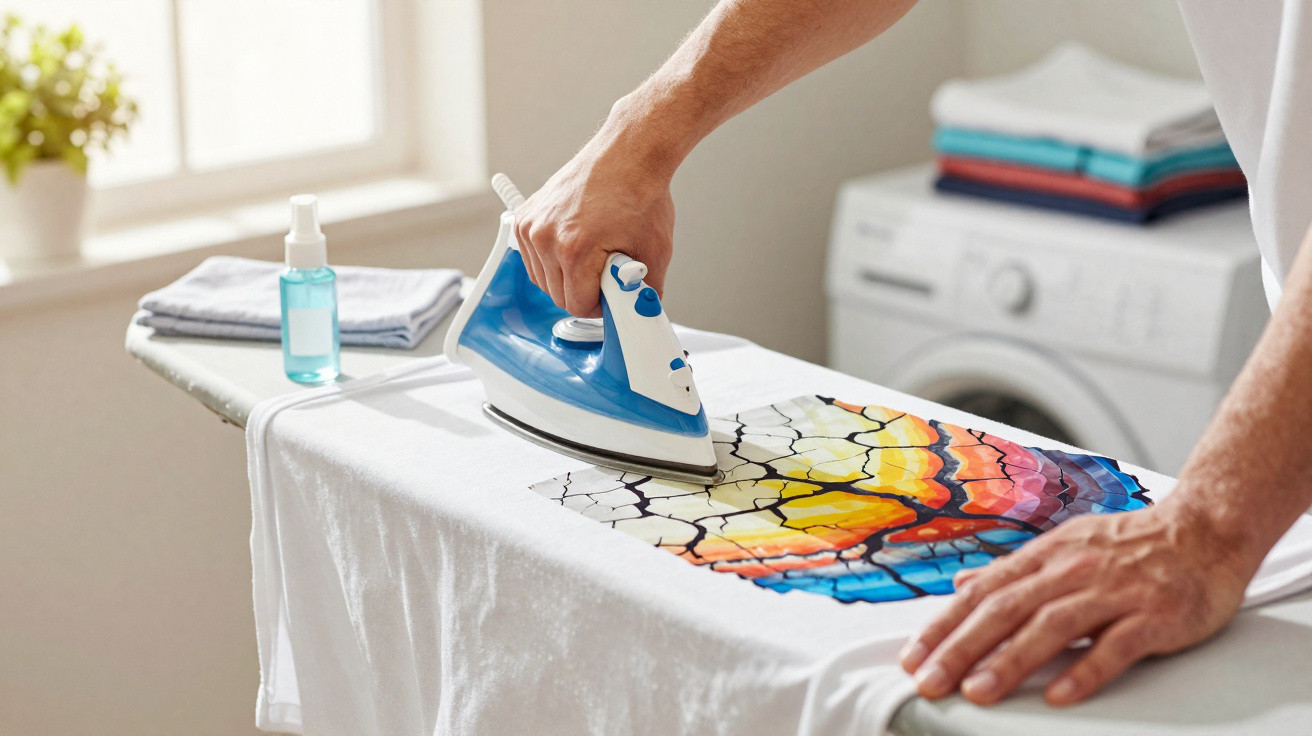
Lay the T-shirt flat on an ironing board with the design facing upwards. The key protective step follows: place a thin cotton cloth or an old pale tea towel directly over the print. This prevents the iron sticking to the softened design or creating shiny patches.
The actual repair ironing is then carried out as follows:
- Place the iron on the cloth; do not slide it across the surface.
- Hold it in place with light pressure for a few seconds.
- Lift it and position it over the next section until the entire design has been treated.
These targeted pressing movements draw the softened print together, close minor cracks and make the graphic look smoother and noticeably fresher. Once it has cooled, the design will usually appear more even and uniform, so that individual cracks are no longer visible from a distance.
How to avoid unwelcome surprises
A few basic rules can help ensure that a favourite T-shirt is genuinely saved:
- Always test first on an old T-shirt or an inconspicuous area.
- Work only on printed sections, never on exposed fabric.
- Start with a little acetone and add more only if necessary.
- Treat lighter-coloured fabrics particularly carefully, as marks show more readily on them.
- Always put a cloth between the iron and the graphic; never iron directly on the print.
“Anyone who works slowly and carefully can often watch the effect develop step by step - and stop in time before going too far.”
Keeping the ‘new old’ print looking good for longer
Once the print is smoother again, a little care will help the repair last as long as possible. For future washes, the most important points are:
- Always turn printed T-shirts inside out.
- Wash at no more than 30°C, ideally on a delicate cycle.
- Avoid the tumble dryer and dry the T-shirt on a washing line instead.
- Avoid the printed area when ironing, or iron it only from the reverse side.
This keeps the repaired surface more flexible and makes it far less likely to crack again. The print stays looking more even for longer, and the T-shirt returns to everyday use instead of ending up in a textile recycling bin.
When the acetone-and-iron trick works - and when it does not
The acetone-and-iron trick is especially suitable for:
- T-shirts with thicker transfer-film or screen prints
- high-quality band or fan T-shirts
- souvenir T-shirts with sentimental value
- children’s T-shirts featuring favourite characters
It is less suitable for very cheap fabrics, extremely thin jersey or print types that resemble a soft, rubberised film. In these cases, the design may smear rather than close up. A very small test patch is therefore advisable before treating a larger area.
A sustainable benefit: less waste, more wear
Treating T-shirts in this way not only saves money but also reduces textile waste. Fashion companies produce millions of garments every year, many of which disappear after only a short time - not because they can no longer be worn, but because they no longer look ‘new’. A straightforward repair technique like this can significantly extend their useful life.
There is another possibility for crafters, too: a partly restored print can be deliberately developed further with creative touches, for instance textile paint, patches or an additional self-applied iron-on design. A garment that was almost rubbish can become a new one-off piece.
Anyone who has seen an apparently ruined graphic visibly improve with just a few simple steps is likely to think differently the next time they sort through their clothes: reach for the bathroom cabinet first, then the iron - and only as a last resort, when nothing else works, the textile recycling collection.



Comments
No comments yet. Be the first to comment!
Leave a Comment