
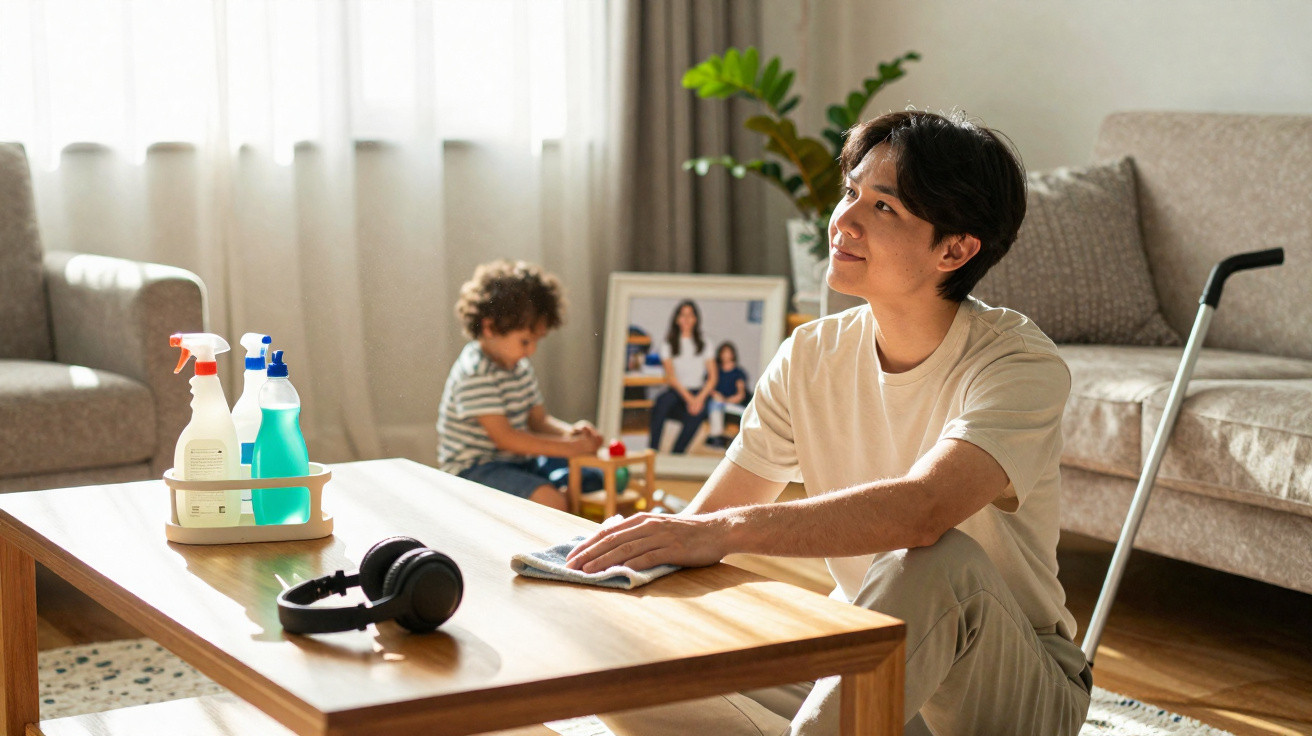
The other evening, I watched my neighbour’s teenager tackle their bedroom with almost aggressive resolve. Clothes were hurled onto the bed, drawers were banged shut and music blasted at full volume. Two floors below, an older woman in our block was carefully dusting the same shelf for the third time, almost as though it were a ceremony. Meanwhile, I was in between, wiping down the kitchen worktop because I could not think clearly while crumbs remained there.
All of us were cleaning.
Yet we plainly were not doing the same thing.
At different points in life, cleaning becomes more than a matter of hygiene. It begins to reveal something subtle but profound about who we are, what unsettles us and what we are trying to manage.
Strangely, the sponge matures alongside us.
When cleaning is really about identity
For children, cleaning generally begins as an instruction imposed from outside. A parent calls down the hall, “Tidy your room before dinner!” and, with little enthusiasm, you push toys under the bed and consider the job done. It seems unfair and faintly ridiculous. You do not especially mind where your socks go, provided you can still locate your favourite one-eyed teddy bear.
Then adolescence arrives, and mess turns into a declaration.
The chair hidden beneath hoodies, the carpet absent from view for three weeks, the sink holding three pots of ramen in quiet resistance to adult life.
Your room is not untidy; it is “creative chaos”.
Or so you assure yourself.
Picture a university hall of residence on a Sunday afternoon. One person is racing about with a bin bag, attempting to reclaim missing cutlery. Another is “deep-cleaning” for the first time in months because their parents are coming over. The disinfectant spray practically carries the scent of panic.
A little later, in your first flat, each time you wipe the worktop it carries a different significance.
All of a sudden, you are buying your own sponge.
You may even feel oddly pleased with your washing-up liquid.
There is a small private satisfaction in making the bathroom resemble a photo from a rental listing, even if it stays that way for barely 24 hours. This is when cleaning ceases to be merely a punishment and begins to feel like evidence that you can, somehow, cope with life.
What changes is not the dust itself, but the meaning your mind assigns to it. As a teenager, untidiness can feel like territory: a space that declares, “this is mine, and I won’t be policed”. In your twenties, tidiness increasingly represents capability. A neat studio flat makes a quiet statement: I may be skint, but I am not adrift. As the years accumulate, cleaning becomes a way of setting boundaries around your time, energy and mental health.
We do not simply clean our floors.
We clean away anxiety, shame and the urge to control at least one small part of the world.
How life stages quietly rewrite your cleaning rituals
An easy way to spot this change is to notice what prompts you to clean at each age. As a student, cleaning often happens in frantic spells before an exam, a date or a visitor. The mess builds and builds… until, one evening, you look around and launch into a two-hour cleaning frenzy. Later, when you share a home with a partner or housemates, cleaning becomes a form of negotiation.
You begin saying things such as: “If I cook, can you do the dishes?”
Suddenly, the state of your relationship can be seen in the grease on the hob and crumbs in the sink.
Then come the years when you may be living with small children, pets or both. You clean in cycles. You collect toys, fold washing, wipe jam off the table, and five minutes later the sitting room appears untouched by your efforts. This is often when people develop the idea of “good enough” cleaning. One part of the home becomes the sacred tidy area, the place you photograph if somebody asks how things are going. Everywhere else? Lived-in, chaotic and sticky in patches.
Let’s be honest: nobody really does this every single day.
Even influencers with immaculate white sofas crop the clutter out of the shot.
Later still, when children, if you have them, are grown up or you are living alone once more, the pace changes again. You are no longer following sticky fingers from room to room. You may find yourself cleaning more slowly and attentively. The shelf you once dusted monthly becomes part of a weekly routine. The noise of the vacuum cleaner on a Saturday morning feels unexpectedly comforting.
This is when cleaning starts to stand for continuity.
It says: I am still here, this remains my home, and I am caring for it.
The actions are the same, but their emotional significance has changed completely.
Turning cleaning from burden into quiet self-respect
One useful adjustment at any age is to make the task smaller. To a teenager, “clean your room” can sound enormous, almost philosophical. As an adult, “deep-clean the whole flat” on a Sunday may ruin your mood before you have finished your coffee. Instead, select one small, visible space and concentrate on it fully.
The bedside table.
The kitchen sink.
The desk where you work each day.
Spend 10–15 minutes making that one area truly pleasant. Quite often, your brain interprets this small patch of order as a major inner success.
Comparison is another quiet source of sabotage. You see a friend’s minimalist sitting room and your own home suddenly resembles a storage unit. Or you visit a relative whose house smells of lemon cleaner and childhood discipline, then leave feeling ashamed of the crumbs on your own sofa. This is where age can mislead us: we continue to judge our current lives against standards from the past or future.
If you are raising toddlers while working full-time, your home will not resemble that of your retired aunt.
That is not failure; it is physics.
Cleaning at 25, 40 or 70 does not take place with the same body, timetable or priorities. The dust remains the same, but you change.
At some point, a therapist told me, “Your house doesn’t need to be ready for guests. It needs to be ready for you.”
That sentence hit me harder than any cleaning checklist.
- Define your current season
Are you in a study-until-2 a.m. period, the baby years or the sandwich-generation years? Clean for the reality you are living, rather than an imagined life. - Choose a “non-negotiable” micro-task
One load of washing, an empty sink at night or a swept hallway. Pick one act that tells your brain: I looked after my space today. - Make one pride corner
It might be a shelf, a coffee table or one section of your bedroom. Keep that spot reliably calm and pleasant. On chaotic days, it offers a point of reference. - Let go of the museum standard
Homes exist to be lived in, not to impress visitors. Some visible evidence of life is normal. Dust is not a moral failing. - Pay attention to what cleaning calms
Do you scrub when anxious? Fold laundry when sad? Once you recognise the pattern, you can decide whether the habit is helping or concealing something.
What your way of cleaning is trying to tell you
The more closely you observe, the more your cleaning habits resemble a private diary. The period when you left washing-up for days may coincide with burnout or heartbreak. A sudden desire to reorganise the wardrobe often appears just before a major decision. When older relatives begin fussing over minor details, such as the exact angle of framed pictures or the arrangement of coffee cups, it may be their way of holding on to order while health, mobility or relationships shift beneath them.
We have all known that moment when wiping a surface feels simpler than confronting a difficult conversation.
Throughout these life stages, one straightforward truth keeps returning: cleaning is seldom only about cleaning. For a teenager, it may be quiet rebellion. For a young adult, it can be a display of competence. For an overstretched parent, it is a battle they keep losing but continue to fight, because love can mean picking up the same toy twenty times. For somebody ageing alone, it may be the last dependable routine in a week that has changed too much.
Seen this way, the question is no longer “Why am I still not more organized?” Instead, it becomes something gentler: “What do I need, really, when I start scrubbing the bathroom at 11 p.m.?”
When you begin listening to your own habits, guilt loses some of its hold. You may notice that you clean compulsively when work makes you feel powerless, or that you stop cleaning altogether when sadness becomes overwhelming. Neither response makes you a “messy” or “neat” person. They simply mark different chapters. The sponge, vacuum cleaner and folded towels in the cupboard are small props in a far larger story of growing up, changing, grieving and hoping.
And unlike your floors, that story is never entirely finished.
| Key point | Detail | Value for the reader |
|---|---|---|
| Cleaning changes with life stages | From childhood obedience to teenage rebellion to adult ritual | Helps you avoid judging current habits against outdated standards |
| Small zones beat total control | Focusing on one visible area creates a feeling of progress | Reduces overwhelm and makes tidying feel genuinely achievable |
| Mess and order carry emotions | Cleaning patterns often reflect stress, identity or transitions | Helps you treat cleaning as a signal rather than only a chore |
FAQ:
- Why did I love cleaning as a kid but hate it now?
As a child, cleaning may feel like a game or time shared with an adult. Later, it takes on the burden of responsibility, and that change can transform a playful activity into a source of pressure.- Is it normal to clean more when I’m stressed?
Yes, many people clean to restore a sense of control when life feels uncertain. It can be calming, provided it does not become your only coping method.- Why does my parents’ house always feel cleaner than mine?
They may have different amounts of time, routines or expectations because they are at another life stage. Comparing a busy home filled with children or early-career demands with a quieter, established home is rarely fair.- How can I stop feeling guilty about my messy place?
Replace “Is my home spotless?” with “Can I live and rest here?” Begin with one small space, and remember that your value is not measured by dust bunnies.- Will my relationship with cleaning keep changing?
Almost certainly. As your health, work, relationships and priorities change, the way you care for your home will change too - and that reflects life, not failure.

Comments
No comments yet. Be the first to comment!
Leave a Comment