
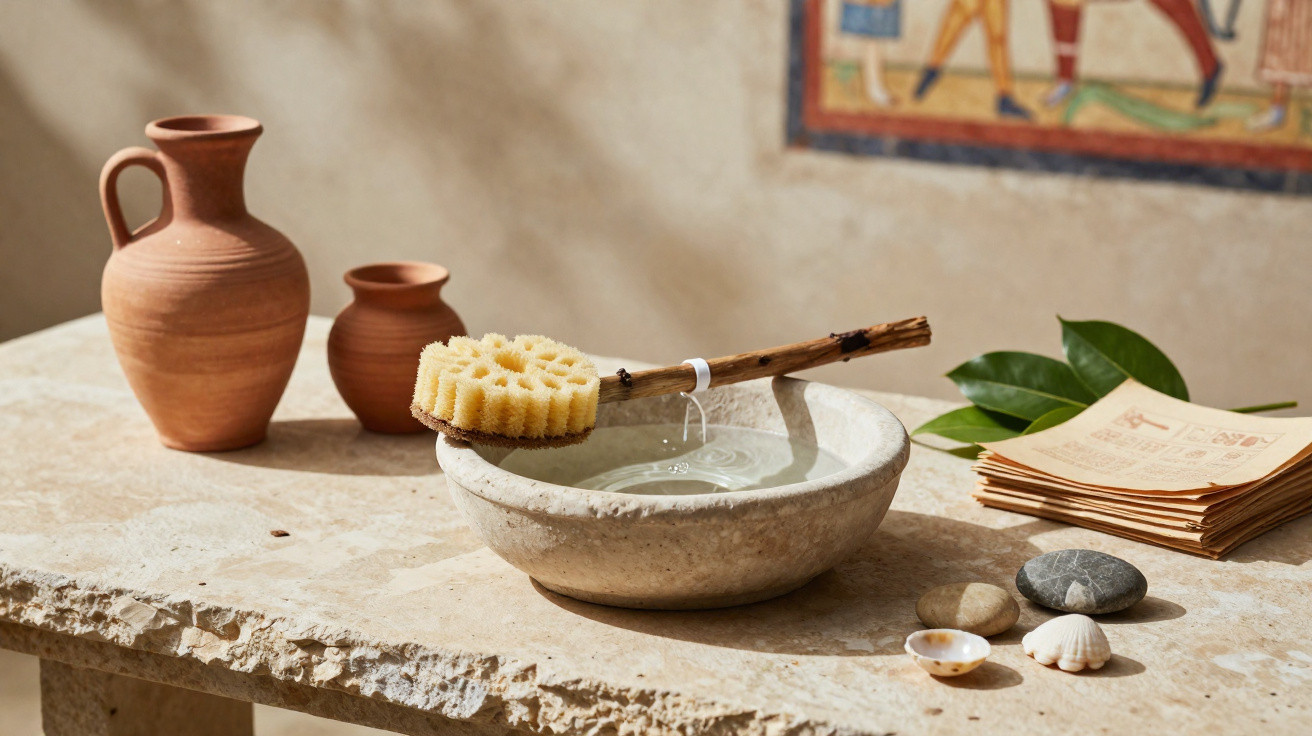
Before toilet paper became an everyday item, people in ancient civilisations relied on water, sponges, shards of pottery, cloth, and whatever else they could gather from the natural world. What someone used depended on climate, what materials were available, and social status-resulting in hygiene routines very different from those common today.
What did the Romans use in public toilets?
In Roman latrines, the best-known implement is the tersorium: a sponge fixed to the end of a stick. Some accounts suggest it was rinsed in salt water or vinegar and then used again, although researchers still debate whether it was applied directly for personal cleaning or used instead to scrub seats and drainage channels.
Roman public toilets had rows of seats with channels where water flowed. Alongside the sponge, leaves, moss, and scraps of fabric may also have been used, depending on what a person could obtain and their financial means.
- A sea sponge attached to a wooden handle;
- Running water in channels beside the seats;
- Leaves and moss collected nearby;
- Small pieces of cloth used by those who could get them;
- Containers of water for rinsing the items.
How did the Greeks manage hygiene without paper?
In Ancient Greece, some people used pessoi-rounded fragments of pottery or smooth stones. These were easy to find, could be reused, and show how hygiene practices depended on available materials, even though they would have been far less comfortable than modern products.
When did the Chinese start using paper?
China provides one of the earliest known records of paper being used for personal hygiene. A text from the 6th century notes that certain papers bearing the names of sages and important passages should not be used in this way, implying that less valued sheets already served that purpose.
Before paper became widespread, wooden or bamboo sticks were also used, with cloth wrapped around the tips. Examples discovered in old latrines along the Silk Road preserved traces that confirm their sanitary use. This development included:
- Thin sticks made from wood or bamboo;
- Pieces of cloth fastened to the end;
- Water used alongside the tool;
- Sheets of paper available among privileged groups;
- Scented papers produced for the imperial court.
What natural materials were used in other regions?
Communities living near rivers often cleaned with water, using jugs and other containers, while groups far from plentiful water sources turned to leaves, sand, snow, smooth stones, straw, hay, and corncobs. Looking at what people used before modern toilet paper makes it clear there was never a single method shared by all societies.
Ancient hygiene followed each society’s resources
The habits of ancient civilisations cannot be judged solely by today’s standards. Clean water, soft fabrics, and paper were expensive or difficult to obtain, so each community made use of whatever it could find locally or produce in sufficient quantity.
Commercial toilet paper appeared only in the 19th century and took decades to become common in homes. Until then, water, reusable implements, and natural materials performed the same basic role-showing how even private routines shift with changes in technology, sanitation, and the production of everyday goods.




Comments
No comments yet. Be the first to comment!
Leave a Comment