
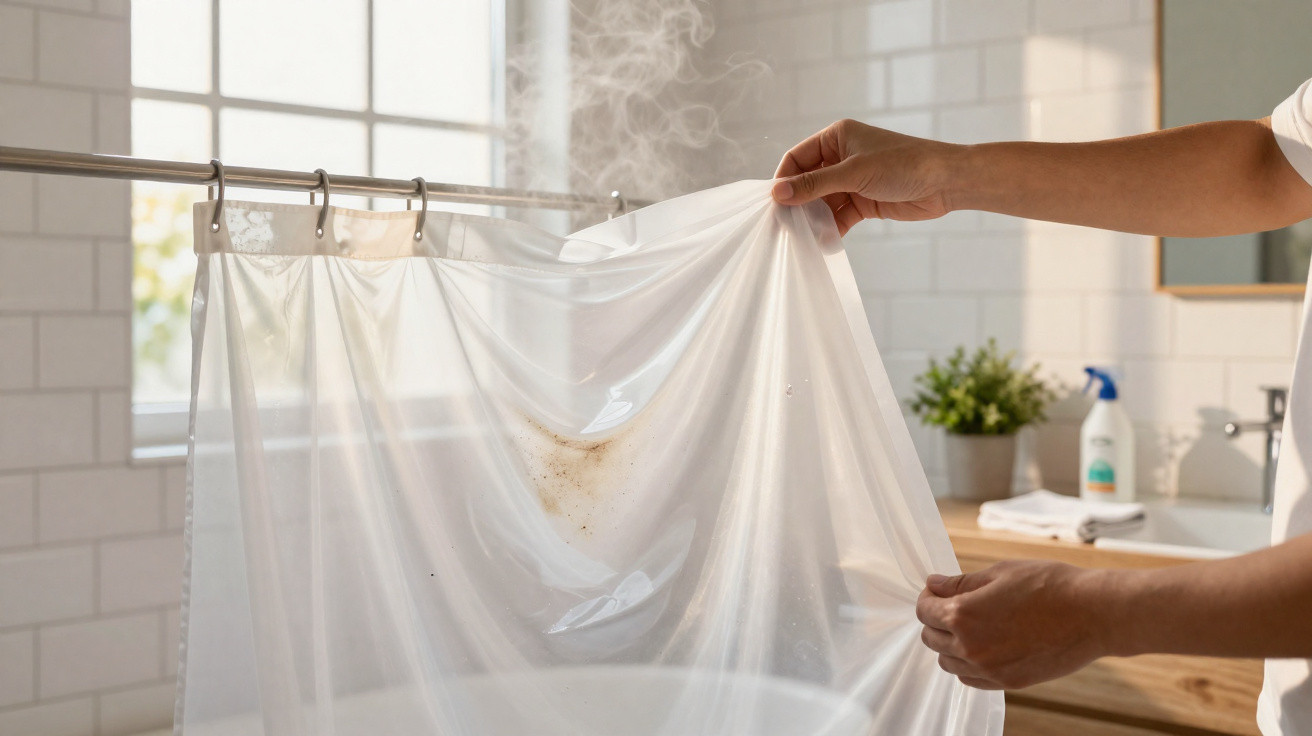
The plastic shower curtain liner in your bathroom is probably not something you give much thought to.
It just hangs there, gets splattered, clings to your legs, and largely just… sits in the background. Days roll into weeks, weeks into months, and that same cloudy liner is still in place, slightly curled at the bottom, with faint orange marks you keep choosing to ignore. You give it a quick spray occasionally, pull it straight again, and promise yourself you’ll sort it out “this weekend”.
Then one morning the light catches it at the wrong angle. You spot little clusters of black specks in the folds and along the bottom edge. You lean in, and suddenly it feels grimier than the shower tray itself. Your mind jumps to what might be living on it, what you might be breathing, and why you never really noticed before.
That’s when it clicks: your shower curtain liner isn’t just plastic - it’s a slow-motion mould problem.
Why your shower curtain liner is a mould magnet
Have a hot shower, step out, shut the door, and you’ve basically made a miniature greenhouse. Warm air, steam and condensation gather around the liner like a damp wrap. Water sits on every crease and droplet, especially along the hem where it collects and takes longest to dry.
The liner doesn’t protest; it simply keeps doing what it’s there for. But within those tiny beads of water and leftover soap, microscopic spores land and begin to settle in. At first, there’s nothing obvious. Then comes a faint film, a pinkish slick near the corners, and speckled grey marks.
By the time there’s even a hint of a musty smell, it’s already well underway.
Public health guidance frequently points to bathrooms as one of the most common indoor places for mould to develop, particularly where ventilation is poor. And the shower curtain liner sits right at the front line. It takes the full hit from water, shampoo, body oils and limescale - all of which cling on and help spores thrive.
Picture a student flat where four people share one small bathroom. The shower runs from 6am until midnight in a constant relay. The extractor fan is broken, the window stays shut for half the year, and the same flimsy liner hangs there, spotted at the bottom like a leopard’s tail. No one feels responsible for it, so no one replaces it.
Six months later, you notice the smell before you feel the hot water.
From a scientific point of view, a liner offers mould exactly what it wants: moisture, a bit of organic residue from soap scum, and damp folds that don’t dry out properly. The plastic itself isn’t really the “food”, but the grime on top of it is. Each shower re-creates the ideal conditions: warm, wet, and with minimal airflow - particularly where the liner sticks to the wall.
Left to its own devices, those black and orange marks aren’t only an eyesore. They can release spores into the air you breathe in that enclosed space, and they don’t stay neatly confined to the curtain. They can move to grout, sealant and even the ceiling. What started as a grubby liner can quickly turn into a broader bathroom issue.
How changing your liner breaks the mould cycle
The most straightforward change - and often the most effective - is almost dull in its simplicity: replace the liner routinely, rather than waiting for it to look revolting. Treat it the way you treat a toothbrush. You don’t wait for the bristles to fall out; you swap it before it becomes a problem.
As a sensible guide, change a basic plastic liner every 2–3 months in a busy home, or every 4–6 months if you live alone and the bathroom dries well. If someone in the household has asthma, allergies, or is especially sensitive to damp, that schedule matters even more. Simply putting up a fresh liner stops established colonies from continuing to build on the old one.
This isn’t just about making things “look nicer”. It’s about disrupting the conditions mould relies on.
On a human level, it can feel like yet another task on an endless list. You work, you commute, and you dash through showers either half-awake or half-asleep. The liner is just part of the scenery - until it stops being. On a damp winter evening, you pull it across and catch that sour edge to the air that doesn’t fully disappear, even after you scrub the tiles.
One reader described finally replacing a liner after months of ignoring the mould spots. The change wasn’t only cosmetic. The bathroom smelt cleaner immediately, and their morning wheeze eased after a few weeks. Was the curtain the only reason? Hard to say. But they did notice the air no longer felt as heavy.
Mould has a way of doing that: it erodes comfort in small, quiet increments.
From a health angle, swapping liners regularly is a low-effort way to reduce repeat exposure. Mould spores can set off coughing, irritated eyes, and for some people, more serious breathing symptoms. A steamy bathroom makes it all too easy for those spores to reach your lungs.
Replacing the liner won’t “fix” humidity in the home, but it does remove one of the simplest surfaces for growth. It also reduces how many spores get disturbed each time you drag the curtain open and shut. Think of it as taking away seats at mould’s table.
Most people wouldn’t deliberately stand and breathe a few inches from a damp, mouldy surface every morning. And yet many of us effectively do, because plastic looks deceptively harmless.
Practical steps: from grimy liner to healthier routine
The most workable approach is to make liner changes feel automatic. Buy two or three at the same time and keep spares in the bathroom cupboard. When you notice spots that keep returning and won’t rinse away, don’t bargain with them. Take it down and put a new one up. Two rings off, two rings back on. Two minutes, no fuss.
If you choose fabric or “mould-resistant” liners, see them as lower-maintenance - not maintenance-free. Wash fabric liners every few weeks on a gentle cycle with hot water and a splash of white vinegar. Put them back up only once they can dry completely, ideally spread out rather than scrunched.
Between showers, pull the liner fully closed so air can reach both sides. It’s a small, quiet habit that helps it dry quicker and slows mould’s progress.
You’ve probably heard the standard advice: ventilate the bathroom, run the extractor, open the window. And yes - it genuinely helps. But realistically, hardly anyone stands there counting out twenty minutes of fan noise after a quick wash. Day-to-day life doesn’t run that neatly.
So focus on “better”, not “perfect”. Open the window while you shower when you can. Leave the door slightly open afterwards. If the fan is reasonably good, consider wiring it to the light switch so it runs whenever someone is in there. Small adjustments add up over time.
Common missteps include wedging bottles into the curtain folds so moisture stays trapped, leaving the hem sitting in a wet puddle in the bath, or using strong bleach so often that the liner goes brittle and cracks - which then holds even more grime in the creases. You don’t need a battle plan; you need a habit.
“I used to attack the black spots with bleach and scrub until my eyes stung,” admits Claire, 34, from Manchester. “Swapping the liner every few months felt wasteful at first. Then I realised I was spending more time fighting a £4 bit of plastic than just replacing it.”
- Choose the right material: Vinyl is inexpensive, but it can cling and hold onto water. Fabric or PEVA liners often dry faster and typically feel less “clammy”.
- Pay attention to the hem: A weighted or magnetised bottom edge encourages water to run off instead of collecting in crumpled corners.
- Keep it straightforward: Rinsing the bottom edge once a week with hot water can slow down staining, especially in hard water areas.
Living with less mould, one small habit at a time
Replacing a shower curtain liner doesn’t feel like a dramatic, life-altering move. It’s not glamorous. No one is uploading tearful before-and-after videos about bathroom plastic. Yet, quietly, it changes the everyday atmosphere.
The room smells fresher. The walls stay cleaner for longer. Those vague “winter coughs” and morning sniffles feel less like a given. You step into the shower without that small, nagging thought about what might be growing a few inches from your face.
At a deeper level, it’s about reclaiming a little control in a room most of us rush through. The bathroom is where you wake yourself up, wash the day away, cry sometimes, sort your hair before a date, and bathe a screaming toddler. We’ve all had that moment of catching our own reflection and thinking everything is moving a bit too fast.
In a tight space like that, small decisions compound - changing a liner, letting the room air out, noticing the subtle warning signs on the surfaces you see daily. Mould doesn’t feel dramatic until suddenly it is. You don’t have to wait for black patches on the ceiling before you start paying attention.
And perhaps that’s the real message. Health at home rarely comes from one grand overhaul. It arrives through tiny, repeatable actions: a corner clipped back, a fabric liner washed, a fresh liner unrolled on an ordinary Tuesday night when nobody’s looking.
| Key point | Detail | Why it matters to you |
|---|---|---|
| Regular liner changes | Replace every 2–3 months in busy homes, 4–6 months if used less | Cuts down hidden mould growth and day-to-day exposure |
| Drying and ventilation | Pull the liner closed and air the bathroom after showers | Keeps surfaces drier so spots take longer to appear |
| Material choice | Fabric or PEVA liners dry faster than basic vinyl | Helps the bathroom stay fresher with less effort |
FAQ:
- How often should I actually change my shower curtain liner? For most homes, every 2–3 months is a reliable routine - sooner if you notice stubborn mould that won’t wash away.
- Can I wash the liner instead of buying a new one? Yes. Many fabric liners, and some plastic ones, can be machine-washed with hot water and a little vinegar, then rehung to dry.
- Is mould on my liner dangerous? For many people it’s mainly an irritant, but if you have asthma, allergies, or a weakened immune system, repeated exposure can be more troublesome.
- Do “mould-resistant” liners really work? They may slow things down, but they don’t stop mould entirely; drying habits and occasional replacement still matter.
- What if I rent and can’t change the bathroom set-up? You can still replace the liner regularly, use the fan or window when possible, and keep the curtain spread out to dry between showers - small changes that don’t require a landlord’s approval.




Comments
No comments yet. Be the first to comment!
Leave a Comment