
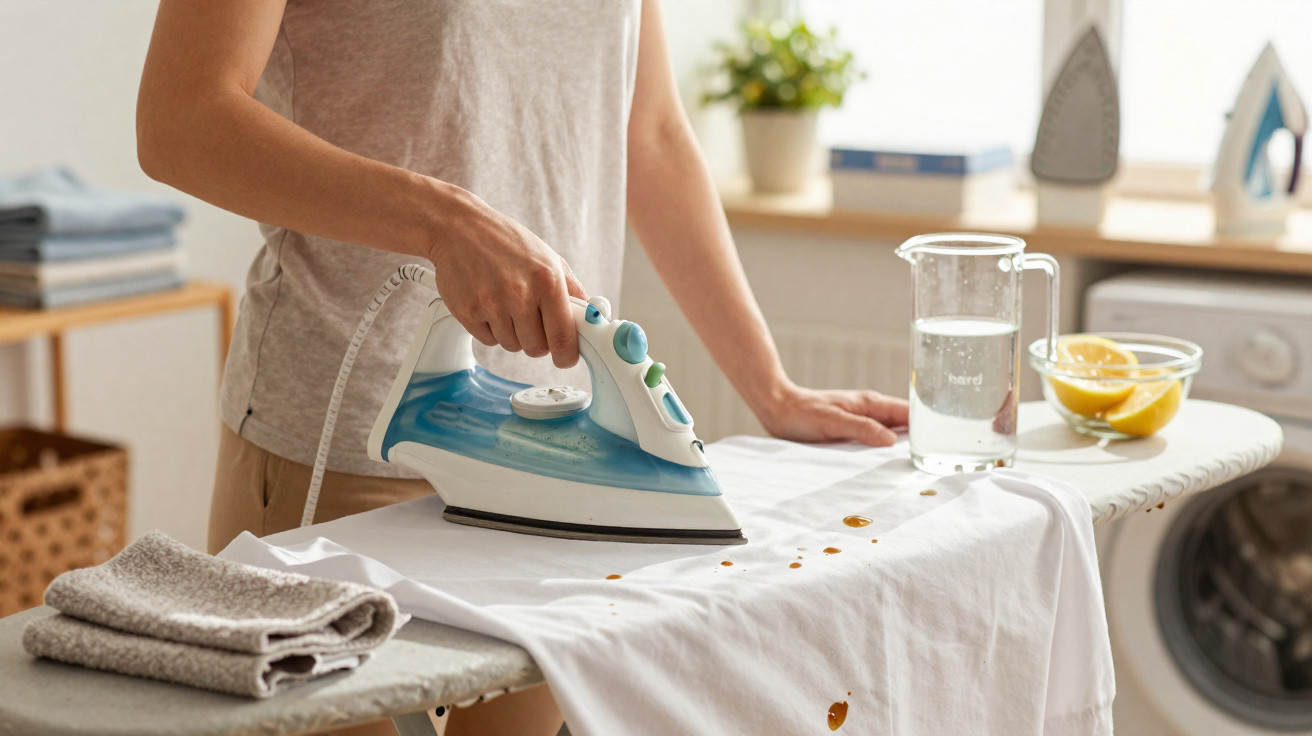
Many people only notice the cry for help when a favourite shirt emerges from an ironing session stained and frustration sets in. These unsightly marks are rarely caused by a “broken” appliance. More often, the culprit is a quiet mineral enemy in the water tank, along with a few everyday mistakes that age an iron far sooner than necessary.
When an iron spits: what the stains really reveal
Water droplets on an iron’s soleplate may seem harmless. The real warning signs tend to be more subtle. Initially, the appliance takes longer to remove creases. Steam seems weak, so you have to pass over the same area repeatedly. Many people blame the laundry or the iron’s “poorer quality”.
The visible clues appear next: white flakes, yellowish specks and brown droplets. They stick to cotton, settle on delicate blouses and make shirts look unkempt despite having just been washed. Once the iron starts making loud hissing or crackling sounds and releases more water than steam during a steam burst, the issue is no longer cosmetic but technical.
Nearly every iron that stains clothes or “spits” has the same underlying cause: stubborn limescale in the tank and narrow internal channels.
Tap water contains naturally occurring minerals, primarily calcium and magnesium. As the appliance heats up, these build up layer by layer in the heating chamber. The resulting deposit is known as limescale or boiler scale. Steam channels become narrower, and some can block entirely. Water then has too little time to turn into steam and is forced back out partly heated, or even cold, together with brown particles loosened from old deposits.
There is also a second consequence: the heating element needs more energy to work through this insulating layer of limescale. That puts strain on the mechanism and increases electricity use. A temperamental iron is therefore doing more than misbehaving; it is signalling increasing wear.
Everyday mistakes that damage an iron water tank too early
Most damage is not caused by a single mishap, but by small habits that build up over time. At first, many of them appear sensible - but they are not.
Water that is too hard and too little maintenance
- Using tap water only despite very hard water: In areas with heavily mineralised water, deposits start forming in the tank almost from the first use.
- Emptying the tank but never descaling it: The water is poured away, but minerals remain behind as a fine film that becomes denser with every ironing session.
- Ignoring warning signs: Continuing to iron despite reduced steam, stains or loud noises gives limescale time to turn into rock-hard plugs.
Many users assume that occasionally emptying the tank is enough. However, this does not affect baked-on deposits on the inner walls. Every refill supplies more minerals that can accumulate there.
Incorrect rescue attempts using harsh products
When an iron begins visibly malfunctioning, many people opt for a drastic treatment. That can do more harm than good.
- Undiluted vinegar in the tank: Neat household vinegar can attack seals and rubber components, particularly when hot. It can create leaks where there was previously only limescale.
- Unsuitable descalers: Powders and liquids designed for coffee machines are not automatically suitable for irons. They may leave residue that ends up on fabric with the next cloud of steam.
- Submerging the entire iron: Placing the whole appliance in the sink risks moisture entering electrical components.
The urge to “give it a really thorough clean” often results in microscopic cracks in seals, damaged hoses and an iron that suddenly drips rather than steams.
Gentle iron descaling: turning a spitting appliance back into a workhorse
A thorough but gentle descaling cycle can often save a struggling iron. The key factors are the correct mixing ratio and patience.
Two tried-and-tested mixtures
| Product | Mixture | Benefit |
|---|---|---|
| Household vinegar (approx. 14%) | 50% water, 50% vinegar | Inexpensive, widely available and reliably dissolves limescale |
| Citric acid (powder) | 1 tbsp per 250 ml water | Low odour and more pleasant for sensitive noses |
Proceed as follows:
- Disconnect the appliance from the mains and allow it to cool.
- Fill the water tank with the mixture up to its normal maximum mark.
- Put the cold iron in the sink or on an old towel.
- Leave the solution to sit for around 30 minutes so it can loosen the limescale.
- Empty the tank completely, then rinse it several times with clean water.
- Refill with fresh water, switch on the appliance and release steam over the sink until no more particles emerge.
In many households, one cycle every one to two months is enough to keep limescale problems under control and help the iron last for a long time.
If your home has very hard water, reduce the interval to roughly four to six weeks. This small amount of effort pays off through fewer stains, shorter ironing times and lower electricity consumption.
Which water protects the tank - and which does not
Several persistent myths surround the subject of water. They can cause manufacturer-made appliances to show signs of ageing prematurely.
Distilled water: a solution or a new problem?
Many people use distilled water exclusively because they fear limescale. It sounds logical, but it brings risks of its own.
- Pure distilled water can, over time, attack certain metals inside the appliance and gradually encourage corrosion.
- Some manufacturers exclude warranty claims if tap water has never been used, as their appliances are designed differently.
A sensible compromise is a blend, such as half tap water and half distilled water or shop-bought ironing water. This considerably reduces the limescale load without leaving the interior completely “mineral-free”.
Filtered water and rainwater
Filtered water from jug filters noticeably reduces the amount of limescale. It protects the tank, but it does not eliminate the need for every descaling cycle. Some minerals remain, especially when the filter is due for replacement.
Rainwater may seem ideal at first glance, but it comes with other risks: dirt particles, micro-organisms and substances from roofs and gutters do not belong in an iron. They can promote odours, discolouration and even biofilm in the tank.
How to extend your iron’s lifespan in everyday use
By adopting a few simple routines, you will need to descale much less often and can use the appliance for longer.
- Do not leave the tank full for weeks: Empty out the water after ironing, briefly heat the appliance and release a few steam bursts into the air.
- Store the appliance upright: This prevents residual droplets from sitting permanently in the same place in the tank or on seals.
- Wipe the soleplate regularly: Once it has cooled, use a slightly damp cloth to remove loosened particles before they bake on again.
- Actually use anti-limescale functions: Many irons have cleaning programmes or replaceable cartridges that are often left unused.
Treating the tank like a small heating system - with the right mixture, rinsing and maintenance - prevents fine steam from suddenly becoming brown droplets.
What is really happening inside an iron
Looking inside the appliance makes its warning signs easier to understand. At its core is a small heating chamber where water is heated rapidly. Fine channels run from there into the soleplate, where the steam escapes. When limescale builds up on the heating coil, it has to work for longer and at higher temperatures. This increases wear and disrupts temperature control.
If islands of limescale form in the channels, they create localised blockages. Steam may still escape from some openings, while only water emerges from others. This is why one section of a garment can look perfectly smooth while water runs from the soleplate elsewhere. It may seem contradictory to non-specialists, but technically it makes unfortunate sense.
When repairs are no longer worthwhile - and how to protect the next iron
Eventually, an iron may continue to struggle despite every care measure: steam repeatedly drops off, the tank leaks or the electronics stop cooperating. In many cases, professional repair then costs more than the appliance is worth.
When buying a replacement, consider the following points:
- Is there an easily accessible descaling opening or cartridge?
- Does the manufacturer provide a defined descaling routine?
- What exactly does the manufacturer recommend regarding water choice?
Anyone frustrated by limescale problems with their first iron can take a different approach with the next model from the beginning: follow a regular descaling schedule, use a water mix and take warning signs seriously before the appliance starts “smearing” over a shirt.
One realistic scenario is a home with very hard water: simply fill the tank with half filtered water and half tap water, then run the gentle descaling mixture through it every six weeks. The annual cost remains in single-digit euros - far below the price of a new iron, not to mention ruined blouses.
Building these routines delivers several benefits at once: the iron works more reliably, the electricity bill rises less sharply, and Sunday ironing is no longer interrupted by sudden brown splashes. A small household detail thus becomes a practical form of looking after your technology.
Comments
No comments yet. Be the first to comment!
Leave a Comment