
I had devoted the entire afternoon to cleaning as though my flat were about to feature in an estate-agent advert. I plumped the sofa cushions, mopped the floor twice and placed candles in carefully chosen spots that said, “I’m effortlessly put together.” By the time my friends were expected, the rooms finally smelled of something besides coffee and overheated laptop.
Then came the final, unhurried inspection: the triumphant host’s tour. The living room was immaculate. The kitchen gleamed. The bathroom had the polished feel of a hotel. I had even folded the end of the toilet roll into a tiny triangle, a phrase I never imagined I would type.
The doorbell sounded. Twenty minutes later, wine glass in hand in the hallway, I began to see exactly what everyone was looking at.
And I remembered the one thing I had missed completely.
The small thing your guests notice before the spotless floor
Watch people entering a home and you will see their eyes make a rapid assessment. They are not immediately studying your gleaming worktops or the throw you spent ages choosing on Pinterest. Instead, they look at whatever sits at eye level, close to their hands and beside the place where they stop.
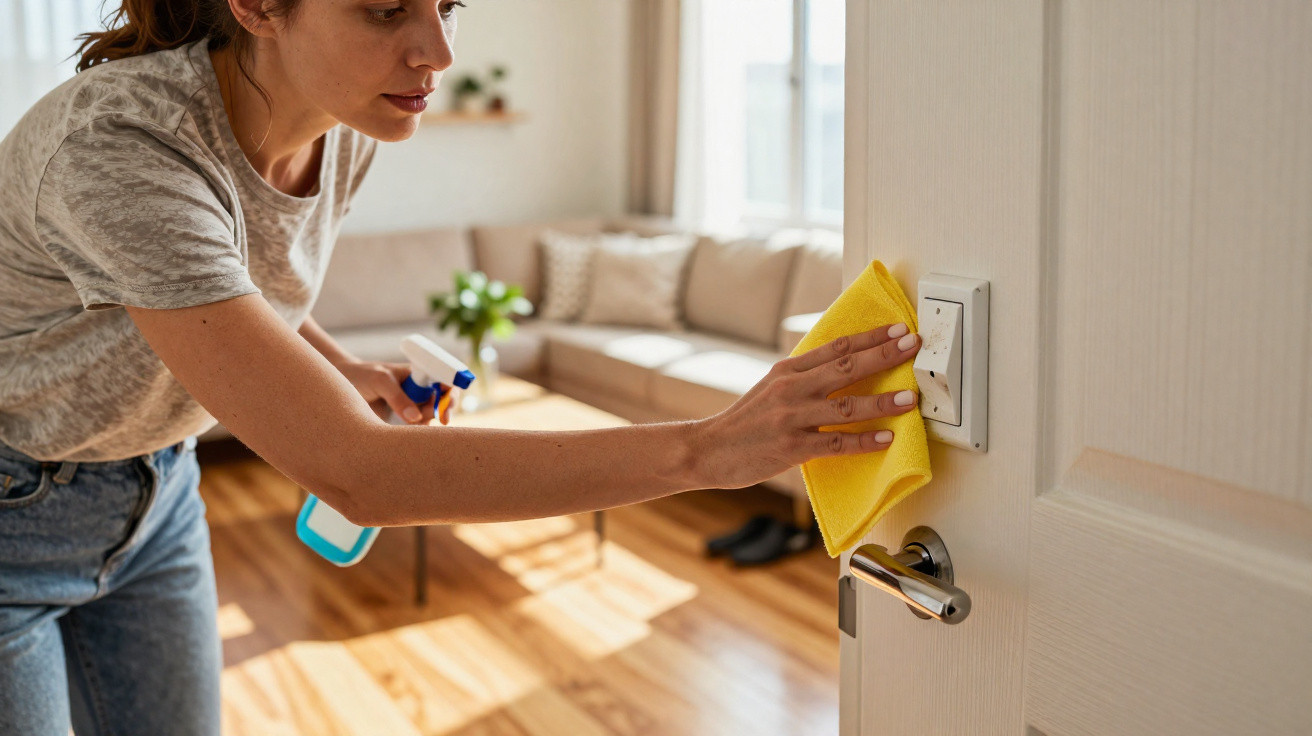
Their attention lands on light switches, door handles and skirting boards. Above all, it goes to your doors and door frames: the surfaces you seldom set out to clean deliberately.
That evening, my doors resembled a fingerprint crime scene. There were smears around the handles, darker marks at shoulder height and a pale line left by somebody once shutting a door with their foot. The floor was clean enough for an operating theatre, yet no one was looking at it. They were focused on the grubby door they needed to push open.
Consider the sequence. A guest rings, you answer the door, and the first thing they physically encounter is… a handle, switch or frame. That is their first tactile encounter with your home, rather than your carefully arranged gallery wall or air purifier.
I once asked an estate-agent photographer which detail spoils an otherwise attractive image. His answer came instantly: “Dirty doors and light switches. They make the whole place feel tired.” I could not forget it. The more people I asked, the more often this same point appeared. “I always notice fingerprints on doors,” one friend said. Another remarked, “If the switches are grimy, I just assume the bathroom isn’t really clean either.”
Hardly anyone says it openly, but these little dirty rectangles send a quiet signal: the home is either cherished… or slightly overlooked.
There is a straightforward reason this detail catches the eye so powerfully. We are naturally alert to contrast and to surfaces we touch. Dark scuffs on a white door draw more notice than a bookshelf with a little dust. A light-coloured switch edged in grey can seem more conspicuous than a crowded table.
We have also spent several years thinking much more about hygiene: hands, surfaces and shared objects. That awareness has not entirely disappeared. When someone presses a light switch, they are partly seeing and partly sensing every person who used it previously. If it appears grimy, the emotional response arrives before the rational one.
Your guest doesn’t need your home to be perfect – they just need not to feel like they’re touching last year’s germs with one finger.
How to rescue doors and switches in ten minutes flat
When people are due to visit, take a cloth, a small bowl of warm soapy water and a dry towel. Begin at the front door, then physically follow the route your guests will use. Wipe every place a hand would naturally reach. Nothing more is required.
Clean the handles, door edges and the wall area directly beside each handle. Do the light switches in the hallway, bathroom and kitchen too. Dry everything swiftly to prevent streaking, particularly on shiny white doors. Move quickly and forget perfection: simply remove the noticeable marks.
Leave this task until the rest of the home is ready if you prefer. It is like applying lipstick five minutes before leaving: a minor action with an outsized result.
One frequent error is treating this as a deep-cleaning task for a major weekend project. In reality, that weekend nearly always fails to happen. Meanwhile, smudges accumulate gradually in layers while you spend time scrubbing the more obvious surfaces.
Another mistake is concentrating only on the places you use most. Visitors often spot areas you barely touch: the second bathroom, the hallway light you never switch on or the balcony door opened only during gatherings. These are precisely the places newcomers to your home tend to investigate.
In truth, no one does this every day. The useful approach is to connect it to a routine you already have, such as putting out the rubbish or wiping the kitchen worktop in the evening. A quick wipe of the nearest switches keeps the task manageable.
A change in perspective helps too. Rather than viewing these areas as sources of embarrassment, think of them as your home’s handshake. You would not meet someone with a sticky hand, and the principle is the same.
“Once I started doing a ‘switch and handle check’ before people came over,” a friend told me, “I stopped apologizing for my house. Even if there’s toy chaos on the floor, those little clean details make it feel cared for.”
- Walk the guest route
Start outside, come in and identify every point your hand naturally reaches. Clean those places first, and only those. - Use one simple kit
An old T-shirt, mild soap and a small sponge are enough. You do not need specialist products, only regularity. - Pick a recurring moment
On Sunday evening, or immediately after cleaning the bathroom, make a quick “door and switch circuit”. - Focus on contrast
Pale doors and switches reveal dirt more readily, so give them an extra wipe. - Don’t chase perfection
Tackle the worst marks. A slight patina of everyday life is fine; your home is lived in, not a museum.
The details that tell the real story of a home
Once you become aware of this doors-and-switches issue, you begin viewing your home differently. You see that guests are not marking you on dust levels or a crease in the sofa throw. They respond to small, purposeful details that quietly say, “Someone pays attention here.”
At times, that detail is a clean light switch. At others, it may be fresh hand towels or the faint scent of food cooking, even when dinner is far from flawless. These are not magazine-worthy standards but human cues: the kind that communicate, “You’re welcome here, I prepared this space for you.”
There is relief, too, in recognising you will always overlook something. Perhaps it is a mark on the mirror, a laundry basket or a kitchen corner you did not manage to reach. The aim is not to complete every item on a list; it is to choose the few details that transform the atmosphere of the entire home.
For you, that may be the bathroom basin and hallway switch. For another person, it could be clear surfaces and a made bed in the guest room. Doors and switches are simply among those neglected pressure points that require almost nothing to put right. They show that caring for your home can be easy, even playful, rather than anxious.
Everyone knows the moment: guests arrive and your mind races through every cleaning job you missed. Yet what people usually remember is much simpler: how they felt as they came through your door.
So, when you are against the clock before the bell rings, perhaps skip reorganising the bookshelf and refolding blankets. Take a cloth and make that ten-minute journey from switch to switch and handle to handle. Let those small, clean touch points convey the message you really want to give.
The remaining mess merely shows that a real person lives there. Usually, that is exactly why your guests came.
| Key point | Detail | Value for the reader |
|---|---|---|
| High-visibility touch points | Doors, handles and light switches draw immediate attention | Helps direct limited cleaning time to the places that matter most |
| Quick cleaning circuit | 10-minute route from the entrance through main guest areas | Lowers stress before visits and increases confidence as a host |
| Small habits, big effect | Linking switch and handle cleaning to existing routines | Keeps the home feeling cared for without extra workload |
FAQ:
- Question 1 How often should I clean doors and light switches?
- Question 2 What’s the safest product to use on switches and handles?
- Question 3 Do guests really notice this more than clutter?
- Question 4 Which areas should I prioritize before an unexpected visit?
- Question 5 How can I turn this into an easy habit and not a big chore?
Comments
No comments yet. Be the first to comment!
Leave a Comment