
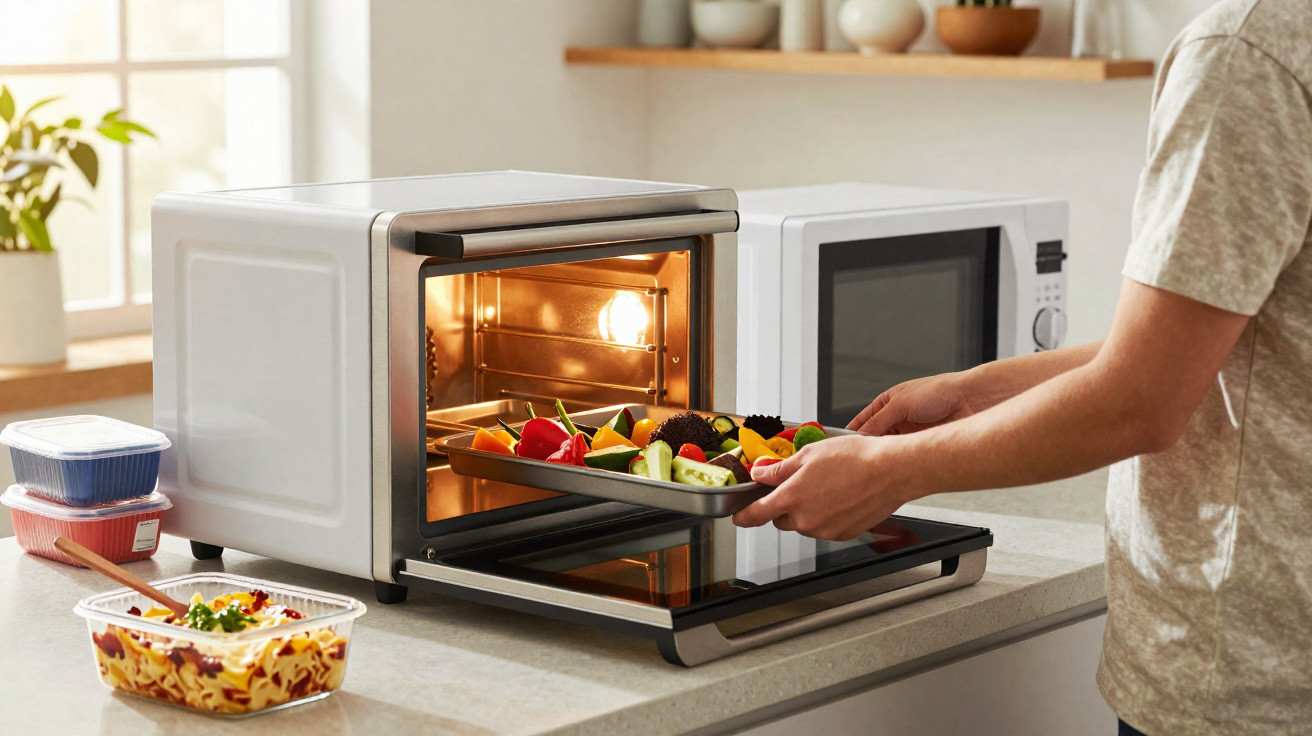
The microwave used to stand for effortless modern living, taking frozen leftovers to a hot plate in a matter of minutes. In 2025, however, that icon is starting to feel a little behind the times as newer appliances promise quicker results, better flavour and more careful energy use. One rival, in particular, is shifting from a niche countertop toy to a genuine alternative.
The microwave’s strange position in 2025 kitchens
For years, the microwave oven was as essential as the fridge: you bought one, no questions asked. It warms up coffee, defrosts mince, softens butter and helps weeknights stay on schedule. Across Europe and North America, most homes still have a unit, and overall sales continue at a steady pace.
Even so, plenty of people now have a love–hate relationship with it. They rely on it every day, yet often admit they don’t fully trust it. Old claims about radiation, nutrients being “killed”, and chemicals seeping out of plastic tubs keep circulating despite repeated fact-checking.
Microwaves are not about to give you cancer, but the way you use them can still affect your health and the quality of your meals.
Meanwhile, compact countertop ovens have started to meet-or even beat-the microwave on the turf it once owned: convenience and speed. That mix is nudging buying choices, particularly in smaller city homes where each plug socket counts.
What the science actually says about microwave safety
A familiar worry comes up repeatedly: could microwave radiation cause cancer? Major health bodies, including the US National Cancer Institute and the World Health Organization, say the answer is no.
Microwave ovens run on non-ionising electromagnetic waves. Their energy is sufficient to make water molecules vibrate and produce heat, but not enough to snap DNA strands-an effect linked to cancer development.
Today’s microwaves are also built as enclosed metal chambers that act like a cage. The door includes a mesh: it allows you to see the food, while keeping the microwaves inside. Provided the door shuts correctly and the seal isn’t damaged, any leakage remains well under safety thresholds.
In practice, the bigger health considerations sit elsewhere: what you heat your food in, what kinds of meals you reheat, and how evenly the food reaches temperature.
The real weak spot: plastics and ultra-processed meals
A lot of “microwave-ready” foods are sold in plastic trays. When plastic is heated, tiny amounts of chemicals can move into the food-more so if the container is thin, scratched, or not intended for higher temperatures.
Certain substances used in plastics and surface coatings-such as some plasticisers, or traces from inks and dyes-draw scrutiny because they may interfere with hormones or accumulate in the body over time. Regulators set limits and manufacturers have already removed some of the worst offenders, but ongoing research is still filling gaps.
The risk does not come from the microwaves themselves, but from heating food in the wrong type of container at high power, day after day.
Nutrition is another piece of the puzzle. The issue with many microwave dinners isn’t the microwave step; it’s that the meals are ultra-processed, typically high in salt, sugar and refined fats. Warm them in a frying pan, an air fryer or a microwave, and the nutritional profile is broadly unchanged.
The quiet rise of the convection oven
As the microwave argument continues, another option has been gaining momentum with far less noise: the countertop convection oven, often marketed as a multi-function air fryer oven.
Where a conventional oven depends largely on still air and hot metal surfaces to transfer heat, a convection oven uses a fan to push hot air around the food. That airflow speeds cooking and helps keep the temperature more even throughout the cavity.
Brands often advertise energy savings of up to 80 percent compared with preheating and running a full-size conventional oven for small portions. Independent testing differs, but the general trend is consistent: for something like a tray of vegetables or a single chicken breast, a small convection unit usually draws less energy than turning on a large built-in oven.
The core promise of convection ovens: microwave-like speed, but with the texture and browning of a conventional bake.
Why some households now skip the microwave entirely
For an increasing number of people, a compact convection oven now handles most everyday jobs that once felt microwave-only. It can:
- Warm leftovers while keeping edges crisp rather than turning them soggy.
- Cook frozen food without firing up a large oven.
- Toast bread and bake small batches of pastries.
- Roast vegetables and fish more evenly, with clearer control over texture.
The difference in results is a big part of the appeal. Leftover pizza tastes noticeably better from a convection oven than from a microwave. Chips regain their bite instead of slumping into a soft heap. Even basic toast tends to brown more evenly thanks to the moving air.
For renters and students, one small oven can stand in for a toaster and much of what a microwave does, while taking up a similar amount of worktop space. That makes it an attractive first buy, particularly in flats where energy prices are climbing and built-in ovens can be ageing or unreliable.
Microwave vs convection oven: how they really compare
| Feature | Microwave oven | Convection oven |
|---|---|---|
| Primary heating method | Microwaves excite water molecules inside food | A fan circulates hot air around the food |
| Speed for reheating | Extremely quick for drinks and softer dishes | Quicker than a standard oven, but usually slower than a microwave |
| Texture | Soft results, sometimes rubbery, with no browning | Crisper, browned surfaces; better for roasting |
| Energy use for small portions | Low to moderate, depending on wattage and time | Low to moderate; often less than using a full oven |
| Best suited for | Soups, drinks, fast reheats, defrosting | Full meals, frozen foods, baking, crisp reheats |
Many homes still keep both appliances. But when someone has space-or budget-for only one, the current drift, especially in newer compact properties, is towards convection.
How to get the most from the microwave you already own
Even if a new convection oven is tempting, the microwave you already have can still earn its place. When used properly, it’s efficient, generally healthy and more controllable than many people assume.
Better reheating with a few simple tweaks
When reheating leftovers, pause mid-cycle to stir, turn or flip the food. Doing so evens out hot and cold areas and lowers the chance of bacteria persisting in cooler pockets-particularly in dense foods like rice or casseroles.
If food tends to dry out, add a small splash of water or use a microwave-safe cover. A little steam helps keep the texture closer to the original.
Where you place the dish also makes a difference. The centre of the turntable can heat less evenly than the edges because the microwave energy pattern inside the cavity isn’t perfectly uniform. Shifting the plate towards the rim helps it travel through different hot zones as it rotates.
A small shift of the plate towards the edge of the turntable can lead to more even heating than adding a full extra minute.
Choosing the right container every time
Metal is still an obvious no, as it can spark. Some newer microwaves include dedicated metal racks, but these are engineered to reflect energy in controlled ways. For everyday heating, glass and ceramic usually offer the best balance of safety and even warming.
If you do use plastic, make sure it is marked microwave-safe and replace any containers that are old, warped or scratched. It’s also wise to avoid heating very fatty or oily foods in thin plastic, as the higher temperatures can put extra stress on the material.
What this shift means for future kitchens
The microwave-versus-convection discussion points to a bigger change in home cooking. Rather than one “main” oven with a microwave as a sidekick, kitchens in the 2030s may increasingly rely on smaller, faster and smarter devices built around specific jobs.
Manufacturers are already trialling hybrid appliances that combine microwaves, convection and even steam in one unit. The pitch is straightforward: microwave speed, hot-air browning, and the gentler finish of steam cooking. In effect, they sit between a classic oven and a professional combi-oven-just in a compact format.
For anyone watching their energy bills, the decision becomes practical: which appliance covers the widest range of tasks for the fewest watt-hours? A convection oven that can roast, bake and reheat may justify the upfront spend more easily than a basic microwave that mainly warms coffee and leftovers.
A useful way to choose is to track your habits for a week. Write down each time you use the microwave, the main oven, the toaster and any air fryer. The pattern often catches people out. If most of your hot meals involve browning, roasting or baking, a solid convection oven may suit you better than upgrading the microwave. If your routine is mostly soups, porridge and baby bottles, the traditional microwave still matches the job.
Food safety should be part of the calculation too. Dense, higher-risk foods-such as reheated rice, large portions of poultry or meal-prep tubs-need to be hot right through the centre. A convection oven, or a combined microwave–convection model, can produce more consistent heating for those dishes, cutting down the likelihood of cold spots where bacteria can survive.




Comments
No comments yet. Be the first to comment!
Leave a Comment